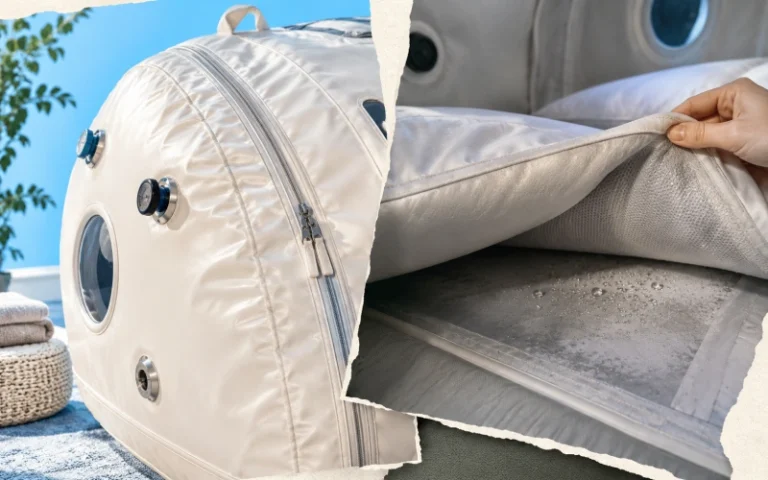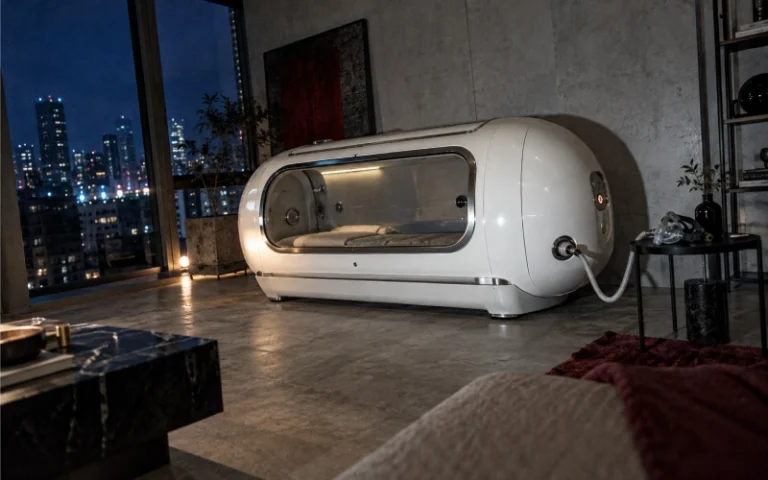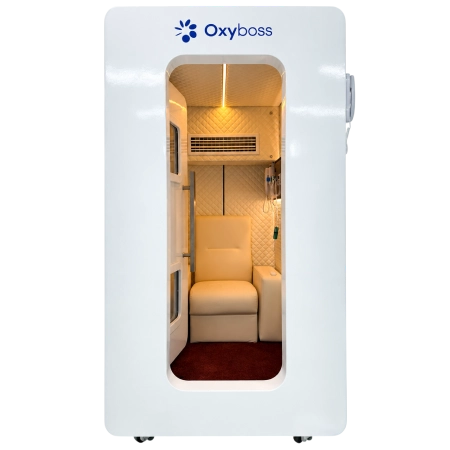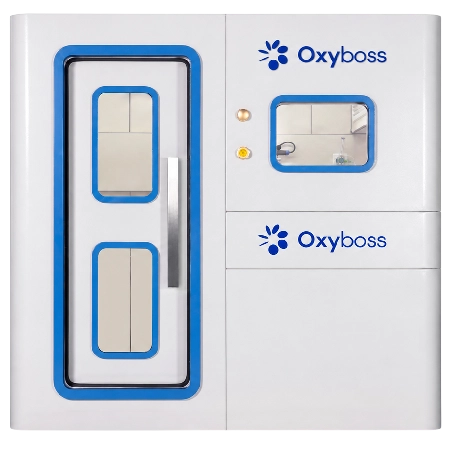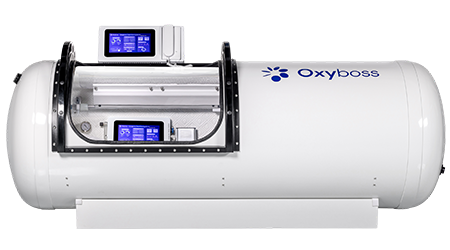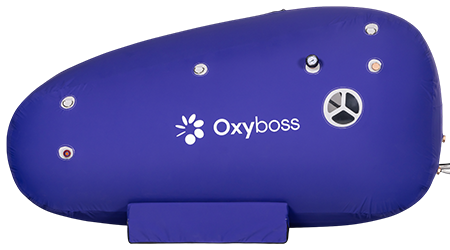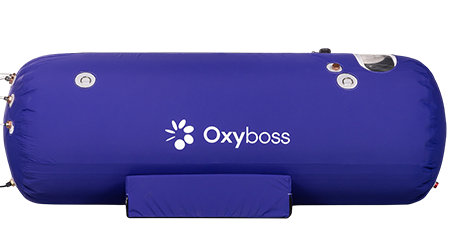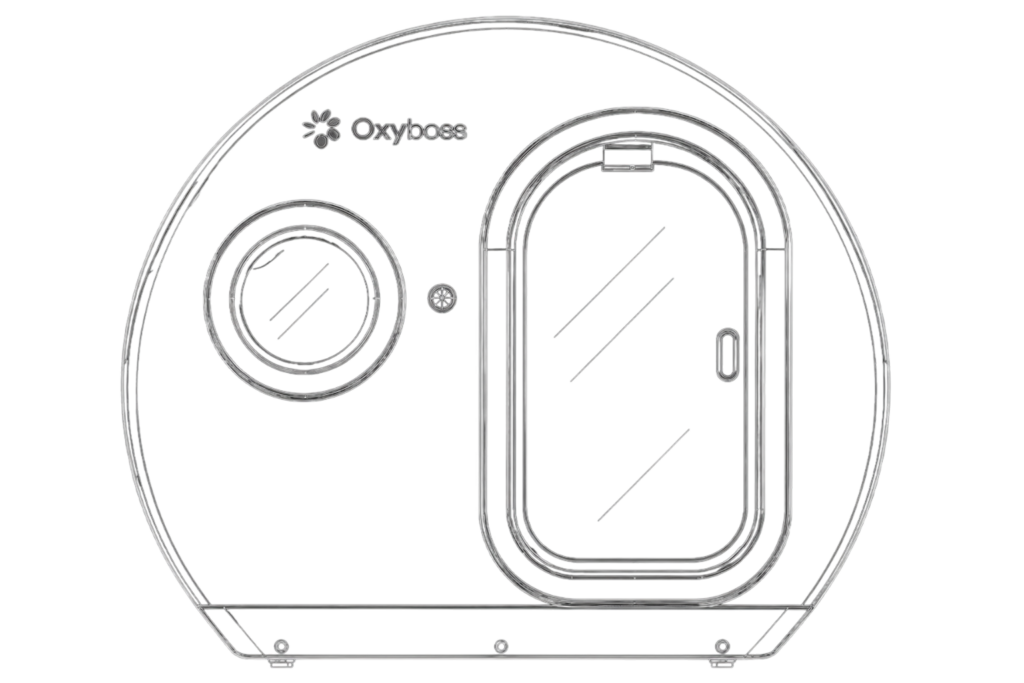
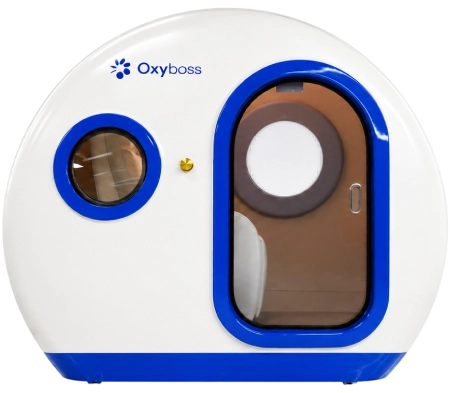
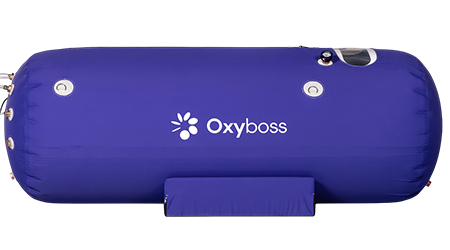
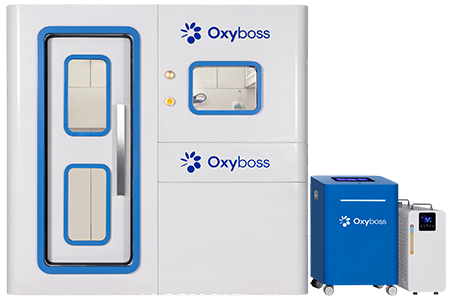
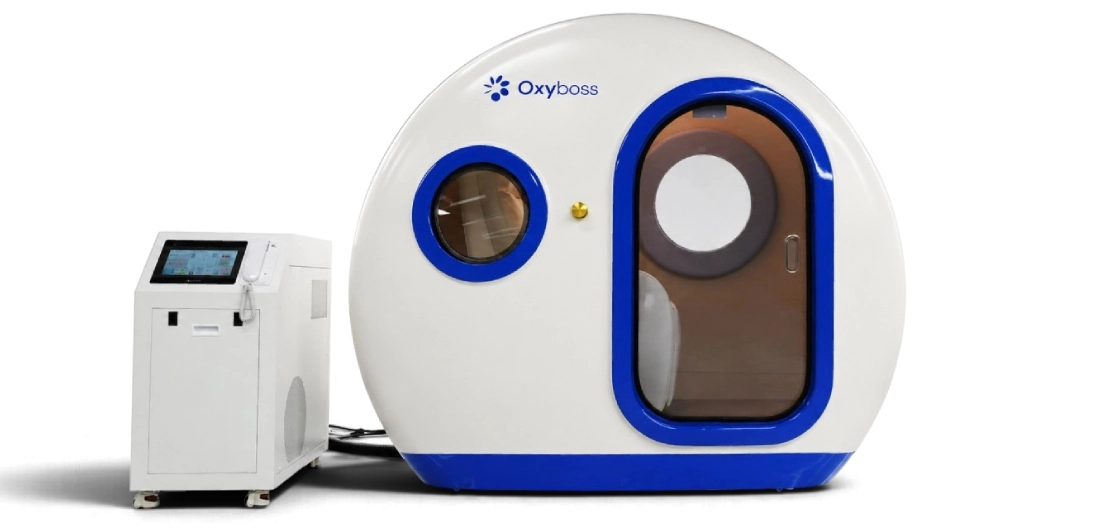
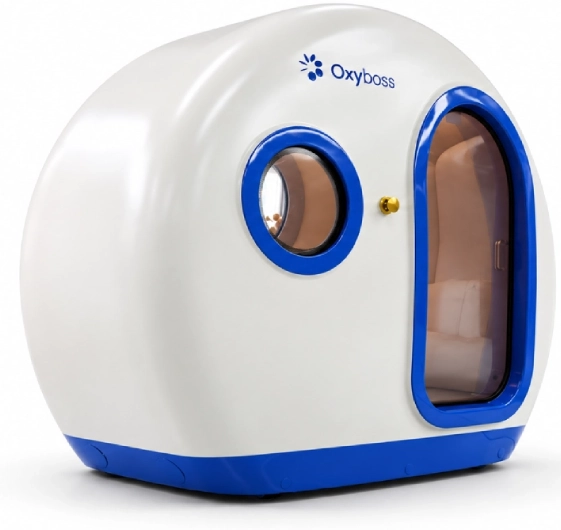
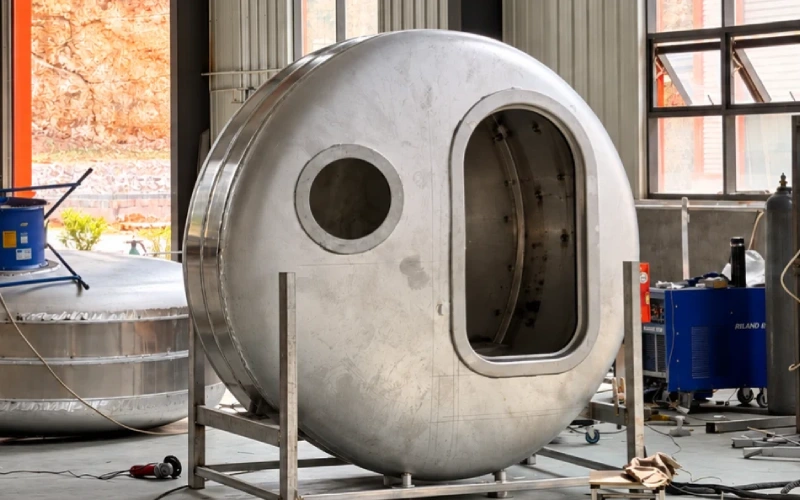
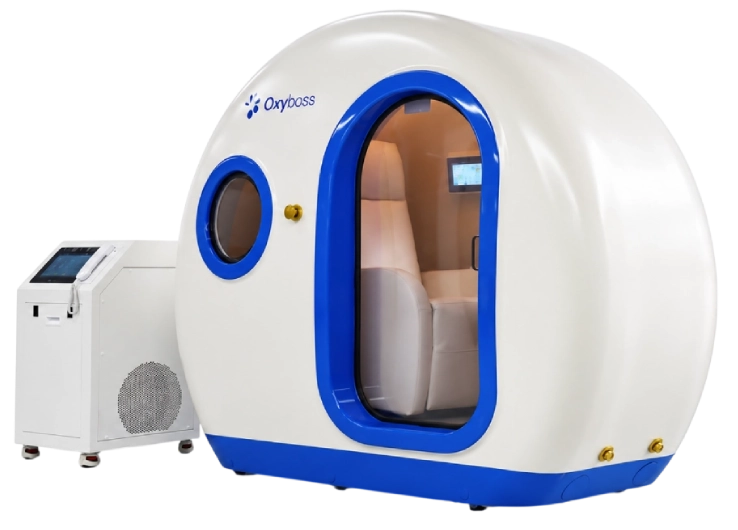
The OT-H401 is a single-occupant sitting hard shell hyperbaric chamber from Oxyboss, a factory-direct manufacturer since 2006. You sit upright, read, or work on a tablet while the chamber pressurises up to 2.0 ATA and the integrated 3-in-1 oxygen source delivers 10 L/min at 90% ± 3% O₂ through a face mask. The 5083-aluminum shell is built to ASME PVHO-1 design criteria, factory-tested for 5–7 continuous days, and ships as one chamber plus a separate oxygen-source crate.
Maximum Operating Pressure
Inhaled Oxygen Concentration
Plasma Dissolved Oxygen Increase
Plasma dissolved oxygen: approx. 3.8–4.1 mL O₂/dL, compared with approx. 0.3 mL O₂/dL under normal air environment.
A sitting hard shell hyperbaric chamber is defined by its pressure vessel; that is the part that separates a hard-shell chamber from a soft-shell chamber and the part that carries the ASME PVHO-1 design responsibility.
5083 aluminum alloy, 4 mm shell. OT-H401 uses 5083 marine-grade aluminum rather than stainless steel — 400 kg total weight while handling 2.0 ATA cycles year after year.
Welding and traceability. Welding is performed to EN ISO 15614-2 and EN ISO 9606-2; a WPQR is available for review. ASME’s PVHO-1 safety standard for pressure vessels for human occupancy covers design, fabrication, inspection, and testing of pressure vessels like the OT-H401.
Continuous working pressure vs. maximum pressure. The OT-H401 holds a stable working pressure for the full 60 – 120 minute session window without active intervention.
The 3-in-1 oxygen source is the part you most often underestimate. On most hard-shell chambers, “oxygen system” means three or four separate boxes — concentrator, compressor, air conditioner, cabling — that you source, install, and warranty yourself. The OT-H401 sitting hard shell hyperbaric chamber ships with all three modules pre-integrated in one chassis, in one crate, under one Oxyboss warranty. Four concrete pain points this design solves:
A hard-shell chamber running above 1.3 ATA needs a compressor stage capable of at least 5 bar outlet pressure. Smaller home concentrators — 5 L/min medical units, portable battery-driven models — cannot supply that. The 3-in-1 ships the compressor pre-matched to the chamber.
A 90-minute session inside a sealed pressure vessel with you breathing through a mask builds heat fast. The 3-in-1's air-conditioner module keeps cabin temperature stable across a 2-hour session; soft-shell suppliers either ask you to buy a separate split unit or warn you about the heat. Integrated, not optional.
The combined 3-in-1 draws about 2.2 kWh per session — most of that is the compressor, not the chamber. Everything lives in one chassis on a single 10 A circuit, so there is no second breaker box to add and no power-balancing act between two appliances.
If a single module fails, the technician swaps that module rather than replacing the whole machine. Spare-part supply continues at cost price after the warranty period, so a 5-year-old 3-in-1 does not become a write-off because one module died.
A 90-minute hyperbaric session is only useful if you can comfortably endure it. The OT-H401 sitting hard shell chamber solves this through seven deliberate design choices engineered to eliminate every common source of discomfort.
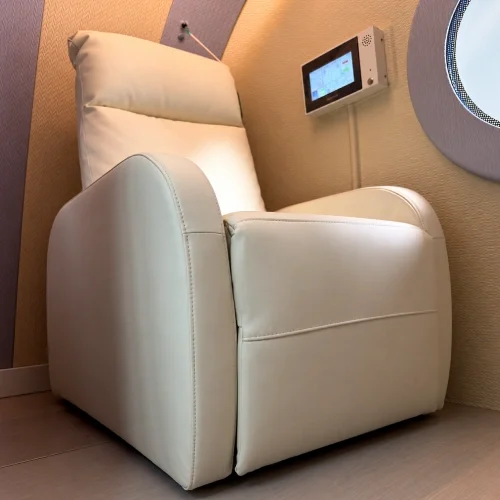
The electric sofa reclines from 0° to 140° with a synchronized footrest, easily controlled via the touchscreen or side panel. It is upholstered in flame-retardant, hypoallergenic leather compliant with oxygen-enriched fire safety standards.
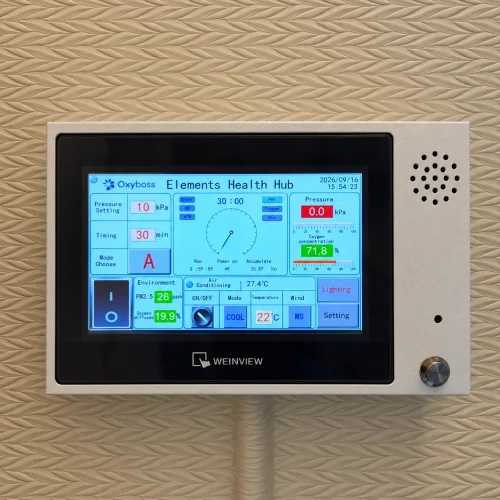
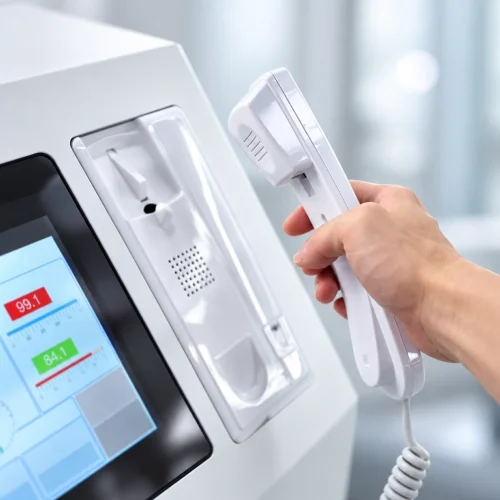
Dual 10-inch anti-glare touchscreens inside and outside mirror each other in real time, letting you independently manage pressure, time, and temperature. You can monitor and adjust your entire session without leaving the cabin or calling for help.
Equipped with a clear two-way intercom, the cabin lets you take calls effortlessly. The ultra-low 45–48 dB(A) background noise ensures natural conversation volume without shouting.
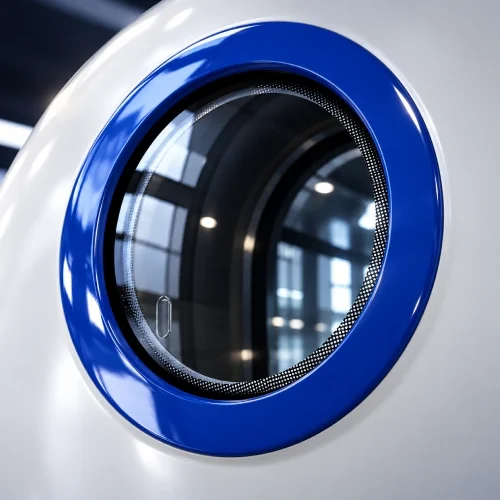
A 30 cm laminated acrylic viewport provides a wide view of the room to maintain eye contact and eliminate claustrophobia. It keeps the sealed chamber feeling open, comfortable, and psychologically welcoming throughout the session.
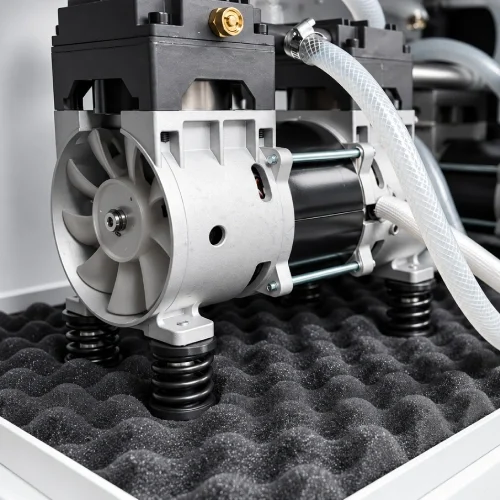
Operating at an ultra-quiet 45–48 dB(A), the chamber isolates compressor and AC vibration completely from the seat. This rattle-free environment ensures you can relax or fall asleep without being startled awake.
Your first question is probably what happens if the power fails. OT-H401’s safety design leans on mechanical, power-independent devices rather than electronics. In the event of a power outage or controller fault, the chamber can still be depressurised and the door still opened from either side.

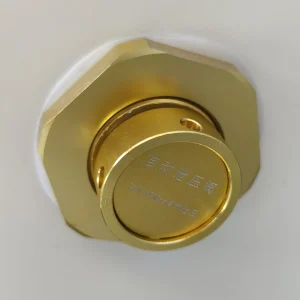
Spring-loaded mechanical valve that opens when pressure exceeds the set value, then re-seats. Releases roughly 3 kPa before returning to normal regulation.
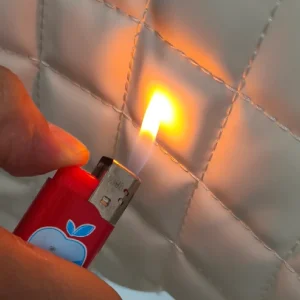
The interior and seating use flame-retardant, anti-static, hypoallergenic leather; the floor is anti-static dissipative. Internal electrical components (lighting, control panels, sensors) run on 24 V low-voltage power.

Hand-turned mechanical valve, operable from inside or outside the chamber.
High-flow pull-type valve for rapid depressurisation in 30 – 60 seconds during an emergency
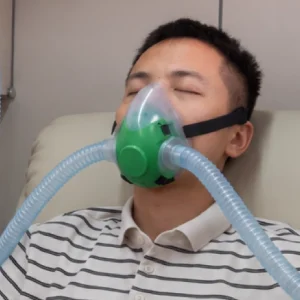
The OT-H401 uses cabin-air pressurisation plus face-mask oxygen delivery, so exhaled CO₂ is vented through the mask/BIBS loop rather than accumulating in the chamber. Recommended cabin-side CO₂ ceiling for hyperbaric facilities sits in the 2,500 – 5,000 ppm range, depending on which standard is referenced. Room ventilation around the unit should sit at roughly 4 – 6 air changes per hour.
A sitting hard shell hyperbaric chamber is a long-life purchase. The OT-H401 sitting hard shell hyperbaric chamber carries a 3-year warranty, after which support continues through spare-part supply and remote engineering. The service model below is the same for any Oxyboss sitting hard shell hyperbaric chamber in the OT-H range.
The chamber carries a 3-year warranty from delivery. Non-consumable faults are repaired with free replacement parts; air freight on the replacement parts is covered by Oxyboss. Consumables (oxygen mask, mattress, pillows, soft padding, door seals) are excluded from the warranty.
Oxyboss ships Delivered Duty Paid: the seller covers transport, customs clearance, and import duties. You are not charged separately at the border. For soft-shell orders, freight is sometimes included; for hard-shell orders, freight is normally itemised separately because the weight and volume are larger.
Once a fault is reported, Oxyboss engineers confirm the issue within 48 hours. Once a faulty module is identified, the replacement part is usually dispatched and delivered within 3 – 5 days, depending on destination.
Because the oxygen source is a 3-in-1 unit split into four modules — concentrator, compressor, air conditioner, control — the technician swaps the failing module rather than replacing the whole machine. Most service events do not require returning the chamber.
Free 1-on-1 video training, an operation video, a user manual, and a training certificate on completion.
Pre-shipment inspection by SGS, Bureau Veritas, TÜV, or a third-party agency of your choice is accepted. You cover the inspection fee.
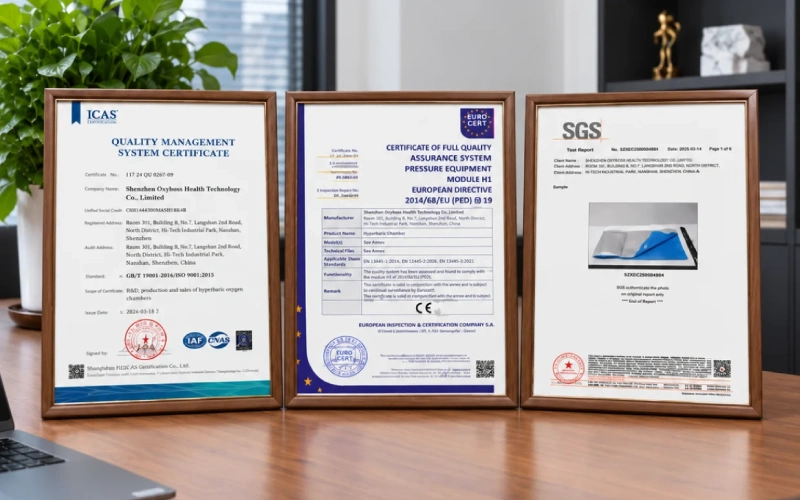
The OT-H401 sitting hard shell hyperbaric chamber is sold as a personal wellness / general-purpose device, not as a medical device. Oxyboss holds the following qualifications:
The questions below align with what you actually ask when comparing sitting hard shell hyperbaric chambers. Each answer points to the section of this page that goes into depth on the topic, so you can move quickly between the question you have and the detail you need.
No. Oxygen dose is a function of pressure, mask-side concentration, and session duration — body position does not enter the calculation. A sitting hard shell hyperbaric chamber running at 2.0 ATA with 90% O₂ delivers the same oxygen dose as a lying hard shell chamber at the same settings.
No. OT-H401 is sold as a personal wellness / general-purpose chamber, not as a medical device. It is not cleared or registered for the diagnosis or treatment of any disease. Oxyboss does not make any therapeutic claims for the product.
A sitting hard shell hyperbaric chamber is a 400 kg pressure vessel plus an oxygen-source crate, so the room has to support both. You need at least 100 cm of doorway clearance, a 10 A electrical circuit with residual-current protection (RCD / GFCI), and roughly 4 – 6 air changes per hour of ventilation. Avoid direct sunlight and damp locations. Verify floor loading before installing upstairs.
After each session: wipe down the cabin and seat with a soft cloth and a mild neutral cleaner (no strong acids, alkalis, or flammable solvents); open the cabin door for 10 – 15 minutes to ventilate; wipe the air inlet and exhaust vents to prevent dust blockage. Every 3 – 6 months or ≈ 500 running hours: inspect / replace the inlet air filter and check the drain. Every 12 months: inspect the door seal, emergency pressure-relief valve, and pressure-regulation system. Detailed procedures are provided in the user manual and maintenance guide.
Email or call Oxyboss technical support. A trained engineer will respond within 48 hours. Once a faulty module is identified, the replacement part is dispatched within 3 – 5 days (destination-dependent). Because the OT-H401 is modular, you usually only swap the affected module rather than sending the whole chamber back.
Yes — the sitting hard shell hyperbaric chamber supports colour, logo, and interior trim customisation at no extra charge. Major customisation (chamber dimensions, shell geometry, seat type, operating system language) is available but incurs an additional engineering and tooling cost. The chamber ships with the full test report for that specific unit before delivery.
The OT-H401 sitting hard shell hyperbaric chamber is a personal wellness product and is not intended for you if you have medical conditions that require a clinical-grade hyperbaric environment.
People who should consult a licensed medical professional before use include those with a history of ear barotrauma or recent ear surgery, untreated sinus block, untreated lung conditions (including collapsed lung), uncontrolled seizure disorders, or those who are pregnant. This list is not exhaustive and is not a substitute for medical advice.
If any of these apply, please consult your physician before using the chamber. Anyone under the influence of alcohol should not enter the chamber until fully recovered.
The OT-H401 sitting hard shell hyperbaric chamber uses cabin-air pressurisation plus face-mask oxygen delivery, which keeps the cabin atmosphere close to normal-air oxygen levels and limits in-chamber fire risk relative to chambers pressurised with pure oxygen. The cabin interior, seating, and electrical wiring are designed to be flame-retardant and anti-static. Internal electrical components run on 24 V low-voltage power. Do not bring lighters, open flames, or non-approved electronics into the cabin. Wear 100% cotton clothing during sessions.
Oxygen toxicity is the result of breathing high-concentration oxygen for an extended period, and the risk grows with both pressure and session length.
The OT-H401 sitting hard shell hyperbaric chamber is sold as a personal wellness chamber, not a clinical device; Oxyboss does not operate a clinical protocol and does not claim that any pressure or duration is "safe" for a specific condition.
As a practical baseline, the recommended session length is 60 – 90 minutes with a maximum of 2 hours per session and 20 – 30 minutes of ventilation between sessions; If you have a respiratory condition, a history of seizures, are pregnant, or are taking medication that may interact with elevated oxygen, consult a licensed medical professional before running longer or higher-pressure sessions.
A mini hyperbaric chamber should do more than sit in your facility — it should earn its place on your service menu. Oxyboss units are engineered around three commercial priorities: consistent session quality, high daily throughput and long operational life. Backed by in-house R&D, strict QC and dedicated OEM capability, every chamber leaves our factory ready to support premium positioning, repeatable client experiences and long-term business growth.
Mini Chamber
Maximum air pressure
Hyperbaric oxygen chamber type
Hyperbaric oxygen chamber material
Hyperbaric chamber dimensions and weight
Room Chamber
Maximum air pressure
Hyperbaric oxygen chamber type
Hyperbaric oxygen chamber material
Hyperbaric chamber dimensions and weight
Capsule Chamber
Maximum air pressure
Hyperbaric oxygen chamber type
Hyperbaric oxygen chamber material
Hyperbaric chamber dimensions and weight
Triangular Chamber
Maximum air pressure
Hyperbaric oxygen chamber type
Hyperbaric oxygen chamber material
Hyperbaric chamber dimensions and weight
Lying-Type Chamber
Maximum air pressure
Hyperbaric oxygen chamber type
Hyperbaric oxygen chamber material
Hyperbaric chamber dimensions and weight
Height
Length
Width
Weight
Type
Sitting Hard Shell Hyperbaric Chamber
Pressure
1.1 – 2.0 ATA
Material
Aluminum Alloy
Default color
White & Blue
Interior seating
Electric sofa
Interior finish
Flame-retardant, anti-static, hypoallergenic leather
The oxygen system plays a central role in the operation of a hyperbaric chamber. A reliable, high-quality system can help reduce maintenance costs and minimize unnecessary operational issues.
At Oxyboss, we have developed an integrated 3-in-1 oxygen system that combines the oxygen concentrator, air compressor, and cooling system into a single unit. Compared with conventional designs commonly used by other brands, our current system represents a more advanced approach to integration, maintenance, and servicing.
The entire system is built around a modular structure, allowing each major component to be removed and replaced independently when needed. We have also optimized the internal wiring by combining multiple cable connections into a single plug, making installation as simple as plugging in a USB device.
These improvements are designed to significantly reduce potential failure points. Compared with traditional system layouts, this design can reduce maintenance-related issues by more than 90%, helping users avoid many of the problems caused by complicated wiring, difficult servicing, and tightly integrated components.
And even if a problem does occur, there is usually no need to dismantle or replace the entire system. The affected module can simply be removed and replaced, making repairs faster, easier, and more cost-efficient.
The result is a compact system that not only saves space, but also simplifies installation, daily operation, maintenance, and after-sales servicing. Most routine operations can be completed by just one person.
Dimensions
930*450*920 mm
Weight
130 kg / 140 kg
Total Air Flow
205 L/min
Rated Power
2200 W / 2900 W
Oxygen Concentration
93% ±3%
Air Flow Rate
120 L/min
Oxygen Flow Rate
10 L/min or 20 L/min
Therapy Pressure
1.1 ~ 2.0 ATA (Adjustable)
Product Features
Dual 10-inch Color Screens
Current
10 A / 15 A
Voltage
110V / 220V / 240V
Input Power
≤ 670 W
Rated Operating Current
≤ 3.20 A
Rated Working Pressure
200 kPa
Rated Air Flow
≥ 120 L/min
Maximum Instantaneous Pressure
250 kPa
Rated Speed
1390 ± 30 RPM
Noise Level
≤ 60 dB
Restart Pressure
0 kPa
Operating Ambient Temperature
5°C–40°C
Dielectric Strength
1800 V AC / 50 Hz / 1 min / 2 mA
Thermal Protector
Automatic Reset, 145 ± 5°C
Insulation Resistance (Cold State)
≥ 500 MΩ
Capacitor
25 μF ±5%, 450 V
Net Weight
10 kg
Type
Water-Cooled Air Conditioner
Air Conditioner Capacity
1.5 HP
Cooling Capacity
3.5 kW
Designed Service Life
15 Years
Tell us your preferred model, usage scenario, and customization needs. The Oxyboss team will provide product details, technical specifications, and a tailored quotation.