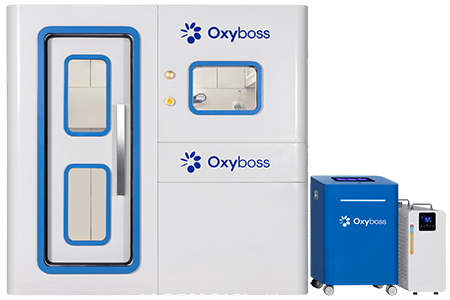
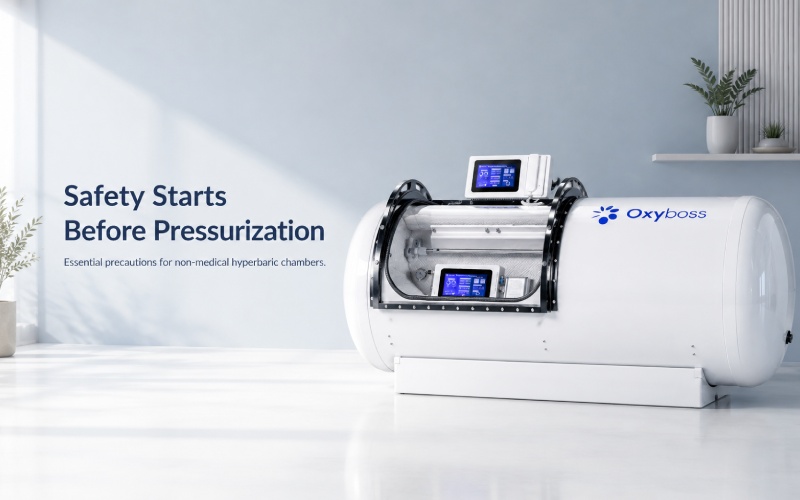
A non-medical hyperbaric chamber is a pressurized environment—and like any pressurized system, it demands respect, preparation, and consistent safety awareness.
Whether you are a first-time home user or a wellness center operator serving dozens of clients per week, understanding hyperbaric chamber precautions protects both people and equipment.
This guide is published by Oxyboss, a manufacturer of non-medical hyperbaric chambers for wellness, relaxation, and recovery support. The content below is for general safety education. It is not medical advice, and it does not replace guidance from a qualified healthcare professional.
Oxyboss Safety Philosophy The best session is one where safety was never in question because the right precautions were already in place.
Why Hyperbaric Chamber Precautions Matter
A hyperbaric chamber session involves multiple systems working together:
- Air pressure control
- Oxygen delivery
- Sealed enclosure
- Relief valves
- Gauges
- Operator controls
A failure or oversight in any one of these creates unnecessary risk.
Proper precautions serve three purposes:
| Purpose | Why It Matters |
| User protection | Reduces the chance of pressure discomfort, fire hazard, or anxiety |
| Equipment longevity | Helps prevent premature wear on seals, valves, and chamber material |
| Operational professionalism | Builds client trust and supports industry best practices |
According to general safety principles recognized by hyperbaric industry bodies such as the Undersea and Hyperbaric Medical Society (UHMS), the vast majority of incidents are preventable through proper training, inspection, and adherence to established protocols.
This is a core reason why Oxyboss includes detailed operation manuals and safety guidance with every unit we manufacture—because precautions only work when people understand them clearly.
The Five Fundamental Safety Rules
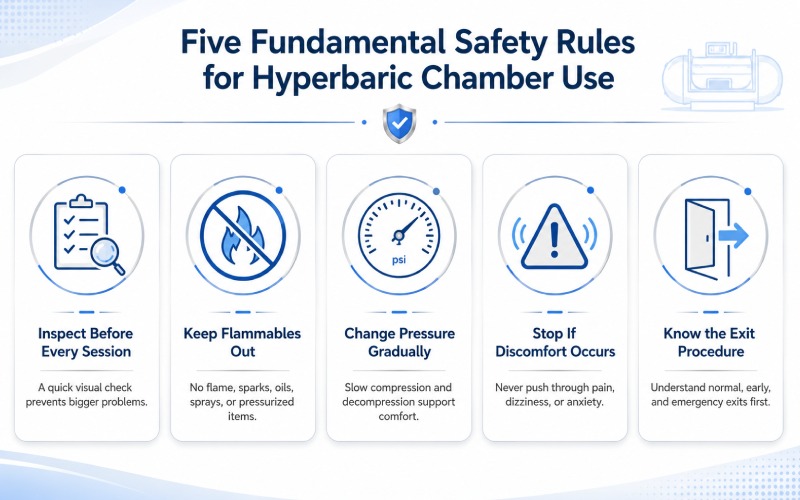
Before diving into specifics, every user and operator should internalize these five principles:
- Never skip the pre-session inspection. A 2-minute visual check prevents problems that take hours to fix.
- Nothing flammable or pressurized enters or stays near the chamber. No exceptions.
- Pressure changes must be gradual. The body needs time to adjust.
- Discomfort means stop. No session is worth pushing through pain.
- Know your exit and emergency procedure before you start. Not after something goes wrong.
Pre-Session Safety Checklist
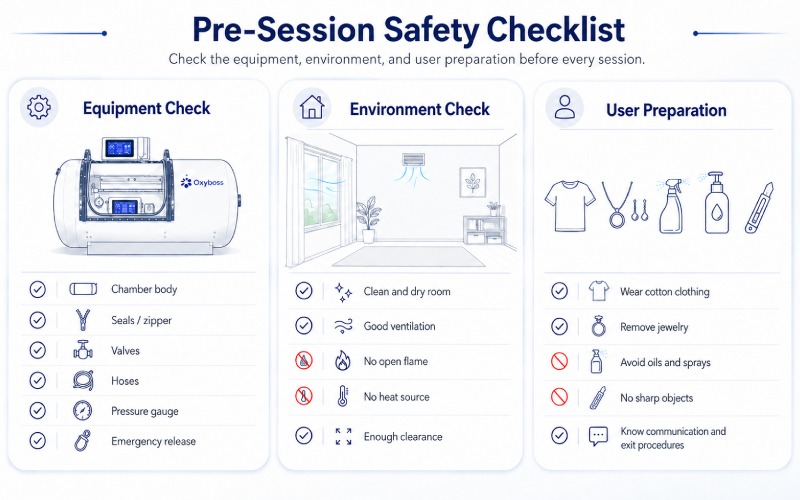
Before any session begins, the operator—or the home user—should complete a basic safety check covering the equipment, environment, and user preparation.
Equipment Check
Confirm the following before each session:
- Inspect the chamber body for visible damage, tears, or material fatigue.
- Confirm the zipper or door seals completely and smoothly.
- Verify valves move freely, hoses are secure, and gauges read accurately.
- Check oxygen tubing and concentrator connections for cracks or loose fittings.
- Confirm the emergency pressure release mechanism operates correctly.
Environment Check
The chamber should be placed in a safe and suitable environment:
- Clean, dry, and well-ventilated room.
- No heat sources, open flames, or direct sunlight nearby.
- Adequate clearance around the chamber for ventilation and emergency exit.
- Room temperature within a comfortable range.
User Preparation
Before entering the chamber, the user should:
- Read the user manual and product usage notice completely before first use.
- Wear clean, comfortable, 100% cotton clothing.
- Remove all jewelry, metal accessories, belt buckles, hairpins, and eyeglasses.
- Avoid oil-based lotions, petroleum jelly, perfumes, or alcohol-based sprays.
- Avoid heavy meals immediately before the session.
- Use the restroom before entering.
- Confirm how to communicate with the operator and how to signal discomfort.
- Confirm normal, early, and emergency exit procedures.
Do Not Enter the Chamber If:
- You feel unwell, dizzy, feverish, or congested.
- You have consumed alcohol or sedating substances.
- You have not received proper usage instruction.
- The pre-session inspection revealed any abnormality.
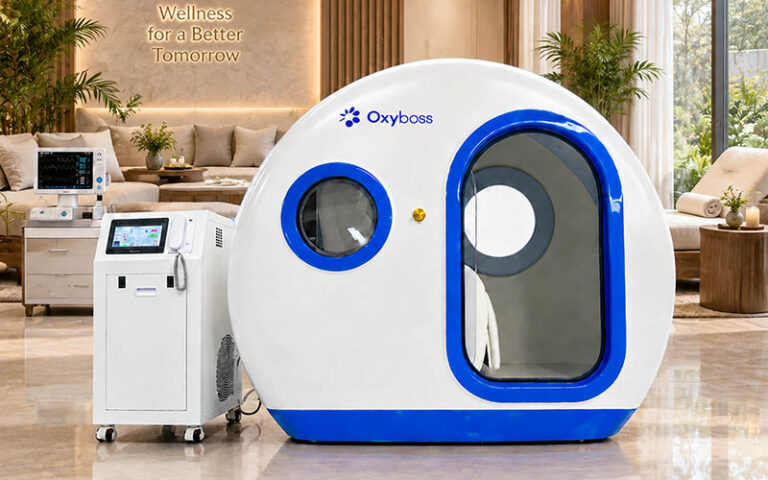
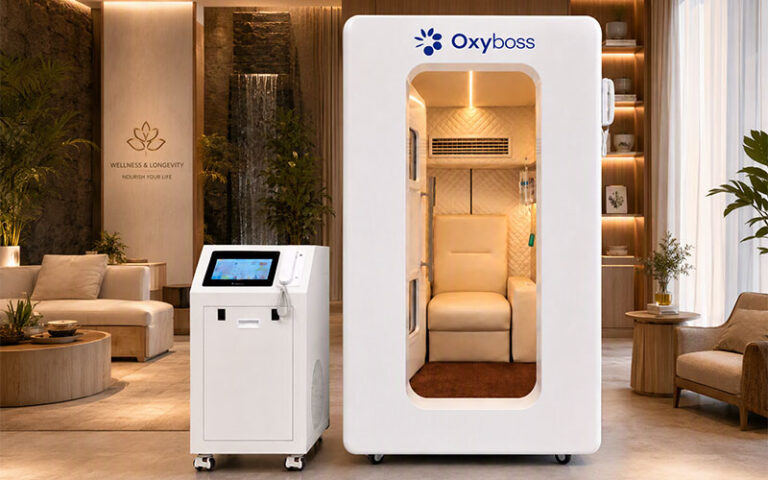
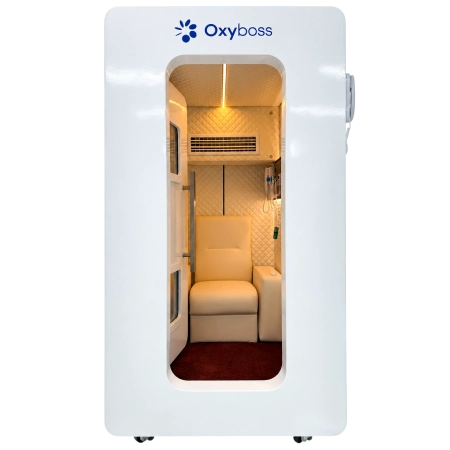
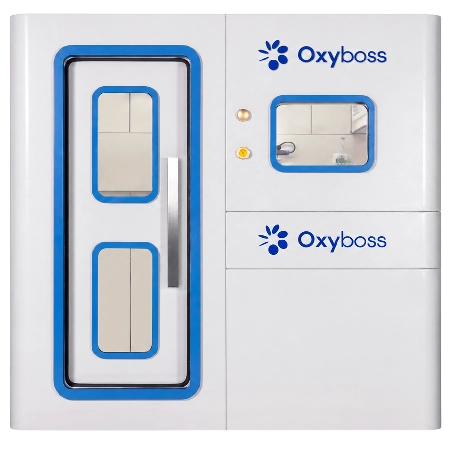
Oxyboss designs its chambers with user-friendly control systems and clear viewing windows—features that support both operator confidence during inspection and user comfort during sessions.
Oxygen and Fire Safety
This is the most critical precaution category. Understanding it correctly eliminates the single largest preventable risk.
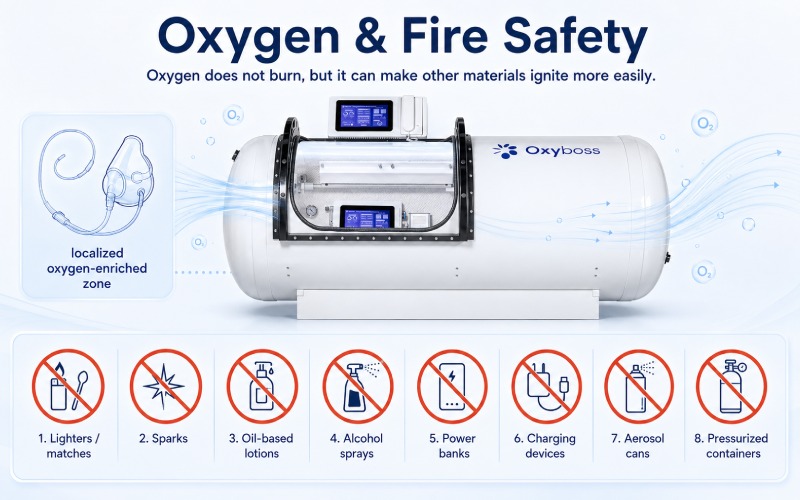
Key Principle Oxygen does not burn. But oxygen-enriched environments cause other materials to ignite more easily, burn faster, and burn hotter.
Even a small increase in local oxygen concentration can change the fire equation dramatically.
In most non-medical soft-shell chambers, the chamber itself is pressurized with filtered ambient air. Oxygen is delivered to the user through a mask or cannula via a concentrator.
While the entire chamber atmosphere does not become oxygen-rich, localized enrichment around the mask area is possible—especially if the mask fits loosely.
Items That Must Never Enter the Chamber
The following items must not enter the chamber unless specifically permitted by the manufacturer or operator.
| Category | Specific Items |
| Ignition sources | Matches, lighters, or any item that can produce a flame or spark |
| Electronics & power sources | Power banks, charging equipment, any electronic device operating above 24V, damaged or overheating battery-powered devices, or any electronic device not permitted by the manufacturer or operator |
| Spark-producing items | Items that generate sparks upon impact, or metal objects that could cause friction sparks |
| Skin products | Oil-based lotions, petroleum jelly, lip balm with petroleum, greasy sunscreen |
| Sprays & liquids | Alcohol-based perfumes, hairspray, hand sanitizer, solvent-based cleaning products |
| Heating devices | Electric heating pads, battery-powered warmers, hot water bottles |
| Static-generating materials | Synthetic fleece, nylon, polyester; wear cotton only |
| Pressurized containers | Carbonated drinks, soda cans/bottles, aerosol cans, or any sealed container with internal-external pressure differential |
| Sharp objects & weapons | Knives, scissors, blades, needles, or any sharp-edged item |
| Flammable materials | Any material classified as flammable or combustible |
Why Pressurized Containers Are Prohibited
Inside a hyperbaric chamber, the external pressure increases. A sealed container, such as a soda can, has a fixed internal pressure.
As external pressure rises and then drops during decompression, the pressure differential can cause the container to deform, leak, or burst—creating a safety hazard and potential mess inside the chamber.
Why Voltage and Device Condition Matter for Phones and Electronics
Low-voltage electronic devices operating at 24V or below may be used when permitted by the manufacturer or operator and when the device is in good condition.
However, “waterproof” does not mean “pressure-safe.” Devices above 24V, power banks, charging equipment, damaged batteries, overheating devices, or devices not permitted by the manufacturer or operator should not be brought into the chamber.
Pressure changes during a session can also compromise device seals and damage internal components.
Facility-Level Fire Precautions
Every facility should follow basic fire safety practices:
- Post a visible “No Smoking / No Open Flame” sign near the chamber.
- Keep an appropriate fire extinguisher accessible according to local safety requirements.
- Ensure room ventilation prevents any oxygen accumulation.
- Never store flammable materials in the same room as the chamber.
This is an area where equipment design matters.
Oxyboss chambers, depending on the model, can include ventilation support and airflow configurations that help prevent localized oxygen accumulation—but no design feature replaces the operator’s responsibility to enforce the rules above.
Managing Pressure Changes and Ear Equalization
Non-medical hyperbaric chambers typically operate at pressures up to 1.5 ATA.
The body experiences two transitions during every session:
Compression: Pressure Increasing
During compression, users may experience:
- A sensation similar to descending in an airplane or diving underwater.
- Fullness in the ears.
- Mild sinus pressure.
- A need for the Eustachian tubes to equalize.
Decompression: Pressure Returning to Normal
During decompression:
- The process is typically more comfortable than compression.
- Pressure should return to normal gradually.
- Rapid decompression should only be used when an emergency requires it.
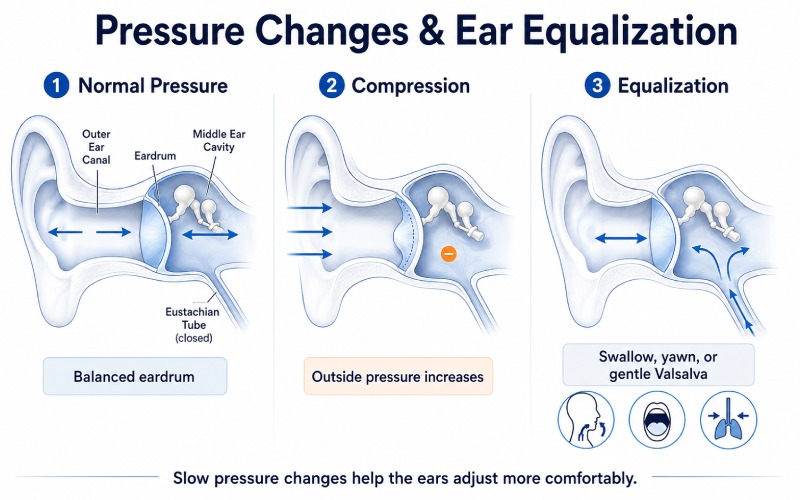
How to Equalize Ear Pressure
Users may try the following methods:
- Perform the Valsalva maneuver: pinch your nose and blow gently with your mouth closed.
- Yawn or open your mouth wide.
- Swallow repeatedly.
- Chew gum, if permitted by the operator and no choking risk exists.
- If you cannot equalize, ask the operator to pause or slow pressurization immediately.
Safety Reminder Pressure discomfort should never be ignored. A safe session is always more important than completing a scheduled duration.
Stop the session and seek professional advice if you experience:
- Sharp or worsening ear pain that does not resolve with equalization.
- Dizziness or vertigo.
- Chest tightness or difficulty breathing.
- Visual disturbances.
- Unusual anxiety, claustrophobia, or panic that does not subside.
Exit Procedures: Normal, Early, and Emergency
Every user and operator must understand all three methods of exiting the chamber before a session begins. This is non-negotiable.
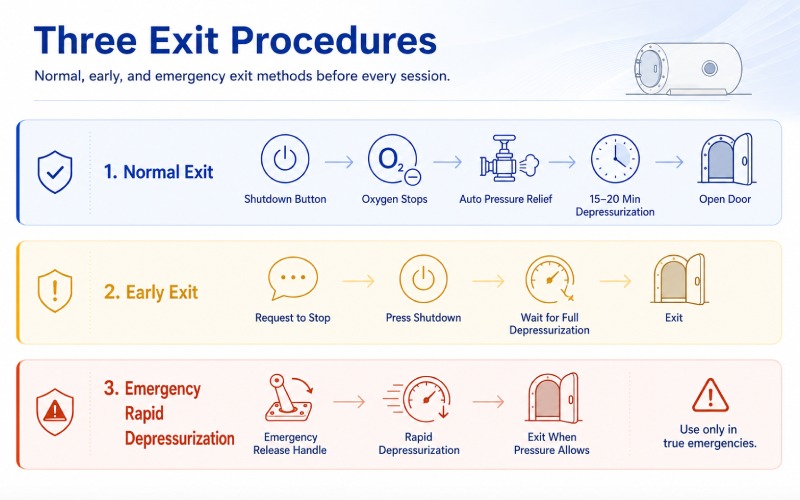
① Normal Exit
When the session is complete:
- Press the shutdown button on the control panel or screen.
- The system enters its shutdown sequence and displays shutdown status.
- After approximately 30 seconds, the oxygen source stops.
- The system pressure relief valve opens automatically.
- The chamber depressurizes gradually over approximately 15–20 minutes.
- Once pressure has equalized to ambient level, the door or zipper can be opened and the user can exit.
Important Do not attempt to open the chamber door until depressurization is complete. The system is designed to depressurize at a rate that is comfortable for the user’s ears and sinuses.
② Early Exit, Non-Emergency
If the user wishes to end the session before the scheduled time:
- Press the “Shutdown” button on the control screen.
- The system will enter the depressurization phase.
- Wait for depressurization to complete fully.
- Open the chamber door and exit.
This method still allows a gradual, comfortable pressure reduction.
The user should communicate their desire to exit early, and the operator should initiate this process promptly.
③ Emergency Rapid Depressurization
In a genuine emergency where rapid exit is necessary:
- Manually rotate the emergency pressure relief handle to accelerate depressurization.
- Exit the chamber as soon as pressure allows the door to open.
⚠️ Warning Rapid depressurization may cause ear pain, sinus discomfort, dizziness, or other adverse sensations. This method should only be used in true emergencies. Non-emergency rapid depressurization is strongly discouraged.
Oxyboss chambers, depending on the model, feature mechanical emergency relief systems that function even during a power interruption—ensuring the user can always exit regardless of electrical status.
Who Should Avoid or Consult a Professional Before Use
Not everyone should use a hyperbaric chamber. Some users should avoid use entirely, while others should consult a qualified healthcare professional before entering any hyperbaric environment.
Medical Disclaimer This information is for general awareness only. It is not a medical screening tool, and it may not be exhaustive.
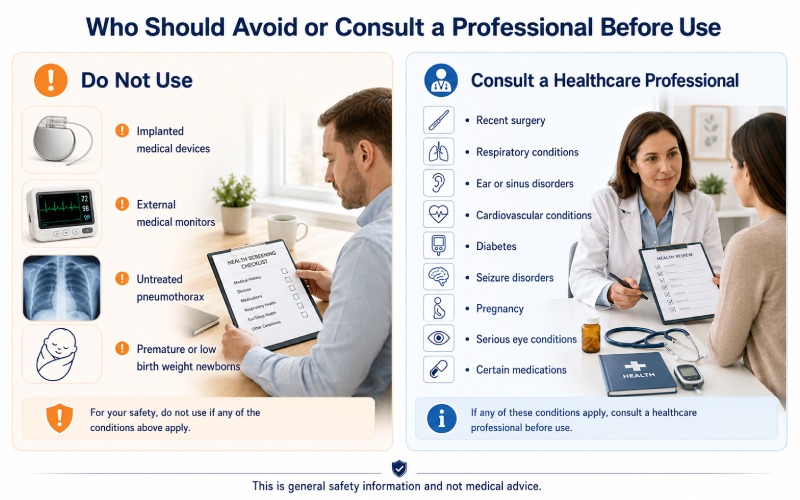
People Who Should Not Use This Product
This product should not be used by:
- Individuals with implanted medical devices such as cardiac pacemakers, implantable cardioverter-defibrillators, or other internally implanted electronic medical devices.
- Individuals wearing external medical monitoring equipment, such as portable ECG monitors or similar wearable medical devices.
- Individuals with untreated pneumothorax, or collapsed lung.
- Premature infants and/or low birth weight newborns.
People Who Should Consult a Qualified Healthcare Professional Before Use
Consult a qualified healthcare professional before use if you have:
- Recent surgery, especially chest, thoracic, or middle ear surgery.
- Respiratory tract infections, lung conditions, or breathing disorders.
- Ear or sinus disorders.
- Cardiovascular conditions or uncontrolled hypertension.
- Diabetes.
- Uncontrolled epilepsy or seizure disorders.
- High fever.
- Claustrophobia or severe anxiety disorders.
- Pregnancy.
- Glaucoma or other serious eye conditions.
- Active bleeding or other unresolved medical concerns.
- Use of certain medications, including disulfiram or certain chemotherapy drugs.
If you have any health condition, take any medication, or are unsure whether a hyperbaric chamber is appropriate for you, consult your healthcare provider before use.
Supervision Requirements
Persons with hearing or visual impairments, persons who cannot read or understand the user manual, and children should never use the chamber without a trained operator, responsible adult, parent, or legal guardian present.
Children should never operate the chamber independently or be left unattended inside.
Oxyboss manufactures non-medical chambers for wellness and recovery support. Our products are not intended to diagnose, treat, cure, or prevent any disease.
Operator Training and Commercial Operating Procedures
For wellness centers, spas, recovery studios, gyms, and longevity clinics, hyperbaric chamber safety is an operational discipline—not just a list of tips.
Every operator should receive hands-on training covering:
- Pressurization and depressurization control.
- Normal, early, and emergency exit procedures.
- Emergency pressure release.
- User communication.
- Oxygen and fire safety rules.
- Cleaning and post-session procedures.
- Daily inspection and basic troubleshooting.
A standard operating procedure should include:
- User screening.
- Pre-session briefing.
- Operator checklist.
- Emergency response.
- Cleaning protocol.
- Maintenance records.
- Staff training documentation.
Daily Operational Checklist
Use this checklist before commercial operation:
- [ ] Visual inspection of chamber body, seals, valves, and hoses.
- [ ] Pressure gauge status check.
- [ ] Emergency release mechanism check.
- [ ] Oxygen tubing and concentrator status check.
- [ ] Room cleanliness and ventilation check.
- [ ] Prohibited items signage visible.
- [ ] Fire safety equipment accessible according to local requirements.
Oxyboss provides operation guidance documentation with our commercial units and can support clients in developing standard procedures.
For businesses purchasing multiple units or building branded wellness offerings, we also offer OEM/ODM support and customized user materials.
Maintenance and Servicing Precautions
A chamber that worked perfectly on Day 1 will not maintain that standard without regular maintenance.
Safety is not a one-time event—it is an ongoing practice.
⚠️ Critical Rule Do not disassemble, modify, or attempt structural repairs on the chamber yourself.
All maintenance and servicing that involves internal components, pressure systems, valves, or structural elements must be performed by the original manufacturer or authorized service personnel. Unauthorized disassembly or modification voids safety assurance and may create dangerous operating conditions.
Routine Maintenance Schedule
| Frequency | Action |
| Before every session | Visual inspection of body, seals, zipper/door, hoses, and valves |
| Weekly | Clean interior surfaces with mild, non-toxic, non-alcohol cleaner; inspect oxygen tubing |
| Monthly | Test emergency release; check pressure gauge status; inspect compressor/concentrator filters |
| Quarterly | Review seals, valves, electrical connections, and ventilation performance |
| Annually | Professional service by manufacturer or authorized personnel; replace wear components per manufacturer schedule |
Signs That Require Immediate Attention
Stop use and contact Oxyboss or an authorized service provider if you notice:
- Chamber material showing cracks, discoloration, or deformation.
- Zipper not sealing fully or requiring excessive force.
- Pressure gauge reading inaccurately or fluctuating.
- Hissing or air leaks during pressurization.
- Oxygen concentrator making unusual noise or not reaching target flow.
- Emergency release valve stiff or unresponsive.
- Any abnormal smell, sound, or behavior during operation.
Never continue operating a chamber that shows any of these signs.
Stop use, document the issue, and contact Oxyboss or your authorized service provider immediately.
Oxyboss designs its products with maintenance accessibility in mind—replaceable components, clear labeling, and after-sales technical support to help operators resolve issues quickly and keep downtime minimal.
Precautions for Home and Commercial Users
Different environments require different levels of operational control, but the core safety principles remain the same.
For Home Users
Home users enjoy the convenience of private sessions but carry full responsibility for safety, inspection, and maintenance.
Key home-use precautions include:
- Place the chamber in a dedicated, clean, ventilated space—not a garage with chemicals, not a kitchen, not near a fireplace or heater.
- Ensure adequate airflow around both the chamber and any connected compressor or concentrator.
- Have another person in the household who understands normal, early, and emergency exit procedures.
- Complete the same pre-session inspection checklist used by professionals.
- Do not use the chamber if you are home alone during your first several sessions.
- Store the user manual in an accessible location.
- Maintain the same prohibited items list and fire safety rules as any commercial facility.
- Never attempt to disassemble, repair, or modify the chamber yourself.
Some Oxyboss chamber models include internal pressure controls that allow the user to manage their own session.
Even so, having someone nearby who can assist in case of unexpected discomfort or equipment issues is strongly recommended, particularly for new users.
For Commercial Users
Commercial users should create a written safety workflow before offering sessions to clients.
This should include:
- User screening before each first session.
- Pre-session explanation and informed consent.
- Operator checklist.
- Prohibited items check.
- Cleaning and sanitation process.
- Emergency response procedure.
- Maintenance schedule and records.
- Staff training documentation.
For commercial buyers and distributors, Oxyboss can provide product manuals, operation guidance, safety documentation, OEM/ODM customization, and after-sales support.
Common Mistakes to Avoid
Avoid these common mistakes:
- ❌ Operating the chamber without reading the user manual and product usage notice.
- ❌ Rushing pressurization without giving the user time to equalize.
- ❌ Ignoring a user’s complaint of discomfort to “finish the session.”
- ❌ Bringing power banks, charging equipment, electronics above 24V, damaged battery-powered devices, or electronics not permitted by the manufacturer or operator inside.
- ❌ Bringing carbonated drinks or pressurized containers into the chamber.
- ❌ Applying oil-based skin products before entering.
- ❌ Placing the chamber near heat sources or in poorly ventilated rooms.
- ❌ Skipping daily inspection because “it was fine yesterday.”
- ❌ Using the chamber when a seal, valve, gauge, or hose appears abnormal.
- ❌ Operating alone without anyone who can assist in an emergency.
- ❌ Neglecting filter replacement and scheduled maintenance.
- ❌ Assuming all users can tolerate the same pressure.
- ❌ Allowing children to use the chamber without a guardian present.
- ❌ Attempting to disassemble, modify, or repair the chamber without authorization.
- ❌ Using emergency rapid depressurization for non-emergency situations.
- ❌ Failing to screen users for contraindicated conditions or implanted medical devices.
How Oxyboss Approaches Safety in Chamber Design
At Oxyboss, we believe safety is not an add-on feature—it is a design foundation.
Every decision we make during product development considers how the chamber will be used in real-world environments by real operators and real users.
Depending on the model, Oxyboss non-medical hyperbaric chambers can include:
| Feature | Benefit |
| Graduated pressure control | Smooth compression and decompression curves that support comfortable sessions |
| Three-method exit system | Normal shutdown with automatic timed depressurization, early exit on demand, and mechanical emergency rapid release |
| Reinforced chamber materials | Selected for durability across thousands of pressurization cycles |
| Mechanical emergency pressure release | Functions even during power interruption, ensuring the user can always exit |
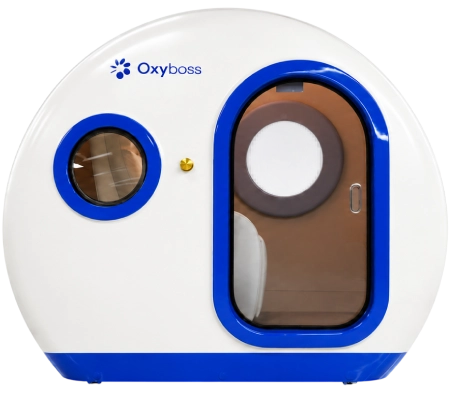
| Clear viewing windows | Reduces user anxiety and enables operator observation |
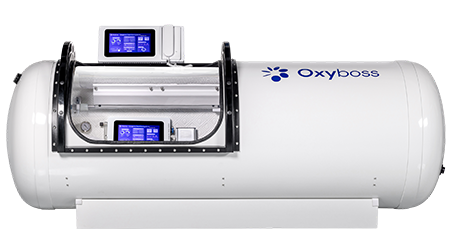
| Intuitive control interface | Screen-based operation designed for operators without engineering backgrounds |
| Reliable sealing systems | Engineered for consistent pressure maintenance with minimal wear |
| Ventilation and airflow support | Promotes comfortable temperature and helps prevent oxygen concentration buildup |
| Comprehensive documentation | User manuals, product usage notices, safety guides, and quick-start references included with every unit |
For commercial buyers and distributors, we also support:
- OEM/ODM customization.
- Multiple chamber configurations.
- Facility setup guidance.
- After-sales technical support.
- Authorized servicing.
- Spare parts supply.
We do not claim our chambers are suitable for everyone or every situation.
We do commit to building equipment that—when used as directed and maintained properly—supports safe, consistent, and comfortable wellness sessions.
Frequently Asked Questions About Hyperbaric Chamber Precautions
1. What should I do before using a hyperbaric chamber for the first time?
Read the user manual and product usage notice completely.
Have a trained person walk you through normal, early, and emergency exit procedures. Complete a pre-session inspection. Remove jewelry, metal items, and sharp objects; wear cotton clothing; avoid oil-based products.
Confirm you understand how to communicate with the operator.
If you have any medical devices, health conditions, or take any medications, consult a healthcare professional first.
2. Can I bring my phone into a hyperbaric chamber?
A phone or other low-voltage electronic device may be used if it operates at 24V or below, is in good condition, and is permitted by the chamber manufacturer or operator.
Do not bring power banks, charging equipment, devices operating above 24V, damaged or overheating battery-powered devices, or any device that has not been permitted for use.
“Waterproof” does not automatically mean “pressure-safe,” and pressure changes during a session may still affect device seals or internal components.
3. Why is fire safety so critical for hyperbaric chambers?
Oxygen-enriched zones—even localized ones near the user’s mask—can cause ordinary materials to ignite more easily and burn more intensely.
Strict fire precautions eliminate potential ignition sources and fuel sources from the environment before they can become a problem.
4. Can I use lotion or skin oil before a session?
No. Oil-based products, petroleum jelly, and greasy cosmetics should not be applied before entering a chamber.
These substances can react with concentrated oxygen and increase fire risk. Use only water-based, unscented products if needed.
5. What should I do if I feel ear pressure during a session?
Try the Valsalva maneuver, swallowing, yawning, or chewing gum if permitted.
If pressure does not equalize or becomes painful, immediately ask the operator to pause or slow pressurization.
Never push through ear pain—request an early exit if necessary.
6. Can I bring a drink into the chamber?
Do not bring carbonated drinks or any sealed pressurized containers into the chamber.
The pressure differential during a session can cause cans or bottles to deform, leak, or burst.
Plain water in an open or flexible container may be acceptable—check your specific chamber’s user manual.
7. How long does it take to exit the chamber normally?
Normal depressurization typically takes 15–20 minutes after the shutdown sequence is initiated.
This gradual process protects your ears and sinuses.
Do not attempt to open the door until depressurization is complete.
8. Are non-medical hyperbaric chambers the same as medical HBOT systems?
No. Medical HBOT systems operate at higher pressures, are classified as medical devices, and are used under medical supervision for specific diagnosed conditions.
Non-medical chambers like those from Oxyboss operate at lower pressures, up to 2.0 ATA, and are designed for general wellness, relaxation, and recovery support—not for treating any medical condition.
9. Who should not use a hyperbaric chamber?
People with implanted medical devices, untreated pneumothorax, or certain medical conditions or medications should avoid use or consult a qualified healthcare professional first.
Because individual circumstances vary, anyone with a health condition, medication use, pregnancy, recent surgery, respiratory concern, ear or sinus disorder, or cardiovascular concern should seek professional guidance before use.
10. Can children use a hyperbaric chamber?
Children must always be accompanied by a parent or legal guardian during the entire session.
They should never operate the chamber independently or be left unattended inside.
Consult a pediatric healthcare professional before use, particularly for premature infants or low birth weight newborns, who should avoid use entirely.
11. Can I repair or modify the chamber myself?
No. All maintenance involving internal components, pressure systems, valves, or structural elements must be performed by the original manufacturer or authorized service personnel.
Unauthorized disassembly or modification is prohibited and may create dangerous conditions.
Routine surface cleaning and visual inspections are the owner’s responsibility; everything else requires professional service.
12. What precautions should wellness centers follow?
Develop a written SOP covering:
- User screening.
- Informed consent.
- Operator checklists.
- Exit procedures.
- Emergency protocols.
- Cleaning procedures.
- Maintenance schedules.
- Mandatory supervision policies.
- Staff training documentation.
Choose a Safety-Focused Non-Medical Hyperbaric Chamber
If you are sourcing a hyperbaric chamber for a wellness center, recovery studio, spa, gym, longevity clinic, distribution business, or home wellness use—Oxyboss is ready to support your project.
We manufacture non-medical chambers with a clear focus on safety, durability, and operator confidence.
Our team can help you with:
| Support Area | What We Provide |
| Product selection | Matching the right model to your use case and environment |
| Pressure and size options | From single-person home units to larger commercial configurations |
| OEM/ODM services | Custom branding, specifications, and documentation for distributors and wellness brands |
| Technical guidance | Setup recommendations, operational workflow, user screening procedures, and safety protocol development |
| After-sales support | Authorized servicing, spare parts, maintenance guidance, and responsive communication |
Every Oxyboss chamber ships with comprehensive user documentation, product usage notices, safety guidance, and the technical foundation to operate responsibly from Day 1.
Disclaimer
Oxyboss manufactures non-medical hyperbaric chambers designed for wellness, relaxation, and recovery support.
Our products are not medical devices and are not intended to diagnose, treat, cure, or prevent any disease.
This page is for general safety education only and does not constitute medical advice.
Individuals with health concerns, implanted medical devices, or those taking medications should consult a qualified healthcare professional before using any hyperbaric chamber.
The contraindication and restriction information listed above is for general awareness and may not be exhaustive—individual medical guidance is always required.