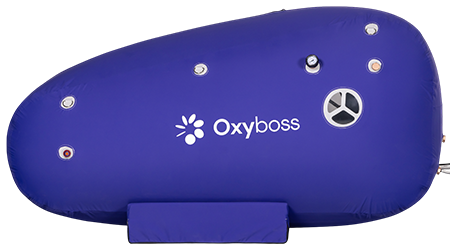
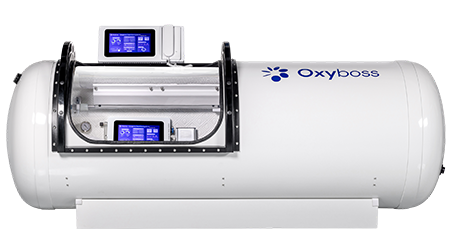
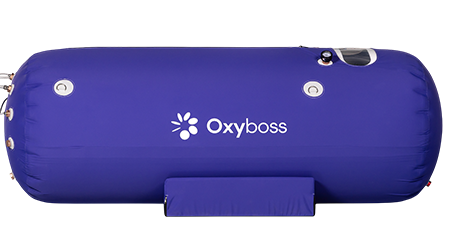
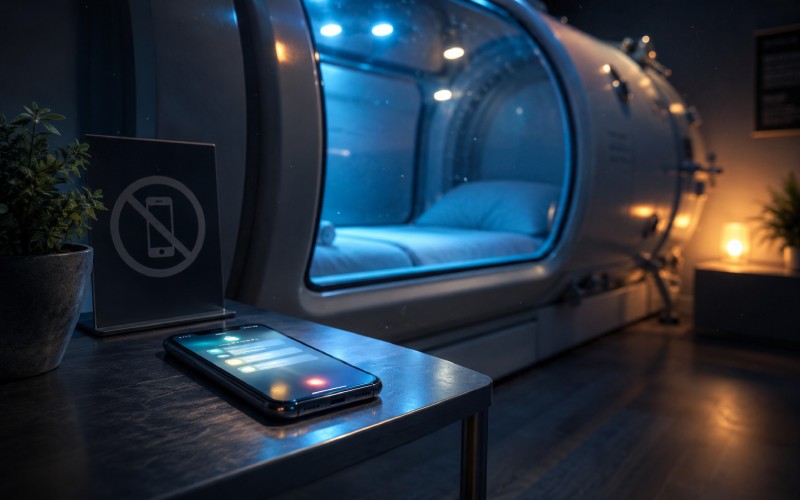
Short answer: it depends on the chamber, the device, and whether the device is approved for that chamber environment.
This is one of the most common questions people ask before using a hyperbaric chamber. It comes up during setup, onboarding, and often right before someone starts their first session. So let’s address it directly — not as a generic safety reminder, but from the practical realities of pressurized, oxygen-enriched environments.
In many medical hyperbaric environments, personal electronics are not allowed. In non-medical mild hyperbaric chambers, the answer can be more nuanced. Certain low-voltage electronic accessories under 24V may be safe to use when they are designed, supplied, or specifically approved for the chamber.
The important word is approved. A device is not automatically chamber-safe simply because it operates at low voltage.
Why Phones and Oxygen-Rich Chambers Require Caution
You already know oxygen supports combustion. That part is obvious. What many people underestimate is not just that “more oxygen = more fire risk,” but how dramatically the ignition threshold can drop in oxygen-enriched conditions.
At elevated oxygen levels, materials you would normally never think twice about — the adhesive holding your screen together, the polymer casing on your battery, the tiny foam gaskets inside your speaker grille — can become fuel. Not theoretical fuel. Fuel that can burn faster and more aggressively than expected.
Your phone’s lithium-ion battery does not need to be defective, old, or swollen to create risk. Under normal atmospheric conditions, a micro-short in a battery cell may produce a small amount of heat that dissipates. Inside a pressurized, oxygen-enriched environment, that same micro-short can create a more serious risk — the separator between anode and cathode may fail, neighboring cells may cascade, and heat output can rise rapidly. In normal air, that may mean smoke or a small flame. Inside a pressurized chamber with elevated oxygen, the consequences can be more serious in an enclosed space where the occupant cannot exit immediately.
Static electricity can make this worse in ways people often do not consider. Sliding a phone out of your pocket, shifting your body on the chamber mattress, or even friction between a cable and fabric can generate micro-sparks that are irrelevant in normal atmosphere but become more significant when local oxygen concentration rises.
This is why many chamber manufacturers and facilities restrict personal electronics. The concern is not just wireless signal. It is battery chemistry, heat generation, materials, pressure, and oxygen concentration working together.
What Pressure Does to Phones and Electronics Inside the Chamber
Set fire risk aside for a moment. There is also a separate mechanical issue that does not get enough attention.
Your phone is not a solid brick. It is a sealed assembly with dozens of tiny air pockets — behind the display, inside the camera module, around the barometric sensor, and within the battery pouch itself. When the chamber is pressurized, those air pockets can compress unevenly.
Here is what that can look like in practice:
| Component | What Happens Under Pressure | Reversible? |
|---|---|---|
| Display assembly | Pressure differential pushes against LCD/OLED layers, causing dark spots or cracking | Sometimes no |
| Lithium-ion battery | Pouch cell compresses unevenly, stressing internal separators and increasing short-circuit risk | Potentially dangerous |
| Camera module | Trapped air distorts lens alignment | Usually yes, but not always |
| Speaker / microphone | Diaphragm deforms under pressure differential | Typically yes |
| Barometric sensor | Feeds incorrect data to the OS | Yes, but may cause software glitches |
| Waterproof seals / IP-rated devices | Pressure can compromise gaskets designed for normal atmospheric conditions | Often permanently compromised |
So even if fire were not the main concern, you would still be risking damage to the device itself. Screens can fail without any visible ignition event. Sometimes it is not a fire issue at all. It is simply physics.
This applies to tablets, e-readers, wireless earbuds, smartwatches, and other personal electronics. Each may contain a lithium-ion cell, sealed cavities, pressure-sensitive components, or heat-generating circuits. Consumer electronics are not automatically designed for use inside a pressurized chamber environment.
“But What About Mild Chambers at 1.3 ATA With Ambient Air?”
This is where the discussion becomes more nuanced.
A soft-shell chamber running at 1.3 ATA on filtered ambient air presents a different risk profile than a hard-shell medical unit running high-concentration oxygen at higher pressure. The fire risk is lower. That distinction matters.
But lower is not the same as zero. Here is why caution still makes sense:
Supplemental oxygen changes the equation. If an oxygen concentrator is being used — even through a mask or cannula — the local oxygen concentration around the face, hands, and lap can rise above ambient levels. A phone placed in that zone is no longer in a normal air environment.
Device design still matters. A low-voltage rating does not tell you whether the battery, housing, seals, screen assembly, cable, or connector has been evaluated for chamber use.
Habits transfer. Someone who gets comfortable using an unapproved personal device in a lower-pressure ambient-air chamber may eventually try the same thing in a higher-risk setup.
The most consistent practice is simple: use only electronics that are approved for the chamber.
What Makes Approved Low-Voltage Electronics Different
Not all electronics carry the same risk profile.
In our mild hyperbaric chamber, approved low-voltage electronic accessories under 24V may be used when they are designed for the chamber environment and used according to the user manual. This may include manufacturer-approved lighting, communication, control, or entertainment accessories.
The difference is not just voltage. It is the full design context.
An approved low-voltage accessory should be evaluated as part of the chamber system — including its power supply, wiring, connectors, heat output, materials, installation method, and expected use during pressurization.
A regular smartphone may also operate at low voltage, but it still contains a lithium-ion battery, sealed components, heat-generating circuits, and materials that may not be suitable for a pressurized oxygen-enriched environment. That is why “under 24V” should not be treated as a blanket permission for all consumer electronics.
The safer rule is:
Use chamber-approved low-voltage electronics only. Keep unapproved personal electronics outside.
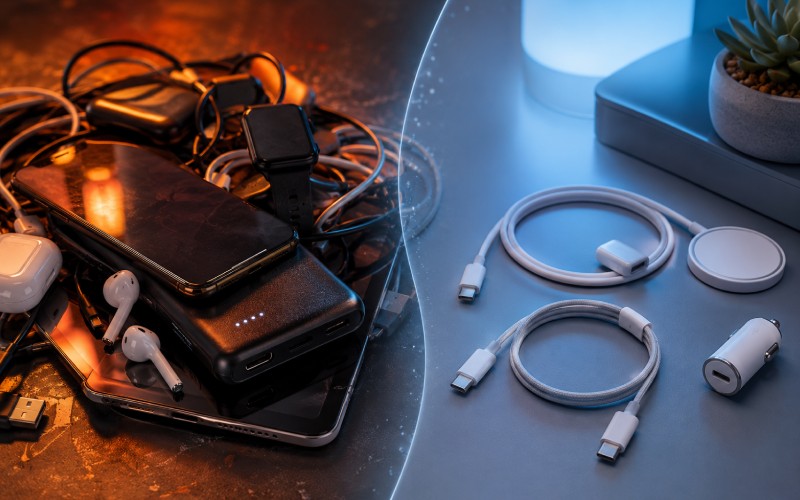
Can You Use Your Phone Inside?
We do not recommend placing a regular smartphone directly inside the chamber unless the specific use method is approved in the user manual.
Airplane mode does not solve the issue. It only disables wireless radios such as Wi-Fi, Bluetooth, and cellular. It does nothing about the lithium-ion battery, processor, screen, heat generation, sealed air pockets, or pressure-sensitive components.
If you want to listen to music, watch content, or stay reachable during a session, use the chamber-compatible solution recommended by the manufacturer. In many cases, the safest setup is to keep the phone outside the chamber and use an approved low-voltage wired accessory or external control method.
What You Can Actually Do During a Session
An hour inside a chamber can feel long if you are used to constant stimulation. That is understandable. But there are safer alternatives.
What works:
Books and magazines — Standard uncoated paper is generally the simplest option. A regular paperback is usually fine. Avoid glossy, laminated covers with petroleum-based coatings if supplemental oxygen is being used.
Sleep — Many people simply rest or fall asleep once they settle in.
Meditation and breathwork — A quiet, controlled environment is well suited to stillness-based routines.
Approved low-voltage accessories — In our chamber, approved electronic accessories under 24V may be used when they are supplied, installed, or specifically approved by the manufacturer.
Hardwired communication systems — If communication is needed, chamber-compatible hardwired intercom systems are the appropriate solution, rather than bringing unapproved wireless electronics inside.
What does not work safely without approval:
Smartwatches — same lithium battery issue, just smaller.
Wireless earbuds — lithium battery in a pressurized environment.
E-readers and tablets — lithium battery plus trapped air pockets behind the screen.
Portable gaming devices — the same issues, often with additional heat output.
Power banks — larger battery capacity and higher heat potential.
If someone claims a consumer device is appropriate for in-chamber use, that claim should be treated cautiously unless the device is approved by the chamber manufacturer.
For Facility Operators: How to Handle the Electronics Question
If you run a facility, you will hear this question often. A few policies make it easier to manage:
Build it into the intake process. Do not wait until someone is at the chamber door. Mention it during booking confirmation and on intake forms.
Define approved devices clearly. If your chamber supports low-voltage electronics under 24V, explain which devices are approved and which are not. Avoid wording that suggests all low-voltage electronics are acceptable.
Provide secure storage. Lockable storage near the chamber area reduces resistance and makes compliance easier.
Provide alternatives. A small library of physical books, magazines, or puzzle books near the chambers can solve most of the boredom problem.
Do not make exceptions for unapproved devices. “Just this once” tends to become a policy by accident.
If occupants need entertainment, communication, or monitoring, keep unapproved screens and electronics outside the chamber boundary and use manufacturer-approved accessories instead.
For Home Users: Setting Up Your Routine
At home, the absence of formal supervision makes consistency even more important.
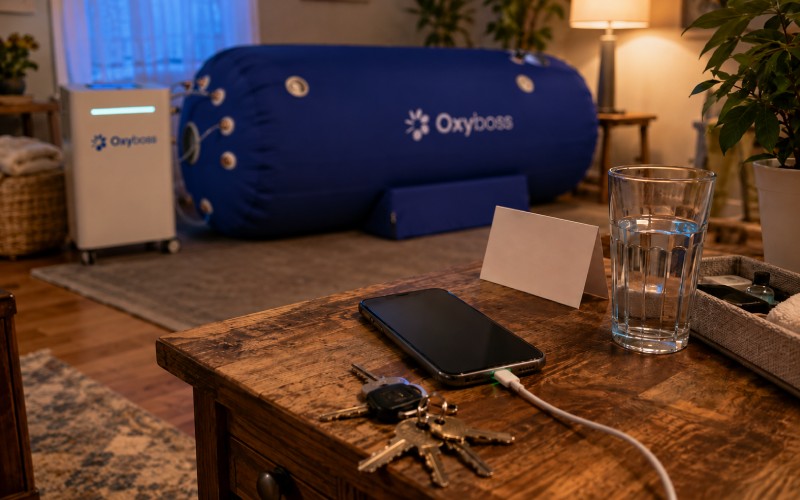
A simple routine helps: put your phone on a charger before starting your pre-session checklist, ideally outside the chamber area if practical. If you need a timer, use the chamber’s built-in controls if available or keep timing equipment outside the chamber. If you need to remain reachable for emergencies, keep the room door open and the phone volume on.
If your chamber includes approved low-voltage accessories under 24V, use them only as instructed in the user manual. Do not substitute other chargers, cables, adapters, battery packs, or consumer devices unless they are specifically approved.
Some users also set “Do Not Disturb” with exceptions for specific contacts. After a few sessions, keeping unapproved personal electronics outside usually becomes automatic.
FAQ
Can I bring my phone if I put it in airplane mode?
Not recommended unless the specific use method is approved by the chamber manufacturer. Airplane mode disables wireless radios — Wi-Fi, Bluetooth, and cellular. It does nothing about the lithium-ion battery, which remains charged and energized. The processor, display, and background systems may also continue running and generating heat. The risk is hardware-level, not signal-level.
What about an old phone with no SIM card, just for music?
It is still a lithium-ion device with trapped air pockets and the same underlying risk profile. If audio is necessary, use a chamber-compatible audio solution designed or approved for that environment.
Are all electronics under 24V allowed?
No. Under 24V is an important design limit for approved accessories, but it is not the only safety factor. Only electronics that are supplied, installed, or specifically approved by the chamber manufacturer should be used inside the chamber.
My chamber only runs at 1.3 ATA — is it really that serious?
Pressure alone may not be the only concern. If any supplemental oxygen is involved — mask, cannula, or oxygen introduced into the chamber space — the local environment is no longer just ambient air. And even at 1.3 ATA, the mechanical stress on phones and screens is still real.
Can I use a walkie-talkie or baby monitor inside?
Not unless it is specifically approved for chamber use. Battery-powered consumer devices should not be brought into the chamber simply because they are small or convenient. If communication or monitoring is necessary, use equipment designed or approved for the chamber.
Can I wear my mechanical watch inside the chamber?
A purely mechanical watch — no battery, no electronics — does not present the same ignition risk. The main question is pressure tolerance. Water-resistance ratings do not always translate directly to chamber use. If the watch is valuable, leaving it outside is usually the safer choice.
What about bringing in a GoPro or action camera without the battery?
Without a battery installed, the camera body is no longer an active electrical source. However, the housing may still contain trapped air pockets that can be affected by pressure. More practically, without a battery it does not function, so there is little reason to bring it inside. If documentation is needed, external camera mounting is the safer approach.
Can I use the electronics that came with the chamber?
Yes, if they are supplied, installed, or specifically approved by the manufacturer and used according to the user manual. Our chamber is designed to support approved low-voltage electronic accessories under 24V, but that approval applies to compatible accessories — not to every personal electronic device.
Pressurized chambers are not the place for unapproved consumer electronics. Use approved low-voltage accessories only, follow the user manual, and keep personal devices outside unless they are specifically listed as compatible. The simplest rule is also the safest one.