The blunt answer first.
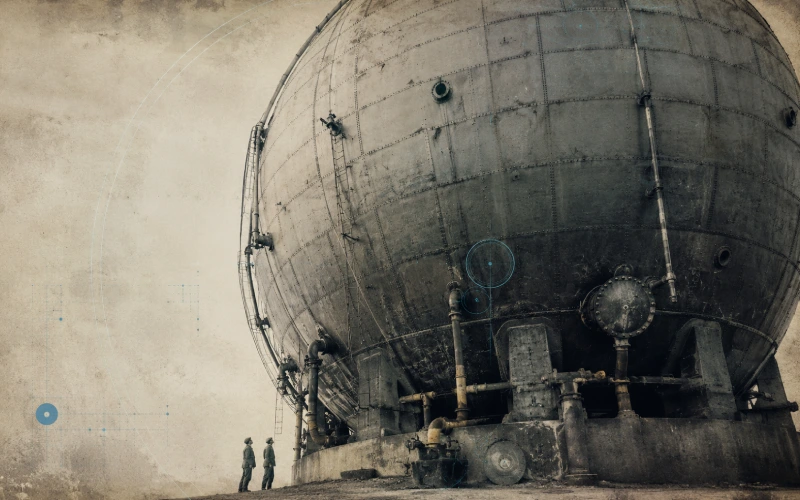
The largest documented hyperbaric oxygen chamber ever built was a five-story steel sphere completed in 1928, about 65 feet high, roughly 900 tons, and designed for around 40 occupants at one time.
That is the historical answer.
The current answer is less clean. “Largest” starts slipping the second you define it too loosely. One operating chamber may be larger by shell size. Another by usable floor area. Another by how many people it can run through in one pressurization cycle. Same topic. Different rulers.
The word “largest” hides three different questions
Most weak articles flatten all of this into one sentence. That is where they go wrong.
| Category | What it actually measures | The practical catch |
| Largest ever built | Raw scale of one pressure shell | It may no longer exist |
| Largest operating chamber | The biggest chamber still in service | Layout and shell size get mixed together |
| Largest by capacity | How many occupants fit in one cycle or one day | This is often a facility claim, not a one-shell claim |
So the safest answer depends on what the reader is really asking.
If the question is historical, the 1928 sphere is the answer.
If the question is modern, there is no honest one-line winner unless the metric is named first.
The strongest historical answer is still the giant sphere
Not a cylinder. A sphere.
That matters, though not for mystical reasons. A sphere handles pressure cleanly. The shell gets help from geometry. The stress distribution is friendlier. But large spheres are awkward once real people have to move inside them, once doors have to be cut in, once floors, benches, viewports, piping, and access paths start demanding straight lines from a curved shell.
So the giant sphere remains the historical outlier. Huge. Efficient under pressure. Uncomfortable as a template for everything that came after.
And the numbers still do the work: five stories, about 65 feet, roughly 900 tons, around 40 occupants.
Why modern “largest chamber” claims keep colliding
Because modern hyperbaric chambers are not judged by diameter alone.
A large shell with clumsy compartment logic can be less capable than a slightly smaller shell with better zoning, better lock transfer, better gas routing, better thermal control, and better pressure stability. Bigger does not automatically mean better. It only sounds better in a headline.
Publicly documented modern examples show the split clearly. One large rectangular chamber is published at 17.2 m by 4.1 m with four compartments. Another documented operating setup is published with 25 seats in one cycle. Both are large. Neither settles the question by itself. One leans on floor geometry. The other leans on cycle capacity.
That is why modern “largest” claims keep talking past each other.
Large hyperbaric chambers stop being shell stories
At small scale, people talk about the vessel.
At large scale, the vessel becomes only one part of the argument.
The real questions shift:
- How are the door openings reinforced?
- How many compartments are inside the shell?
- How stable is the pressure when people or equipment move through locks?
- How is exhaust routed without building noise, backpressure, or ugly flow behavior?
- How much of the chamber is usable volume, not dead shape?
That is where the serious designs separate themselves.
A spherical shell wins the pure geometry contest. A cylinder is easier to build, easier to enter, easier to fit with rails, benches, piping runs, and repeated access. A rectangular chamber gives better floor use, but corners and cutouts stop forgiving anything. The stress field has to be managed instead of admired.
So the biggest hyperbaric chamber ever built and the best large operating chamber are not always the same answer. Close, sometimes. Not identical.
What actually matters inside a huge oxygen chamber
The first issue is compartment layout.
A giant uninterrupted volume sounds impressive until someone has to move occupants, isolate a section, stage an entry, or recover from an interruption without resetting the whole shell. Multi-compartment architecture fixes that. Or at least contains it.
The second issue is gas routing.
A huge hyperbaric chamber is not just a bigger room with more supply. Flow paths become part of the structure. Supply rate, dump rate, pressure tracking, exhaust balance, environmental turnover. If those are weak, the chamber feels crude no matter how large it is.
The third issue is thermal load.
Compression adds heat. Flow adds heat. Steel stores heat. Large chambers punish sloppy cooling fast, then punish it again during longer runs. The bigger the shell, the less helpful guesswork becomes.
The fourth issue is acoustics.
Dense gas changes sound. Curved steel throws it back. Valves chatter. Exhaust lines hiss. Structural vibration travels through supports, piping, and slab connections in ways that are easy to underestimate and annoying to live with. Capacity numbers rarely mention that. They should.
The fifth issue is control stability.
This one gets ignored because it looks boring on paper. Good. It should look boring. A large chamber only feels serious when the control system is steady enough that nobody talks about it.
A harder way to audit any “world’s largest” claim
Use a stricter checklist. It clears out most of the noise.
| Question | Why it matters |
| Is the claim about one shell or an entire facility? | Facility throughput is not shell size |
| Are the dimensions internal or external? | External size can exaggerate usable scale |
| Is the chamber single-compartment or multi-compartment? | Layout changes operating value |
| Is the claim about floor area, shell size, or cycle capacity? | These get blurred constantly |
| Does the design favor pressure efficiency or usable space? | Big geometry can still waste volume |
This is usually enough.
A hyperbaric chamber can look enormous in a brochure and still lose once usable volume is separated from outer volume. Another chamber can look less dramatic and outperform it because the inside is organized properly. That is not contradiction. Just engineering.
So what is the answer?
Use this if you want the historical answer:
The world’s largest documented oxygen chamber was the five-story steel sphere built in 1928, about 65 feet high and roughly 900 tons.
Use this if you want the modern answer without pretending the category is cleaner than it is:
There is no single universal modern winner unless “largest” is defined first: shell size, usable floor area, compartment layout, or cycle capacity.
The second answer is less satisfying. Still better.
FAQ
Was the largest oxygen chamber ever built spherical or cylindrical?
Spherical. That is part of why it remains such an outlier. A sphere handles pressure efficiently, but it becomes awkward once access, movement, and internal layout start dictating the design.
Is the largest chamber ever built still operating?
No. The strongest historical candidate belongs to the record, not the current active field.
Why do modern “largest chamber” claims conflict with each other?
Because they are often measuring different things and presenting them as if they were the same thing. Shell size, floor plan, compartment count, cycle capacity, and total site throughput do not mean the same thing.
What matters more than raw size in a large oxygen chamber?
Usually this: compartment logic, opening reinforcement, pressure stability, gas routing, exhaust behavior, thermal control, acoustics, and usable interior volume.
Are modern large chambers usually designed around one giant uninterrupted interior?
Not usually. Once scale increases, segmentation becomes more useful. It makes access, isolation, staging, and operating continuity easier to manage.
What is the safest one-line answer to publish?
The largest documented hyperbaric oxygen chamber ever built was a five-story steel sphere from 1928, while modern “largest” claims depend on whether the comparison is based on shell size, usable layout, or operating capacity.