The short answer is it depends on which chamber you’re in. The range runs from ambient air at roughly 21% all the way to 100% pure oxygen — and the percentage alone tells you far less than you’d think.
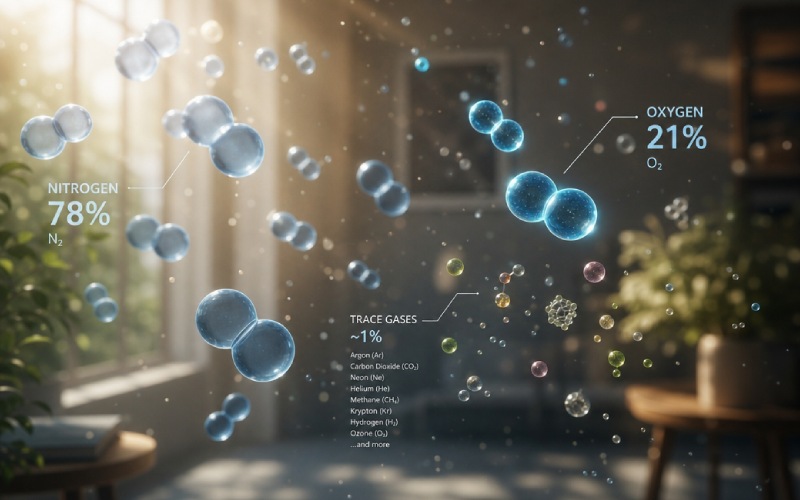
The air you’re breathing right now sits at about 78% nitrogen, 21% oxygen, and a thin slice of argon and other trace gases. A hyperbaric chamber shifts that equation, sometimes dramatically, sometimes barely at all. What actually matters is the combination of oxygen concentration and pressure working together. Understanding that relationship is the entire point of this article.
The 21% Baseline You Already Live In
At sea level, atmospheric pressure is 1.0 ATA (atmospheres absolute). The dry inspired oxygen partial pressure in normal air is roughly 160 mmHg before humidification and gas exchange in the lungs. By the time that air reaches the alveoli, the number is lower. Your hemoglobin — the oxygen-carrying molecule in red blood cells — is still already about 97% saturated under normal conditions. There isn’t much headroom to load more oxygen onto hemoglobin just by breathing richer air.
This is why a standard oxygen mask at normal room pressure has a ceiling. Hemoglobin saturates. It doesn’t much care whether the surrounding gas is 50% or 100% oxygen once it’s topped off.
So how does a pressurized chamber do something different? By going after the other pathway: dissolved oxygen in plasma.
Percentage vs. Partial Pressure — Where Most People Get Lost
People hear “100% oxygen” and do the mental math: 100 / 21 = about 5, so it must be five times stronger. That arithmetic is real but misleading without one more variable.
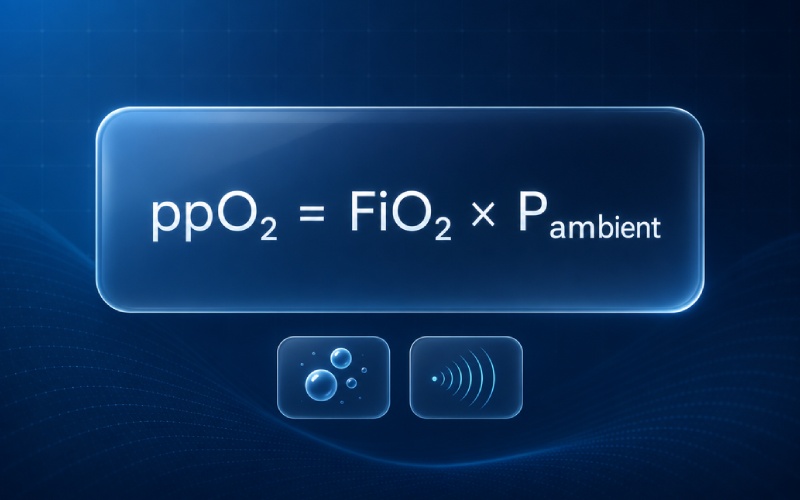
The relationship that governs everything:
ppO2 = FiO2 x Pambient
Where:
- ppO2 = oxygen partial pressure (the number your body actually responds to)
- FiO2 = fraction of inspired oxygen (the “percentage” expressed as a decimal)
- Pambient = total ambient pressure in ATA
Breathing 100% oxygen (FiO2 = 1.0) at normal atmospheric pressure (1.0 ATA) gives you a theoretical inspired ppO2 of 1.0 ATA — around 760 mmHg. That already raises dissolved plasma oxygen from its baseline ~0.3 mL/dL to about 1.5 mL/dL.
Now pressurize that environment to 2.0 ATA while still breathing 100% oxygen. Your theoretical inspired ppO2 doubles to approximately 1,520 mmHg. Dissolved plasma oxygen climbs to roughly 4.4 mL/dL. That’s over 14 times the normal baseline.
Push to 3.0 ATA and dissolved plasma oxygen reaches approximately 6 mL/dL — which, on paper, is sufficient to meet resting tissue oxygen demand through plasma alone, without any hemoglobin contribution whatsoever.
Pressure is doing the heavy lifting. The percentage sets the stage. The pressure pushes the gas into solution. This is Henry’s Law applied to physiology: the amount of gas dissolved in a liquid is proportional to the partial pressure of that gas above the liquid. Double the pressure, roughly double the dissolved gas.
The Two Major Chamber Configurations and Their Oxygen Percentages
Not all chambers deliver oxygen the same way. The design determines both the concentration of oxygen you breathe and the safety architecture of the entire system.
Monoplace Chambers (Hard-Shell, Single-Occupant)
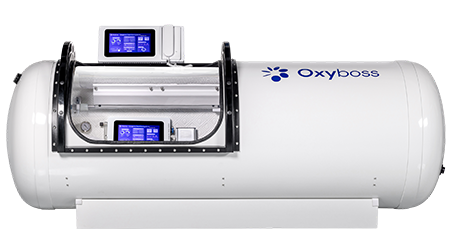
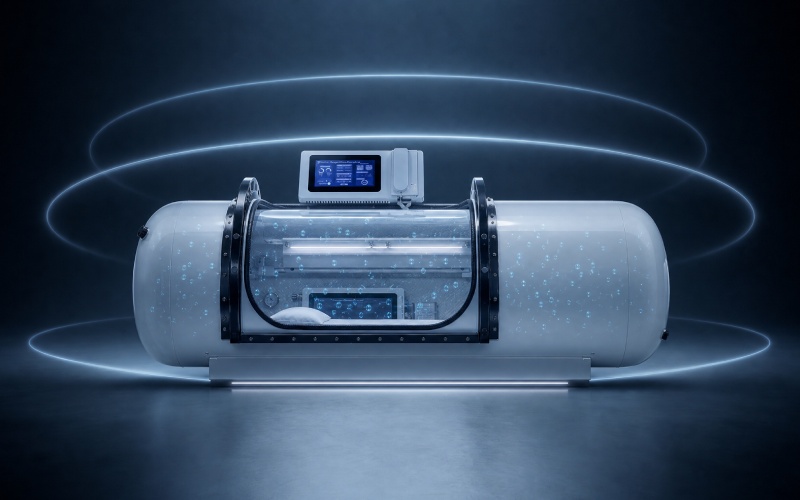
These are the clear acrylic or steel tubes designed for one person. Many monoplace systems pressurize the chamber interior with 100% oxygen, so you lie inside and breathe it directly — no mask, no hood. Other monoplace designs use air pressurization with oxygen delivered through a separate breathing interface. The exact configuration depends on the system.
Typical operating range: 2.0 to 3.0 ATA.
In systems where the whole environment is saturated with pure oxygen, fire risk management is the primary engineering constraint. No petroleum-based products, no unapproved electronics, no static-generating materials. Every surface, fabric, and material inside must be verified compatible with an oxygen-enriched environment.
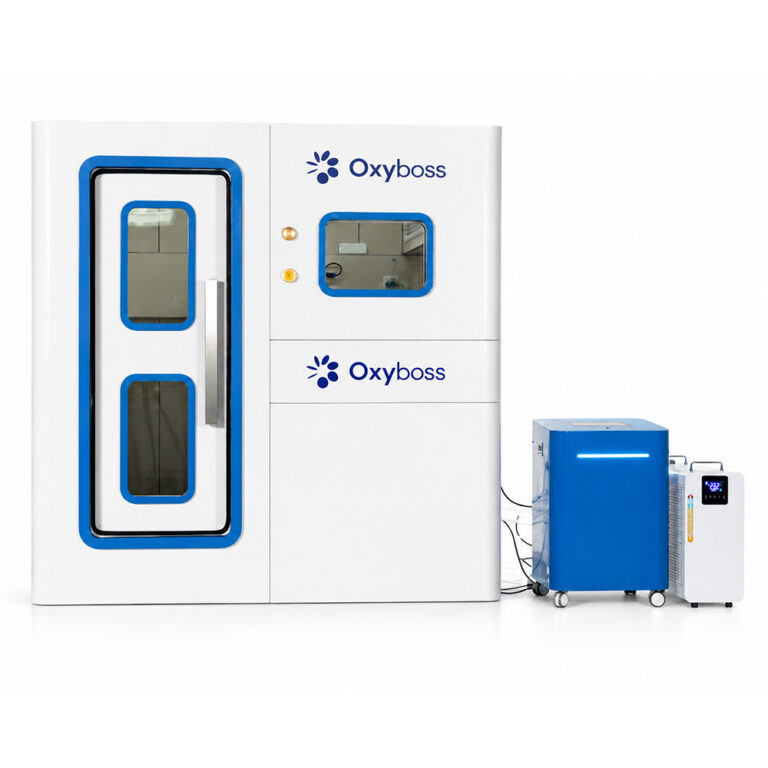
Multiplace Chambers (Hard-Shell, Multi-Occupant)
Walk-in rooms — sometimes large enough for a dozen seats or more. The chamber itself is pressurized with compressed air (still ~21% oxygen). Occupants then breathe 100% oxygen through individual masks or overhead hoods connected to a separate delivery system.
Typical operating range: 2.0 to 3.0 ATA.
The physiological outcome for the person breathing through the mask is essentially identical to a monoplace system at the same pressure when the breathing gas is the same. But the safety profile of the room is different: the chamber atmosphere stays near-normal air composition, and the concentrated oxygen is contained within the breathing circuit. This design dramatically reduces the ambient fire risk.
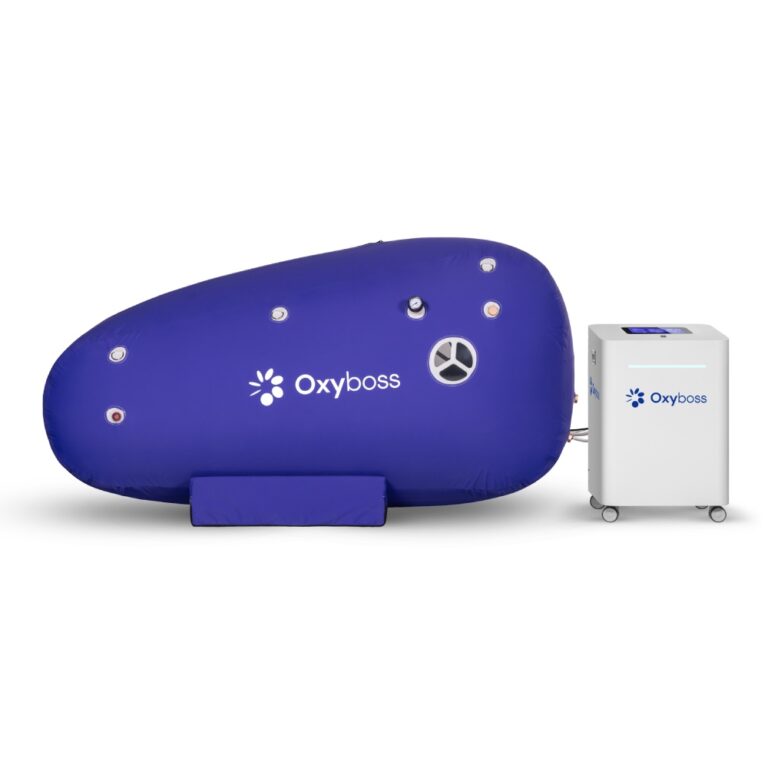
Soft-Shell (Mild Hyperbaric) Chambers
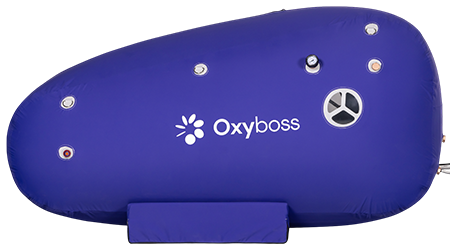
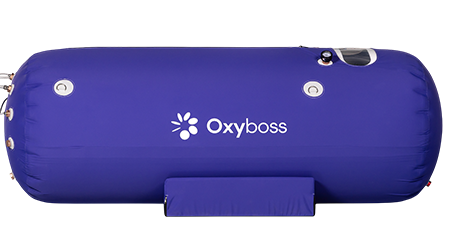
These portable, inflatable units represent a distinct category. They typically reach pressures of 1.3 to 1.5 ATA. The chamber is pressurized with room air or sometimes slightly enriched air.
Oxygen delivery varies by configuration:
- Without supplemental oxygen: You’re breathing ambient air (~21%) at mild pressure. The math: 0.21 x 1.3 = 0.273 ATA — equivalent to roughly 27% oxygen at sea level.
- With an oxygen concentrator and mask: A concentrator typically produces up to ~93% oxygen at the output. What you actually inhale through a mask — accounting for seal, dilution, flow rate, and system design — lands somewhere around 50% to 70% effective FiO2 depending on mask fit and concentrator performance. At 1.5 ATA with 60% effective oxygen, you get ppO2 = 0.9 ATA, which is approximately equivalent to breathing 90% oxygen at sea level.
Soft-shell chambers and hard-shell chambers serve different use cases and operate on different scales of the pressure spectrum. They’re not interchangeable, and lower-pressure soft-shell exposure should not be described as equivalent to standard higher-pressure medical HBOT.
The Real Numbers: Oxygen Across Every Configuration
| Chamber Type | Pressure (ATA) | Breathing Gas | Theoretical Inspired O2 Partial Pressure (mmHg) | Dissolved Plasma O2 (approx. mL/dL) | Equivalent Sea-Level O2 % |
| None (normal breathing) | 1.0 | Air (21%) | 160 | ~0.3 | 21% |
| Normobaric mask | 1.0 | 100% O2 | 760 | ~1.5 | 100% |
| Soft-shell, no concentrator | 1.3 | Air (21%) | 208 | ~0.4 | ~27% |
| Soft-shell + concentrator & mask | 1.3 | ~60% effective | ~592 | ~1.2 | ~78% |
| Soft-shell + concentrator & mask | 1.5 | ~70% effective | ~798 | ~1.6 | ~105% |
| Hard-shell monoplace | 2.0 | 100% O2 | 1,520 | ~4.4 | ~200% |
| Hard-shell monoplace | 2.4 | 100% O2 | 1,824 | ~5.3 | ~240% |
| Hard-shell monoplace | 3.0 | 100% O2 | 2,280 | ~6.0 | ~300% |
Reading the table: “Equivalent Sea-Level O2 %” is conceptual — it shows what oxygen percentage at 1.0 ATA would produce the same partial pressure. Values above 100% are physically unreachable without pressure, which is the entire reason chambers exist. “Theoretical Inspired O2 Partial Pressure” is also a conceptual calculation based on FiO2 x ATA. It is not the same thing as measured alveolar or arterial oxygen pressure.
Why the Percentage by Itself Doesn’t Tell You Much
Two setups can both be described as “oxygen in a chamber” while delivering very different physiological loads:
- A hard-shell monoplace at 2.4 ATA breathing 100% oxygen: ppO2 = 1.824 ATA
- A soft-shell at 1.3 ATA with a concentrator providing ~60% effective O2: ppO2 = ~0.59 ATA
The first scenario delivers roughly three times the oxygen loading of the second. The physics are not in the same range. This doesn’t mean one is “good” and the other “useless” — it means they serve different purposes at different intensity levels.
For anyone evaluating chambers — whether for a facility, a wellness studio, or personal use — partial pressure is the dose metric that matters. Oxygen percentage is one input to that formula. Pressure is the other.
What Happens to Oxygen Inside Your Body Under Pressure
Under normal atmospheric conditions, the vast majority of oxygen transport is hemoglobin-dependent. Plasma carries a trivial fraction. This works fine for normal physiology.
Under hyperbaric conditions with elevated oxygen:
- Plasma becomes a meaningful oxygen carrier. At 2.0 ATA with 100% O2, dissolved plasma oxygen rises from 0.3 mL/dL to approximately 4.4 mL/dL — a 14-fold increase. Plasma is not bound by the same saturation ceiling as hemoglobin.
- Oxygen diffusion distance increases. Normal tissue oxygenation depends on proximity to capillaries. At higher partial pressures, oxygen diffuses further from the vessel wall into surrounding tissue, reaching areas that were previously oxygen-deficient.
- Hemoglobin stays loaded on the venous side. Normally, hemoglobin drops to about 75% saturation after giving up oxygen in the tissue bed. Under hyperbaric conditions, enough dissolved oxygen is present in plasma that hemoglobin can remain near full saturation even after transit through tissue.
- The body responds with vasoconstriction — and the net oxygen delivery still increases. Higher oxygen tension triggers mild vasoconstriction, which sounds counterproductive. But the plasma is so oxygen-rich that the reduced blood volume still carries more oxygen than normal perfusion at baseline. The vasoconstriction has a separate useful effect: it can reduce fluid accumulation in tissue.
Even at milder pressures (1.3 to 1.5 ATA), the partial pressure increase produces a measurable shift in dissolved plasma oxygen. The magnitude is smaller, but it’s not zero. Some peer-reviewed studies have documented measurable physiological changes at these lower pressure levels, though the body of evidence is still maturing compared to higher-pressure data, and these exposures should not be treated as equivalent to standard medical HBOT.
The Nitrogen Question
When the breathing gas is 100% oxygen, nitrogen drops out of the equation. This matters in specific contexts.
Under normal conditions, nitrogen is inert — the body doesn’t metabolize it. It sits dissolved in tissues at equilibrium. Under increased pressure, more nitrogen dissolves (Henry’s Law again). If ambient pressure drops too quickly, that dissolved nitrogen forms bubbles.
In a 100% oxygen environment, no new nitrogen is being added. Existing nitrogen in tissues gradually washes out through respiration. This nitrogen washout property is the physical mechanism behind the use of pressurized oxygen to address gas bubble issues in diving.
In multiplace chambers pressurized with air, the attendants and technicians inside are breathing nitrogen at elevated pressures. This is why multiplace facility operators follow specific exposure limits and decompression considerations for their staff.
Session Parameters in Practice
A typical hard-shell session runs 60 to 120 minutes at pressures between 2.0 and 2.4 ATA. The breathing gas is 100% oxygen, often with scheduled “air breaks” — short intervals where the occupant switches to breathing regular air. These breaks manage cumulative oxygen exposure.
Soft-shell sessions typically run 60 to 90 minutes at 1.3 to 1.5 ATA, with or without supplemental oxygen depending on configuration.
The number of sessions varies with the intended use. Some protocols call for 20 sessions. Others go to 40 or beyond. The oxygen percentage doesn’t change between session one and session forty. What changes is the accumulated effect on tissue over time.
Fire Safety and Its Direct Relationship to Oxygen Percentage
This cannot be understated, especially given recent industry events. Oxygen does not burn — but it aggressively accelerates combustion of other materials, and this acceleration scales nonlinearly with concentration.
At 21% oxygen (normal air), most materials require a substantial ignition source. At 100% oxygen, the ignition threshold drops sharply. Fabrics, oils, hair products, lip balm, electronics — all become potential fuel sources at elevated oxygen concentrations.
Hard-shell monoplace chambers manage this by enforcing strict material controls. No personal items, no petroleum-based products, approved attire only. Every item entering the chamber must be vetted.
Multiplace chambers manage it by keeping the room atmosphere at normal air composition while routing concentrated oxygen through sealed breathing circuits.
Soft-shell chambers operate at lower oxygen concentrations and pressures, which inherently reduces the fire risk. But “lower risk” is not “no risk,” particularly when oxygen is being enriched inside an enclosed space. Static-generating fabrics, electronics, and uncontrolled ignition sources remain hazards at any elevated oxygen level.
Any chamber operator — whether in a facility setting or at home — should follow the manufacturer’s instructions for use and adhere to applicable fire prevention guidelines.
Choosing the Right Configuration for Your Needs
Because you now understand that the oxygen percentage and pressure together determine the physiological dose, the practical question becomes: which combination fits your situation?
For facility operators: Key considerationsHard-shell chambers (monoplace or multiplace) deliver the full pressure spectrum (2.0 to 3.0 ATA) and, depending on system design, either 100% oxygen directly or oxygen through a dedicated breathing circuit. They require dedicated space, electrical infrastructure, trained operators, and compliance with applicable fire safety codes and pressure vessel standards.
Soft-shell chambers (1.3 to 1.5 ATA) have a lower barrier to entry: smaller footprint, simpler setup, lower capital cost. They are well-suited for wellness-oriented facilities, recovery studios, and fitness environments where accessibility and session volume matter.
Mixed fleets can make sense. Some facilities run both hard-shell and soft-shell units to serve different use cases and price points under one roof. Regardless of chamber type, operators should maintain strict material controls in the chamber environment and ensure all staff are trained on safe operating procedures.
For individual buyers: Key considerationsSoft-shell chambers are the practical choice for most home environments. They’re portable, fit in a spare room, and don’t require specialized electrical work. Operating at 1.3 to 1.5 ATA, they provide a meaningful increase in dissolved oxygen — particularly when paired with a quality oxygen concentrator where permitted by the manufacturer and applicable requirements.
Hard-shell home chambers (typically up to 2.0 ATA) are also available in some markets. They require more space and investment, but deliver higher pressure and oxygen loading. These are suited for buyers who have consulted with a qualified professional and determined that higher-pressure protocols align with their goals.
*The break-even math on home ownership versus paying per session at a facility depends entirely on local session pricing, chamber cost, and how often the unit is used. Multiple household members sharing a unit can change that calculation significantly.
Common Misconceptions
“More pressure is always better.” Not necessarily. As pressure rises, the risk profile climbs, and higher oxygen partial pressures require tighter management of exposure time. This is why sessions include time limits and air breaks at higher pressures.
“Soft chambers and hard chambers do the same thing.” They don’t. The physiology is dose-dependent. A 1.3 ATA chamber with room air and a 2.4 ATA chamber with 100% O2 are operating at different orders of magnitude for dissolved plasma oxygen. This doesn’t invalidate either — it means they serve different tiers of intensity.
“The oxygen percentage is the most important spec.” Partial pressure is the dose. Percentage is one component. Pressure is the other. A 1.5 ATA chamber with 70% effective oxygen (ppO2 = 1.05 ATA) actually delivers a higher partial pressure than breathing 100% oxygen at normal room pressure (ppO2 = 1.0 ATA). The math is clear.
“You can replicate hyperbaric results with a high-flow oxygen mask at normal pressure.” You can raise FiO2 to near 100%, which gives you ppO2 = ~1.0 ATA. That does increase plasma oxygen roughly fivefold over room air. But you cannot achieve the 1,500+ mmHg partial pressures of a 2.0 ATA session without the pressure component. It’s not a matter of breathing harder — the physics won’t allow it.
FAQ
What percentage of oxygen do you breathe in a hyperbaric chamber?
It depends on the type. In many monoplace hard-shell chambers, 100% — the chamber is pressurized with oxygen and you breathe it directly. In multiplace hard-shell chambers, the room uses normal air (~21%), but you breathe 100% oxygen through a mask or hood. Soft-shell chambers vary: some use only room air at mild pressure (~21%), while others add an oxygen concentrator that delivers approximately 50% to 93% through a mask, depending on configuration, system design, and mask fit.
How much more oxygen does your body absorb in a hyperbaric chamber compared to normal?
At 2.0 ATA breathing 100% oxygen, dissolved plasma oxygen increases approximately 14-fold over normal levels. Even at milder pressures — say 1.5 ATA with 70% effective oxygen — dissolved plasma oxygen roughly quadruples compared to breathing room air at sea level. The exact multiplier depends on both the chamber pressure and the oxygen concentration being used.
What’s the difference between soft-shell and hard-shell chambers in terms of oxygen?
Hard-shell chambers (monoplace or multiplace) operate at 2.0 to 3.0 ATA and deliver 100% oxygen either directly or through a breathing interface, producing very high oxygen partial pressures. Soft-shell chambers operate at 1.3 to 1.5 ATA, typically with room air or enriched air via a concentrator, producing lower partial pressures depending on configuration. They serve different intensity tiers and should not be described as equivalent systems.
Does the oxygen percentage change during a session?
In a monoplace chamber pressurized with oxygen, no — the environment stays at 100% oxygen throughout the session. In a multiplace setting, oxygen delivery through masks remains at 100%, but occupants take scheduled “air breaks” where they temporarily switch to the chamber’s ambient air (~21%). These breaks help manage cumulative oxygen exposure over longer sessions.
Can I use an oxygen concentrator at home instead of a chamber?
A concentrator alone produces 90% to 95% oxygen at normal atmospheric pressure. That gives you a ppO2 of approximately 0.72 ATA at 95% purity after accounting for inspired conditions. This is meaningfully higher than room air and can serve specific purposes. But it cannot replicate the dissolved plasma oxygen levels achieved inside a pressurized chamber — even a mild one. At 1.3 ATA with a concentrator, you’re already exceeding what a concentrator alone can do at 1.0 ATA. Pressure multiplies the oxygen dose.
What ATA pressure is most commonly used in hard-shell chambers?
The range of 2.0 to 2.4 ATA covers the majority of established hard-shell chamber protocols. Many facilities standardize at 2.0 ATA because the safety profile at that pressure is well-documented, while the oxygen loading is substantial enough to drive meaningful physiological responses.
Why does fire safety matter so much with hyperbaric oxygen?
At elevated oxygen concentrations under pressure, the combustion risk for ordinary materials increases sharply. Items that are completely benign in normal air — lip balm, certain fabrics, personal electronics — can become ignition hazards. All responsible chamber operators enforce strict material controls for this reason. This applies across both hard-shell and soft-shell environments, with the risk scaling alongside oxygen concentration and pressure.
Is a soft-shell chamber “good enough”?
That depends entirely on what you’re using it for. A soft-shell chamber at 1.5 ATA with a good concentrator and mask can deliver a ppO2 that exceeds what you’d get breathing 100% oxygen at normal pressure. For wellness, recovery support, and daily use in a home or studio setting, soft-shell chambers represent a practical and accessible entry point. For higher-intensity protocols requiring 2.0+ ATA, a hard-shell chamber is necessary. The two categories are not equivalent, and soft-shell systems should not be described as a substitute for standard medical HBOT where such treatment is indicated.
This content is for general information and education purposes. It does not constitute medical advice or any other form of professional advice. Pressurized oxygen environments carry inherent risks including fire hazard. Always follow the manufacturer’s instructions for use, consult a qualified professional before beginning any protocol, and ensure proper training for all chamber operators.