The hardest part of a chamber session usually isn’t the hour inside. It’s the first five minutes.
That’s when the pressure actually changes. Your ears, your sinuses, and whatever’s in your head about “will this hurt” all show up at the same time. First-timers tend to assume they just need to be brave and sit still. The ones who have a hard time aren’t the ones who felt pressure — they’re the ones who waited too long to say anything about it.
This isn’t about toughness. The compression phase is a short technical window with a specific set of moves, and when nobody tells you the moves, you default to the wrong one.
What’s physically happening
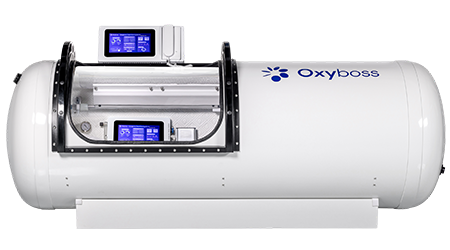
The hyperbaric chamber starts at everyday air pressure, around 1.0 ATA (one atmosphere). The pump pushes it up to the target. On our chamber that target is 1.5 ATA, reached in a linear 5-minute ramp — roughly 0.1 ATA added each minute. Think of it as a 5-meter descent in water spread evenly across five minutes. Not fast by diving standards. Not slow either.
Three things happen at once.
The air inside gets slightly warmer. Compressed gas releases heat, so it’s physics, not a malfunction. The feeling fades once the chamber reaches target.
The air gets a little drier and sounds a little closer to your head. Also normal.
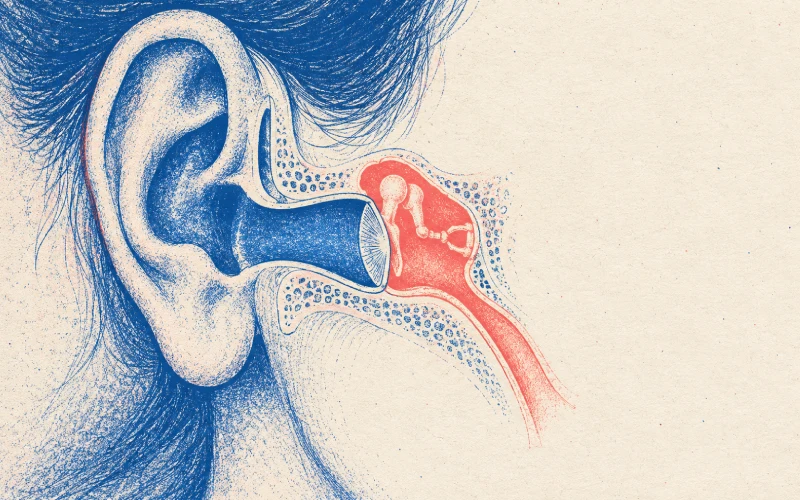
The real one: pressure on the outside of your eardrum rises faster than pressure behind it. The eardrum gets pushed inward. That’s the “full” feeling that creeps in within seconds of the pump starting.
Everything after this is about keeping those two pressures matched.
The core mistake, in one line
Waiting for pain is the mistake.
Here are the mechanics, because the mechanics are the whole point.
The Eustachian tube — the little passage between your middle ear and the back of your throat — is a one-way valve. At rest it stays closed. To open it you need an active muscle movement: swallowing, yawning, moving the jaw. MedlinePlus has a plain description of how ear barotrauma builds up.
The valve opens easily when air inside the middle ear wants to escape outward. That’s why the ride out tends to feel easier. It is much harder to force air inward against a growing pressure gap. The bigger the gap, the stiffer the valve gets. Past a certain point, the walls of the tube collapse against each other and no amount of swallowing or blowing will pop it. You’ve locked it shut.
Pain shows up right around that locked-shut point. By the time you feel real pain, you’ve missed the opening window. The ride from there is harder, not easier.
So the right move isn’t to wait and see. Equalize before you feel anything, then keep equalizing in short cycles the whole way up.
Common doesn’t mean normal
Two things can both be true, and most of the confusion in the first-timer world is because people stack them wrong.
Johns Hopkins Medicine notes that during pressurization some ear discomfort is common and ear popping or pain is a frequently reported sensation. The Undersea and Hyperbaric Medical Society page on side effects lists middle ear barotrauma as the most frequently reported side effect in hyperbaric settings.
Common is a frequency word. It describes how often something happens.
Normal is a tolerance word. It describes whether to live with it.
Ear fullness during the ramp is common. Ear pain that persists past a quick equalization isn’t something to grit your teeth through. It’s a signal to pause the ramp and work the techniques, not to push through and finish the clock.
Equalize early, equalize often — and have a plan B
A lot of first-timers know one method. Pinch the nose, close the mouth, blow softly. That’s the Valsalva maneuver and it works for a lot of people in the first minute or two.
The problem is that Valsalva delivers a fixed amount of force — however hard your diaphragm can push — against a pressure gap that keeps growing. It works at 1.1 ATA, works a bit less at 1.3, and often works barely at all by 1.5 if you’ve started it late. The fix isn’t to blow harder. Blowing harder has its own risks.
The fix is to have a sequence.
Here’s the order to tape to the inside of the chamber door:
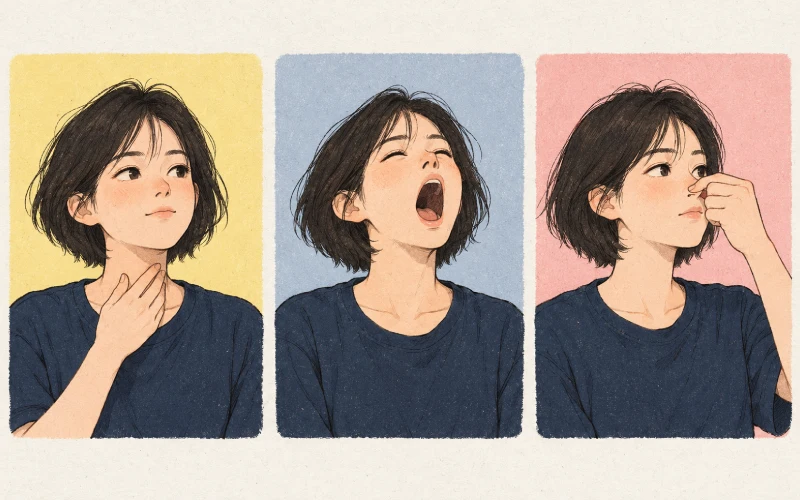
- Swallow. Dry swallow or sip water. Lowest-effort move, and it opens the tube naturally.
- Yawn, even if you have to fake one. A fake yawn uses the same muscles.
- Head-to-shoulder swallow. Turn your head as far to one side as it will go, chin toward shoulder, then swallow. The angle helps open the tube mechanically. The Dartmouth-Hitchcock hyperbaric patient education page lists this one specifically. It gets left off a lot of lists.
- Jaw side-to-side. Shift your lower jaw left, hold, then right, hold. Same tube-stretching logic as the head turn.
- Toynbee. Pinch your nose and swallow at the same time. Different muscle pattern than Valsalva, no forceful blowing.
- Valsalva. Nose pinched, mouth closed, gentle breath out through the blocked nose. Not a hard push. If it doesn’t pop on a soft try, don’t escalate — switch techniques.
- Frenzel. Pinch your nose, make a hard “K” sound at the back of your throat while pressing your tongue up. Divers Alert Network teaches this one for divers who find Valsalva fading mid-descent.
Early and often beats late and hard. Every twenty seconds in the first two minutes is a reasonable rhythm. If one technique isn’t getting a pop, don’t repeat it harder — switch.
The five-minute ramp, minute by minute
Our chamber climbs linearly from 1.0 to 1.5 ATA across five minutes. Here is what to do inside that window.
Minute 0, before you hit start. One practice swallow and one fake yawn outside the chamber. If either one doesn’t give you a slight ear pop or a shift in sound, your tubes are already struggling and today may not be the day.
Minute 1. Pressure is still close to normal — you’re at roughly 1.1 ATA, the gap is small. Build the habit now, don’t wait. Swallow once every 20 seconds. You should get a faint pop or shift at least once in this minute.
Minutes 2 to 3. This is the steep-feeling middle, around 1.2 to 1.3 ATA. Rotate the techniques: swallow, head-to-shoulder, jaw-shift, Toynbee. Keep the cycle short. If one technique fails twice in a row, stop repeating it and move to the next.
Minutes 4 to 5. You’re approaching the target. If the ears have been popping on cue, the ramp will feel like it smooths out — the last few tenths of an ATA are the easiest. Keep sipping water. Don’t suddenly stop equalizing when the pump sound changes; keep the rhythm for another 30 seconds past target.
When something’s off: the three-step rule
Clinics with full staff run a longer cascade for compression trouble. In a solo setting the useful version is three steps.
Step one: pause the ramp. Our chamber controller lets you hold or step back 0.1 to 0.2 ATA. Hold it there. Breathe. Run through the technique sequence slowly. Give it a full 60 seconds.
Step two: resume at half speed. If the pause worked and both ears cleared, add pressure back more gradually. A linear ramp isn’t a requirement — it’s a comfort setting. Nobody is grading you.
Step three: end the session. If step two fails, come back down to 1.0 ATA at a controlled pace and open the chamber. One missed session doesn’t matter. One ignored warning sign can.
The one thing not to do: force the ramp through pain. The outcome is usually a few hours of ear fullness, sometimes a day or two of muffled hearing, and in rare cases a torn eardrum. If ear fullness or hearing change hangs around past 24 hours after a session, see an ENT. Not worst-case thinking — just the right follow-up.
Today isn’t your day if…
Half the first-session struggles aren’t technique problems. They’re anatomy problems that showed up at the wrong time.
Skip the session today if:
- Head cold or active sinus congestion. Blocked nasal passages make tube opening close to impossible.
- Active allergy flare and no normal yawn-pop on the ground.
- Flu, fever, or recent ear infection.
- Recent ear surgery that hasn’t been cleared.
- No equalization at all when you try the moves outside the chamber — a practice swallow with no pop means the tubes are closed today.
- An un-cleared chest or lung issue. Pressure change and trapped air don’t mix. The Johns Hopkins Medicine complications page covers the precautions.
Not being able to equalize isn’t a personal failing. Prospective research referenced on the UHMS side effects page shows that in a clinical hyperbaric population, close to half of first-session patients turned out to have objective evidence of Eustachian tube dysfunction after their first exposure. That’s data from higher-pressure clinical settings, not a soft chamber — but the anatomy transfers. If your tubes don’t cooperate on the surface, they won’t cooperate under pressure. Reschedule.
After the session: the next 24 hours
Compression gets the attention. The hours after exit don’t.
Most people feel fine or mildly tired. Published research on hyperbaric populations reports mild tiredness lasting 2 to 4 hours during the first several sessions, fading as the body adjusts. Hydrate. Skip anything demanding for the rest of the afternoon.
The three things to notice, even if the session felt smooth:
- A new ringing in one ear that wasn’t there before, especially if it doesn’t settle in a few hours.
- Muffled hearing on one side, as if a finger is pressing softly on the ear.
- A delayed pop or a “wet” feeling in the ear that shows up an hour or two later.
Any of those: call an ENT, don’t wait for the next session. Delayed middle-ear fluid is a documented pattern. It can show up well after you’ve left the chamber and gone about your day.
Compression and the ride out also aren’t mirror images. The ride out tends to feel easier because air in the middle ear wants to vent outward, and the Eustachian tube cooperates with that direction. Not always, though. If you’re popping persistently on the way out, or feel pressure building the other way, slow it. The exit can be managed the same way as the entry.
Decision table: continue, slow, or stop
| What you’re feeling | What to do | Why |
|---|---|---|
| Mild fullness, pops after a swallow or yawn | Keep going at normal pace | Expected sensation; the tube is doing its job |
| Fullness that doesn’t clear with 2 swallows and 1 yawn | Pause the ramp, cycle 3 more techniques | The gap is widening; buy room to open the tube |
| Fullness turning to pressure or a dull ache in one ear | Hold or step back 0.1–0.2 ATA, retry techniques for 60 seconds | Pain is a late signal; back off before it localizes |
| Sharp pain, popping sound without relief, or sudden ringing | End the session, controlled return to 1.0 ATA | Protect what’s there; book an ENT if symptoms last past 24 hours |
| Ears cleared but sinuses still feel heavy | Pause until sinuses release, then resume slowly | Sinus barotrauma has the same cause and the same fix |
Frequently asked questions
What involves breathing pure oxygen in a special chamber?
That’s clinical hyperbaric oxygen setups, run under medical supervision in rigid chambers at 1.9 to 3.0 ATA, with pure oxygen delivered through a mask or hood. A mild chamber at 1.5 ATA, compressed with room air, is a different category of device. Different pressure, different gas, different use case.
How do you fix middle ear pressure?
Open the Eustachian tube actively — swallow, yawn, move the jaw, or use a nose-pinched technique like Toynbee or Valsalva. Do it before you feel pain, not after. If no technique works and pressure is building, stop adding more pressure and give the tube a minute to recover.
Can you overdo a hyperbaric chamber session?
At pressures above 2.0 ATA, a 2023 systematic review in Frontiers in Medicine found adverse events in roughly 30% of participants versus about 10% in controls. Soft chambers run below 1.5 ATA, which keeps the exposure much smaller — not zero. One well-paced session is the goal, not back-to-back marathons.
Are soft hyperbaric chambers effective?
The UHMS position statement on low-pressure chambers is specific: chambers under 1.4 ATA have FDA 510(k) clearance for acute mountain sickness and are compressed with air, not oxygen. Our chamber reaches 1.5 ATA — a mild hyperbaric environment, not a clinical hyperbaric oxygen setup. People buy them for wellness reasons; we don’t make outcome claims.
Why would a hyperbaric chamber explode?
Pure oxygen plus a spark plus a flammable material is the pattern behind every chamber fire in the literature. That’s why FDA guidance to providers covers lighters, batteries, hair products, lotions, and loose synthetic fibers before entry. Our chambers compress with room air, and the same precautions still apply.
What should I avoid doing right after a session?
Hard workouts, long drives if you felt tired on exit, hot showers in the first hour (your sinuses are still settling), and any new ear-pressure challenges — flying, scuba, altitude — the same day. Hydrate instead.
How much does an hour in a chamber cost?
At the home-use end, soft chambers in the 1.3 to 1.5 ATA range run from a few thousand dollars for entry-level units to five figures for larger builds. Clinical hyperbaric oxygen sessions are a separate conversation and happen in a facility.
Can hyperbaric settings help with sudden hearing loss?
That specific question sits in clinical hyperbaric oxygen research, well above the pressure range of a mild chamber. If you’re asking about sudden hearing loss, start with an ENT right away — the time window matters.
Can I feel claustrophobic in there?
Some first-time users do. Short practice sessions with the chamber door open help, as does picking music or a podcast ahead of time. If a quick breathing pattern — four seconds in, six seconds out — doesn’t settle it after a minute, end the session. The chamber will still be there tomorrow.
The short version
You’re the one at the dial. Handle the first five minutes like a skill, not a formality. Equalize before you feel anything. Rotate the techniques instead of repeating the first one harder. If something doesn’t clear, pause the ramp — the chamber doesn’t care about finishing on time, and neither should you.