



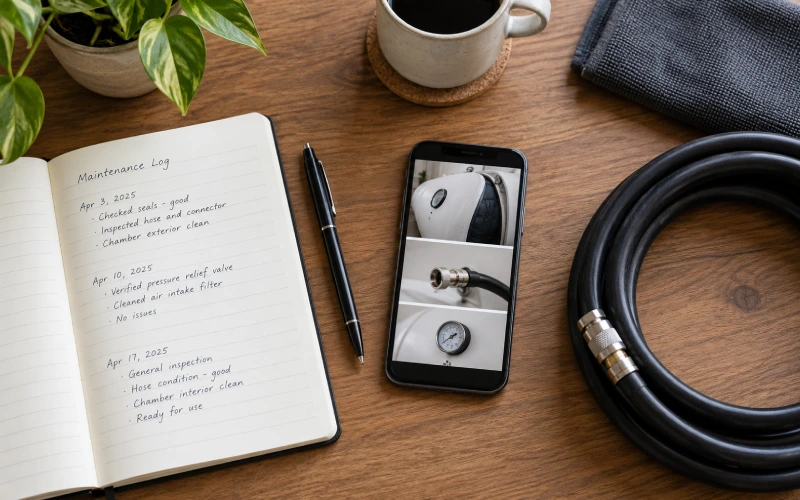
Kink the same hose in the same spot twice and you don’t have a hose problem anymore — you have a routing or storage problem, and you need a written record to catch it. Here is how to look at the hose, when to stop using it, what to write down, and where the replacement should come from.
1. A kink once and a kink again are two different problems
Kink a hose once and the fix is boring: retire it and put a new assembly on. Nothing to write about.
The interesting case is the same hose kinking in the same place, more than once. That is not really a hose defect anymore. Something upstream is doing it — how the hose is routed, how it is stored, the corner it lives near, the compressor position, the length you chose, or the environment around it. The whole point of the paperwork is to turn one-off events into a pattern you can act on.
A working repeat rule. Same defect (kink, flatten, soft spot, bulge) at or within a couple of inches of a previous location, twice inside one service cycle → the assembly moves from “watch it” to “pull it and diagnose the cause.” Pick a different threshold if you want. But pick one — a log without a repeat rule cannot escalate anything, and “we should probably replace it” is not a decision, it’s a mood.
2. Stop it before it becomes a log entry
The best kink log is the one with nothing in it. That means the hose is routed and stored so it never bends past what it can handle.
2.1 Respect the minimum bend radius
Every reinforced hose has one. Bend it tighter than that and the reinforcement layer is already being damaged — the cover often still looks fine right up to the failure. Two rules that actually work:
- Follow the minimum bend radius listed on your product’s spec sheet along the entire run. It is not an average. A single tight spot at the coupling counts.
- If the hose has already been bent tighter than the minimum, do not straighten it and put it back. That bend was a damage event, not a temporary shape you can undo.
General industrial-hose guidance says the same thing plainly: “Never bend the hose tighter than the recommended minimum bend radius.” (Gates Corporation, Industrial Hose Safety Bulletin, https://www.gates.com.) Different industry, same physics.
2.2 The four things that actually prevent a kink
Telling someone to “be careful” is not a prevention strategy. Give the hose something physical to keep it out of trouble:
- Bend restrictor / strain relief at each end, especially at the compressor and chamber couplings. That is where the sharpest curve tends to form.
- Spring guard around the hose. A spring around the tube physically enforces a minimum radius — the hose cannot bend tighter than the spring will let it.
- Abrasion-resistant sleeving where the hose crosses a doorway, runs under a rug, or lives near a corner that would otherwise chew the cover.
- Swivel connector on the chamber end (usually). A swivel absorbs the rotation you put in when you walk around the setup. Rotation locked into a rigid fitting is where “coil memory” comes from, and coil memory is where repeat kinks start.
2.3 Storage and routing — the boring stuff that fixes most repeats
- Do not coil the hose tighter than its minimum bend radius. If your natural coil is tighter, use a larger loop or a reel sized for the radius.
- Do not hang the weight of the hose off a coupling. Weight pulling on a fitting shortens that fitting’s life faster than pressure does.
- Keep it out of doorways, off floor thresholds, and away from anything that can shut on it (cabinet doors, chair legs on castors, closet doors closing on the run).
- Never let it get stepped on with weight. Not people, not equipment carts.
- Keep it away from heat, open flame, and direct sun over long periods.
- Keep it away from oil, grease, lubricants, and any hydrocarbons. Clothing and tools that will touch the hose or the fittings should be free of oil too. Zero tolerance is the standard here, not a preference. (NFPA 99 §14.3.2.3 on oxygen compatibility of gaskets, sealing surfaces, and lubricants, https://www.nfpa.org.)
3. What to look at every time — the visual inspection
The visual is the entry-level check, and it is also the one you do most often. Frequencies come later, in section 6.
Look at every one of these, every time:
- Hose body end to end — kink, flatten, soft spot, bulge, blister, cut, cover damage, exposed reinforcement
- Bend zones and any point that already curved during the last session
- Both couplings — nuts, ferrules, O-rings, threads
- Hose clamps and any strain relief piece
- Ports on the chamber and the compressor — wear, oil residue, cracks
- How the hose is coiled right now — a tight coil packed away right after inspection is one of the most common repeat-kink causes
If you smell hydrocarbons, see oil residue, or feel anything sticky on the hose, stop the inspection there and clean or replace before the next pressurization. Wiping the outside is not a fix in oxygen service — do not “clean and continue.”
4. When you retire the hose — the condemnation list
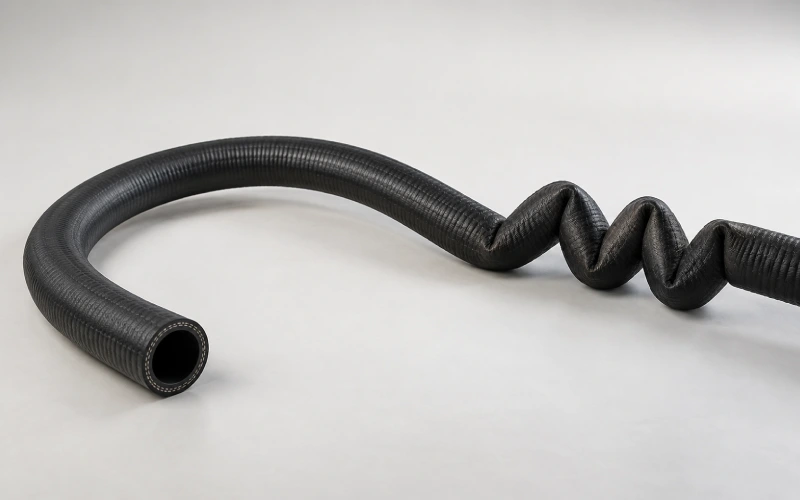
Take the hose out of service if any of these are true. This is a hard list, not a judgment call. General industrial-hose safety guidance is worded conservatively for a reason, and the same logic applies here.
| # | What you see | What to do |
|---|---|---|
| 1 | Kink or crush that does not return to round | Retire. Do not straighten. |
| 2 | Bulge or blister under pressure | Retire. Reinforcement compromised. |
| 3 | Soft spot — an area that gives more easily than the rest of the body | Retire. |
| 4 | Cracks, cuts, or abrasion that expose the reinforcement (you can see the braid or textile) | Retire. |
| 5 | Loose areas of the cover — cover moving independently of the tube underneath | Retire. |
| 6 | Coupling slippage, or a hiss under pressure at the coupling | Retire the whole assembly. Do not attempt a field re-swage. |
| 7 | Damaged threads, torn O-rings, or nut damage | Replace the coupling components. Retest before returning to service. |
| 8 | Oil / hydrocarbon contamination — residue, smell, staining | Retire. Do not clean and reuse an oxygen-service hose that has been exposed to oil. |
Sources: Gates, Industrial Hose Safety Bulletin, https://www.gates.com; ARPM technical bulletins on industrial hose inspection, https://arpminc.com.
4.1 The 20% outside-diameter line — with limits
General industrial-hose guidance also uses a quantitative retirement line: a permanent outside-diameter reduction greater than 20% → remove the assembly from service, and assemblies with lesser reduction should pass a hydrostatic test before being put back into use. (Gates Industrial Hose Safety Bulletin, https://www.gates.com; ARPM Hydrostatic Testing Procedures, https://arpminc.com.)
How to actually use that rule on our product:
- It comes from general industrial and hydraulic hose practice. It is not written for chambers.
- It is not a substitute for what your product’s own spec sheet says. If our spec sheet is tighter, ours wins.
- For a low-cost, replaceable consumer air-supply hose, running a hydrostatic test is often not economical. Replacing the assembly is usually the honest answer.
4.2 Hydrostatic test — when it makes sense at all
If a hydrostatic test is on the table:
- Test with water, not compressed gas. Compressed gas stores far more energy at the same pressure, and a failure under gas is a real safety event. (ARPM guidance, https://arpminc.com.)
- Follow the pressure level and hold time on your product’s spec sheet.
- Log the test as an event of its own (see section 5).
- Applies only to reusable pressure-carrying components on chambers that support it. For most portable and soft-chamber hoses, “test and reuse” is not really an option — replacement is the honest answer.
4.3 Do not do these
- Do not heat, straighten, or “reshape” a kinked hose.
- Do not clamp, splice, or wrap a damaged section.
- Do not substitute a hose, compressor, fitting, or lubricant that your product manual does not list. Swapping in a different compressor model is one of the fastest ways to void a warranty and invalidate every prior test.
- Do not reuse a hose that has ever been oil-contaminated. Does not matter how clean it looks now.
5. The maintenance log — what a good record actually contains
If a chamber owner keeps a log at all, most keep too little of it. Here is the field list. Every event goes down as a row.
5.1 The full field list
Equipment identity
- Manufacturer
- Model
- Serial number
- Hose assembly identifier — if you run more than one hose on one chamber, tag them so the log can distinguish them
When and where
- Date and time
- Location where the chamber was in use
- Chamber pressure at the time of the observation, if the finding happened during or after a session
Who and why
- Inspector or technician (name + role)
- Reason for the entry — routine inspection, incident during use, post-session check, scheduled test
What was found
- Condition observed — write it as location + defect + severity + leak yes/no. Example: “18 in. from chamber-end coupling, single sharp kink, ~45°, no audible leak.” Avoid “there’s a bit of a kink” — the next person cannot decide from that sentence.
- Whether this is a repeat at or near a prior location — cross-reference the earlier entry ID
What was done
- Disposition — one of: return to service / monitor / hydrostatic test then return / retire / refer to manufacturer
- Corrective action — including routing, storage, or accessory changes that address the cause
- Parts replaced, with part numbers and source
Sign-off
- Signature and date of the person who did the work
- Release authorization — separate signature by whoever is authorized to return the equipment to service
Document control (for the log itself, not the entry)
- Version and revision date of the log
- Prepared by / reviewed by / approved by
- Retention: keep every entry for the life of the chamber
5.2 Minimum-viable log entry — for anyone who will not read the field list above
Date/Time: 2026-03-14 09:20
Chamber:   [Manufacturer] / [Model] / SN 4XZ-01138
Hose ID:   HOSE-A (compressor-to-chamber, 10 ft)
Inspector: J. Nguyen (owner-operator)
Finding:   18 in. from chamber-end coupling, sharp kink ~40°,
           no audible leak at 1.3 ATA.
           Same location as entry 2025-11-02.
Repeat?    Yes — second event at this location this cycle.
Action:    Retired HOSE-A. Root cause: routing crossed doorway.
           Rerouted HOSE-B along wall. Ordered replacement
           per manual, PN [XXXX], from authorized supply.
Signed:    J. Nguyen, 2026-03-14
Released:  A. Park (site lead), 2026-03-14
That is the whole thing. Every field earns its place.
5.3 A photo is not a record
Photos are useful — attach them. They are not a substitute for the fields. A photo of a kink does not tell the next inspector when it happened, whether the assembly is still in service, or whether this is the third time in the same spot. Words plus a photo beats a photo alone.
5.4 Take it out of service, visibly
While a hose is under review or has already been retired, tag it clearly so nobody plugs it back into the ready-to-use kit during a busy morning.
The pattern comes from fire-protection practice. NFPA 99 requires that when a chamber’s fire-suppression system is out of service, a sign indicating its status is “conspicuously posted.” (NFPA 99 §14.3.1.7.1, https://www.nfpa.org.) The same logic works on a hose: mark it, keep it separate from the ready-to-use kit, and log the tag-out as its own event.
6. How often to check — one number will not fit every part
You will see a lot of different numbers floating around for “how often.” That is because the numbers describe different objects, not different opinions. The honest split:
| Object | Check type | When | Source of the frequency |
|---|---|---|---|
| Hose assembly (compressor → chamber) | Visual + hands-on | Before each use | Product manual; general oxygen-service practice |
| Air-pressure gauges, water-level indicators (Class A multiplace) | Visual | Before each chamber pressurization | NFPA 99 §14.3.2 requirements on gauges and level indicators, https://www.nfpa.org |
| Acrylic viewports, pressure vessel body | Visual | Daily, per ASME PVHO-2 in-service guidance | ASME PVHO-2, https://www.asme.org; also referenced by UHMS Hyperbaric Facility Accreditation Manual, https://www.uhms.org |
| Environmental sampling / atmosphere testing | Testing | Every 6 months | NFPA 99 §14.2.9.6.1, https://www.nfpa.org |
Two things to be honest about:
- The NFPA / ASME / UHMS rows are written for medical hyperbaric facilities, typically multiplace Class A chambers. If you operate a home, portable, or soft chamber, those specific requirements do not apply to you — but they are a useful reference for what “reasonable practice” looks like.
- “Before each use” is realistic in a professional setting. In a home setting, honest guidance is: eyes on the hose before each session, a hands-on check when you re-coil after each session, and a full end-to-end look every time you change seasons or move the equipment.
7. Symptoms during a session — and what to log
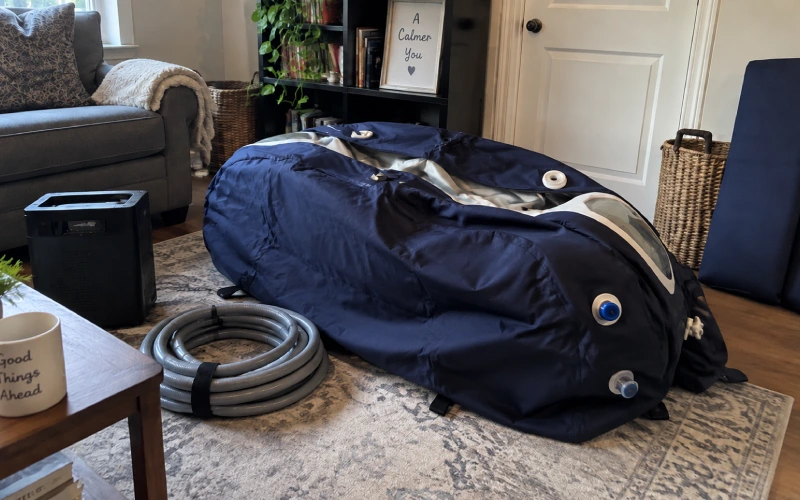
Something happens mid-session, this table tells you where to look and what field to fill.
| Symptom | Most likely spots | What goes in the log |
|---|---|---|
| Audible hiss | Coupling seal, threaded fitting, cover blister | Condition observed — location + hiss + pressure at the time |
| Chamber will not inflate | Compressor supply, hose kink or crush, coupling not seated | Action — which component was verified |
| Slow pressurization | Partial obstruction, kink, undersized replacement hose, aged coupling | Time to target pressure vs prior sessions |
| Will not hold target pressure | Leak in hose, coupling seal, chamber seam, valve | Isolate and log — do not “top up” and continue the session |
| Cover ballooning under pressure | Reinforcement damage | Retire immediately, do not test |
One deliberate note. On this hardware, the hose runs from the compressor to the chamber and carries compressed air. If a kink is present, the effect to describe is on supply pressure, inflation time, and ability to hold pressure — that is the honest engineering description of what a restricted air line does.
8. Who is allowed to sign off?
A maintenance log is only as strong as the person who signs the release line.
- The person performing the inspection can be any trained operator following the product manual.
- The person authorizing return to service should be one of: the manufacturer, an authorized service technician, or a designated on-site lead who has been trained on this specific product.
- Class A multiplace facilities have a formal role for this — the hyperbaric safety director — and UHMS materials require the safety director to approve, in writing, equipment brought into the chamber. (UHMS Guidelines for Hyperbaric Facility Operations, https://www.uhms.org.) Home and portable users do not have that role by default. That is not a loophole, it is a reason to be clearer about who signs your form.
9. Home, portable, and facility settings — same hose, different context
The hose is the same piece of hardware, but the environment changes what “reasonable practice” looks like.
- Home / soft-sided. The hose lives in a home, near soft furniture, sometimes near pets and children. Real threats: doorways, cabinet corners, tight coils in a storage bag, gravity sag at the compressor coupling. A simpler log is fine. The discipline is checking the same three places every time and writing down what you saw.
- Portable. The hose gets moved, packed, and unpacked. The single riskiest moment is repack — that is when a small kink becomes a permanent memory in the tube. Slow down at repack. That saves more hoses than any other single habit.
- Clinical / multiplace. The standards get much more specific and the paperwork gets much more elaborate — NFPA 99, UHMS accreditation, safety-director sign-off, formal preventive-maintenance program, retention periods driven by accreditation. If you operate a Class A multiplace chamber, you already have written procedures.
10. Supply and warranty — where the replacement comes from
Buying the replacement in the same place you bought the chamber is not just convenience. It is how the safety chain stays intact.
- Order replacement hoses and couplings from us or from an authorized distributor. Give the model number, serial number, and hose assembly identifier when you contact us.
- Substituting a non-approved hose, compressor, fitting, or lubricant is one of the most common reasons a warranty ends. Swapping the compressor model — even to a “better” one — voids warranty on the whole system in most product lines. Check your product manual before you assume otherwise.
- Warranty documentation and any receipts for prior service belong alongside the maintenance log, not in a separate drawer. When the next inspector opens the file, everything they need is in one place.
11. FAQ
Small kink, no visible damage — can I straighten it?
No. A kink is a reinforcement-layer event even when the cover looks fine from the outside. Retire and replace.
How often do I actually need to check the hose?
Eyes on before every session. Hands-on when you re-coil. Full end-to-end at least once between seasons or after any move.
My spec sheet lists a different minimum bend radius than something I read online. Which one wins?
Yours. Any general-industry number is a floor for the underlying physics; the product spec is the actual limit for the assembly you have.
Do I need to run a hydrostatic test on a home-chamber hose?
Almost never worth it. Replace the assembly. Hydrostatic testing lives in commercial and clinical maintenance programs where the hose is a serviceable component you invest in keeping.
My chamber is not a medical device. Do I still need a maintenance log?
Yes. Not because a regulator says so — because a hose that kinks twice in the same spot cannot tell you what happened without a written record. Preventive-maintenance records also help us honor your warranty if there is a claim.
Who is qualified to release the chamber back to service after a hose event?
The person listed in your product manual, an authorized service technician, or an on-site lead we have trained on this specific product. If you are not sure, ask us before you inflate.
I keep seeing kinks even after I rerouted the run.
That is a pattern, not a hose problem. Contact us. “Report to the manufacturer” is what makes routing or design fixes actually reach the next revision.
References
- NFPA 99, Health Care Facilities Code — Chapter 14 (Hyperbaric Facilities). National Fire Protection Association. https://www.nfpa.org/codes-and-standards
- ASME PVHO-1 & PVHO-2 — Safety Standard for Pressure Vessels for Human Occupancy and In-Service Guidelines. American Society of Mechanical Engineers. https://www.asme.org/codes-standards
- UHMS Hyperbaric Facility Accreditation Manual — Undersea and Hyperbaric Medical Society. https://www.uhms.org
- FDA 21 CFR / Device Classification (product code CBF) — U.S. Food and Drug Administration. https://www.fda.gov/medical-devices
- FDA MedWatch — adverse event reporting program. https://www.fda.gov/safety/medwatch-fda-safety-information-and-adverse-event-reporting-program
- OSHA 29 CFR 1910 / 1926 — U.S. Department of Labor, Occupational Safety and Health Administration. https://www.osha.gov/laws-regs
- Gates Corporation, Industrial Hose Safety Bulletin — general industrial hose retirement criteria (kink, bulge, soft spot, loose cover, exposed reinforcement, 20% OD reduction). https://www.gates.com
- ARPM (Association for Rubber Products Manufacturers), Hydrostatic Testing Procedures — industrial hose hydrostatic-test guidance. https://arpminc.com
Scope note. This page describes home, portable, and soft-chamber products. Our chambers are not cleared or approved by FDA and are not intended for any medical use. Where a standard is cited above (NFPA 99, ASME PVHO, UHMS accreditation), the standard’s scope is the setting it names, not this product.