





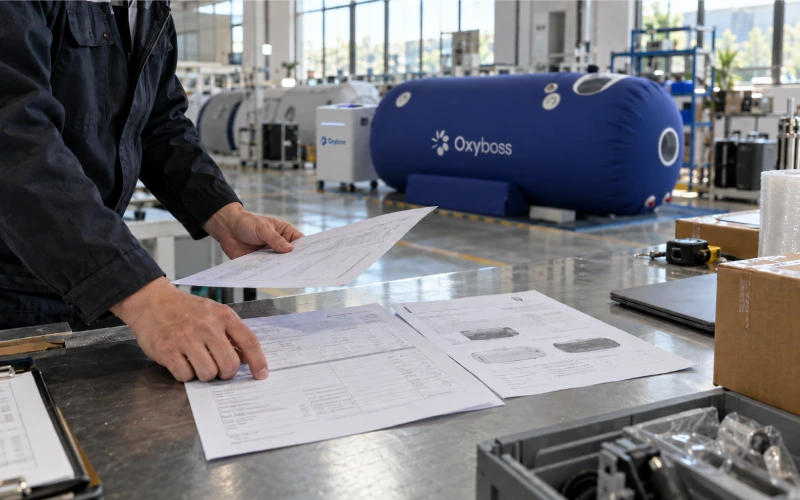
You booked the container. You paid the deposit. Then customs holds your chamber at the port and asks why the number on your invoice does not match the number on your bill of lading.
That is the situation this page is written to prevent.
We build non-medical, wellness-purpose hyperbaric chambers — soft-shell enclosures used for relaxation, recovery, and sleep support. This is not a buyer’s guide, not a clearance manual, and not legal advice. This is a straight look at which fields on which documents have to say the same thing, from the side of the people who actually write those documents: the factory.
If one field is off, the paperwork is not “wrong” in the abstract. It just fails to match. That single failure is what gets a shipment held.
The paperwork bundle — and why “having it all” is not the point
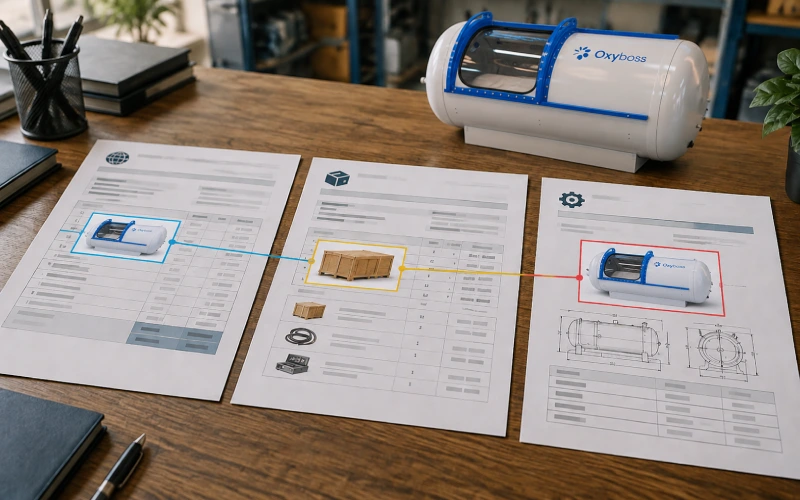
Every hyperbaric chamber shipment moving into the United States travels with a standard document bundle. Nothing here is a secret:
- Commercial invoice
- Packing list
- Bill of lading (or air waybill)
- Certificate of origin
- Manufacturer’s declaration / product specification sheet
- Data plate / nameplate on the physical unit
- Entry filing submitted to CBP by the importer of record or broker
- Any product-marking on the outer carton
Having the bundle is table stakes. It does not clear your shipment.
What clears the shipment is that every field appearing on more than one document says the same thing. That is the part almost no page online spells out. So that is what the rest of this page is about.
U.S. Customs and Border Protection puts it plainly in its own guidance: importers are responsible for using “reasonable care” to file entries with information that is complete, accurate, and consistent across all supporting documents.[^1] The FDA states the same principle for import entry data: “If the information submitted does not match, the FDA may gather additional information or may detain the product.”[^2]
That word — match — is the whole game.
The eight fields that actually cause holds
1. Product description — the same words everywhere
The plain-English description on your invoice is the first thing a customs officer reads. It has to say the same thing on the packing list, on the bill of lading, and on the entry.
Not “similar.” The same.
If your invoice says “Soft-shell hyperbaric chamber, portable, wellness use,” your packing list cannot say “Hyperbaric oxygen unit” and your bill of lading cannot say “Pressure oxygen equipment.” Those are three different things to a reviewing officer. Even if all three describe the same box, the mismatch triggers a request for information, which stops the container.
Pick one description. Use it everywhere. Nobody paraphrases.
2. Intended-use wording — the single most sensitive line
This is the field that decides whether your shipment is treated as a wellness product or pulled into a different regulatory lane entirely. It is also the field most likely to be inconsistent, because different people write different documents.
Our rule internally: the intended-use sentence is copy-pasted, not rewritten. The same string appears on the invoice, on the product spec sheet, on the carton label, on the manual, and on the website product page.
For our chambers that sentence reads, verbatim: “For personal wellness, relaxation, and recovery use. Not intended to diagnose, treat, cure, or prevent any disease. Consult a physician before use.”
That sentence is not marketing. It is a classification anchor. The moment one document says “therapy” and another says “wellness,” you have created a contradiction on your own paperwork. Nobody at the port did that. You did.
The FDA is direct about this: entry data must match the product’s actual intended use, and inconsistencies are grounds for detention.[^2] The Federal Trade Commission separately holds you responsible for the wording used to describe the product to consumers.[^3] So the same sentence has to survive both readings.
3. Model number and serial number
Model number goes on the invoice, the packing list, the entry filing, and the data plate. It has to be character-identical everywhere. HC-3000 is not the same string as HC 3000 or HC3000. Spaces, dashes, and case matter, because the entry filing is machine-read.
Serial numbers are per-unit. If you ship five units, your invoice and packing list list five serials, and each of those five serials is stamped on that unit’s data plate. Cross-check before the container closes. A serial on a plate that does not appear on the packing list is a mismatch, even if you shipped the right number of boxes.
4. Country of origin — the same country, in every language
Country of origin has to appear on the invoice, the packing list (implicitly, through the marked cartons), the certificate of origin, the data plate, and the entry.
Two things go wrong here.
First, the marking on the physical product has to match the marking on the paperwork. If the data plate reads “Made in China” and the certificate of origin says “People’s Republic of China,” those are the same country but not the same string. Some ports accept the equivalence; some do not. Pick one form and use it on every document and on the plate itself.
Second, if the chamber contains components substantially transformed in a different country, the country of origin is the country of final substantial transformation — not the country where the last screw went in. The legal framework for this is set out in 19 U.S.C. § 1304 and 19 C.F.R. Part 134.[^4][^5] If you are unsure, the correct move is a binding ruling request from CBP under 19 C.F.R. § 177.2 before you ship, not a guess on the invoice.[^6]
5. HTS classification — one code, on the invoice and on the entry
The Harmonized Tariff Schedule code appears on the commercial invoice and on the entry filing. Those two have to match.
The relevant U.S. tariff heading for apparatus designed for oxygen or ozone therapy is 9019.20 in the Harmonized Tariff Schedule.[^7] The full 10-digit statistical suffix depends on the specific configuration of the unit, and the correct move for any specific model is to request a binding ruling from CBP rather than guess.[^6] We do not publish a full 10-digit code here because that number is model-specific and any code we quoted would be misleading for someone else’s product.
What you can and should do: pick the code, put it on the invoice, put it on the entry, and make sure your product description supports that code. Filing under 9019.20 with an invoice that describes the product as “recreation equipment” is an internal contradiction, even though both fields are technically populated.
6. Manufacturer name and address — one legal entity
The manufacturer name has to match on the invoice, the packing list, the certificate of origin, the data plate, and the entry. One legal name. One address.
If your factory is legally “XYZ Health Technology Co., Ltd.”, the data plate cannot read “XYZ Wellness” and the invoice cannot read “XYZ Health Tech.” Those are three names on one shipment.
The importer of record is a separate role. If you sell to a U.S. distributor and that distributor is the importer of record, the distributor’s name goes on the entry — not on the data plate. Do not conflate the two. Distributors sometimes ask factories to omit or change the manufacturer name to hide sourcing. Do not do this. Country-of-origin marking under 19 C.F.R. Part 134 requires the ultimate purchaser to be able to see the country of origin at the time of purchase; obscuring the manufacturer risks marking violations.[^5]
7. Quantity, weight, and value — the numbers have to add up
Quantities are the easiest field to fail on, because three different people fill in three different documents.
- Invoice quantity = packing list quantity = bill of lading piece count.
- Weight declared on the bill of lading = total weight on the packing list.
- Value on the invoice = value declared on the entry.
If one line says 5 units and another says 5 cartons, that is not the same thing — 5 units in 3 cartons is a mismatch even if both numbers look “close.” Line-item math has to be complete: unit price × quantity = extended value, and the sum of extended values = invoice total. Rounding errors of a few dollars are enough to trigger a manual review on high-value shipments.
8. The data plate — the source of truth on the physical unit
The data plate is stamped on the chamber itself. It cannot be edited after the container ships. Which means everything else has to agree with the plate — not the other way around.
Our plates carry, at minimum:
- Manufacturer legal name and address
- Model number
- Serial number
- Date of manufacture
- Maximum working pressure (in kPa and PSI)
- Country of origin
- A batch/lot identifier
If any of those numbers on the plate does not match the corresponding field on the paperwork, the paperwork is wrong — you cannot re-stamp a plate to fix a document. Build the paperwork off the plate, not the other way round.
What actually happens when a field does not match
A mismatch does not usually mean seizure. It means delay.
The typical sequence is:
- Entry is filed.
- A screening system flags an inconsistency — most often between the invoice description and the HTS code, or between the country-of-origin marking and the certificate of origin.
- CBP issues a CF-28 (Request for Information) to the importer of record.[^1]
- The container sits in a bonded warehouse. Demurrage clocks starts.
- The importer responds. If the response is satisfactory, release. If not, a CF-29 (Notice of Action) follows, and the entry may be liquidated at a higher duty rate or the goods refused entry.
The costs stack fast: demurrage, storage, broker time, and — if the goods are ultimately refused — return freight or destruction. None of it comes out of the factory’s pocket directly, but it burns the relationship with your U.S. buyer, and the buyer’s next order goes to whoever’s paperwork was clean.
That is why we treat document consistency as a factory-side responsibility, even though we are not the importer of record.
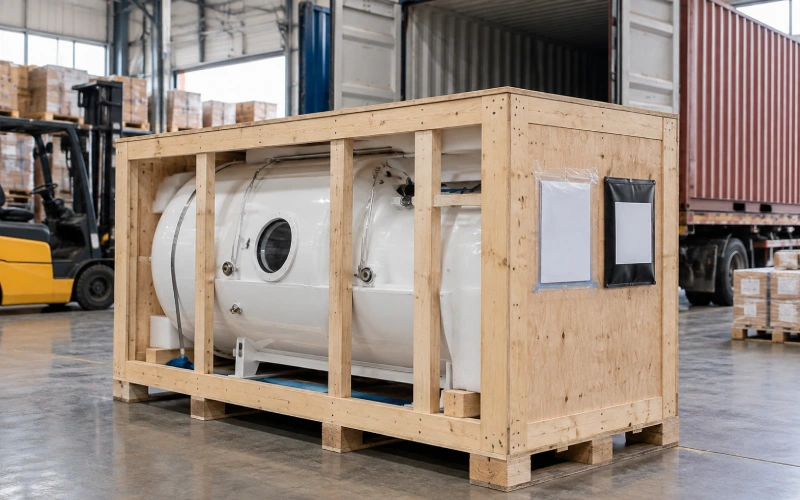
A short pre-ship checklist we run before every U.S. container
You are welcome to steal this. Nothing on it is proprietary.
- [ ] One product description string. Same words on invoice, packing list, bill of lading, entry.
- [ ] One intended-use sentence. Same words on invoice, spec sheet, carton label, manual, website.
- [ ] Model number is character-identical everywhere (spaces, dashes, case).
- [ ] Serial number per unit appears on invoice, packing list, and the physical data plate.
- [ ] Country of origin is the same string on invoice, certificate of origin, data plate, carton marking.
- [ ] Manufacturer legal name is the same on invoice, certificate of origin, data plate, entry.
- [ ] Quantity: invoice = packing list = bill of lading piece count.
- [ ] Weight: bill of lading = packing list total.
- [ ] Value: invoice total = entry value.
- [ ] HTS code on invoice = HTS code on entry, and the product description supports the code.
- [ ] Incoterms on invoice = incoterms in the sales contract = incoterms in shipping instructions.
- [ ] Carton marking shows country of origin, visible without opening the box.
- [ ] Every document uses the same date format (avoid mixing MM/DD/YYYY and DD/MM/YYYY).
- [ ] Currency is spelled out on the invoice (USD, not “$”).
- [ ] Manufacturer, importer of record, and consignee are three separate lines, none of them collapsed.
If any box is unchecked, the container does not leave.
Common questions we get from U.S. buyers
Do these chambers require FDA clearance to import?
Our chambers are wellness products, not clinical apparatus. We do not make disease-treatment claims. The regulatory status of any specific import is a determination for the importer of record and their customs broker, using the actual product configuration and labeling. If you need certainty for your specific import, request a written determination from your broker or a binding ruling from CBP.[^6]
Who is responsible for the paperwork — the factory or the importer?
Legally, the importer of record is responsible for the entry filing.[^1] Practically, most of the source data on that filing (product description, model, serial, HTS, origin, manufacturer) comes from the factory. If our data is inconsistent, the importer’s filing is inconsistent. So we treat consistency as our job.
What if a document already shipped with an error?
Correct it before the container arrives, in writing, to the importer and the broker. A corrected invoice attached to a Post-Entry Amendment is far cheaper than a CF-28 response after the container is on hold.
Do you supply a certificate of origin?
Yes, for every U.S. shipment. It is signed on our letterhead, matches the invoice line-for-line, and states the country of origin in the same string used on the data plate and the carton marking.
Can we use our own commercial invoice template?
Yes, and we recommend it. What we insist on is that the field values we supply — description, model, serial, quantity, origin, manufacturer, HTS, intended-use — appear on your template verbatim. Reformatting the layout is fine. Rewriting the values is not.
The one-line summary
Customs does not fail your shipment because your paperwork is wrong. It fails your shipment because your paperwork contradicts itself. The fix is upstream, on the factory floor, before the container closes — not downstream at the port.
If you want a copy of our pre-ship checklist as a fillable form, or want to discuss a specific shipment, get in touch.
Sources
[^1]: U.S. Customs and Border Protection, “Importer Responsibilities” and “Basic Importing and Exporting.” https://www.cbp.gov/trade/basic-import-export
[^2]: U.S. Food and Drug Administration, “Importing Medical Devices and Radiation-Emitting Products into the United States.” https://www.fda.gov/medical-devices/importing-and-exporting-medical-devices/importing-medical-devices-and-radiation-emitting-electronic-products-united-states
[^3]: U.S. Federal Trade Commission, “Health Products Compliance Guidance.” https://www.ftc.gov/business-guidance/resources/health-products-compliance-guidance
[^4]: 19 U.S.C. § 1304 — Marking of imported articles and containers. https://www.govinfo.gov/app/collection/uscode/
[^5]: 19 C.F.R. Part 134 — Country of Origin Marking. https://www.ecfr.gov/current/title-19/chapter-I/part-134
[^6]: 19 C.F.R. § 177.2 — Procedures for issuance of rulings and other advice. https://www.ecfr.gov/current/title-19/chapter-I/part-177
[^7]: U.S. International Trade Commission, Harmonized Tariff Schedule of the United States (heading 9019). https://hts.usitc.gov/