The phrase “tanks, concentrators, or all-in-one” sounds like a three-way choice. It isn’t. It’s three different questions, stacked on top of each other, and the hard part is pulling them apart before you pick anything. One question is where the oxygen comes from. Another is where it goes once it’s in the room. The third is how much of the system the manufacturer owns, and how much you own. Pick one answer from each and you have a working setup. Treat it as a single pick and you lose the middle question entirely, which is the one that tends to decide the rest.
The rest of this page unpacks those three in order, then adds the thermal piece that doesn’t fit any of them, closes with how to verify any number on any spec sheet, and lists the citations.
1. Where the oxygen comes from
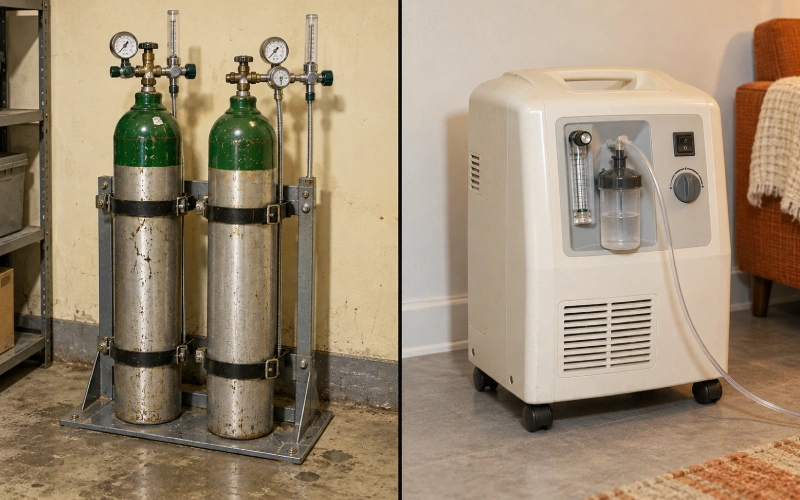
Two legitimate sources sit at this layer. The first is oxygen cylinders — tall metal bottles of medical-grade compressed oxygen, usually around 2,200 psi, hooked to a regulator and feeding a mask. When one empties you swap it. A D-size cylinder, running at a conservative 2 L/min, lasts about three and a half hours. The second is oxygen concentrators — a plug-in appliance that pulls room air, pushes it through zeolite sieve beds (the step called pressure-swing adsorption, or PSA), and outputs a stream that is roughly 90–96% oxygen at low flow. No refills, no delivery driver, no bottle in a closet.
Both work. The practical gap sits in logistics and ongoing cost rather than in the oxygen itself.
| Factor | Cylinders | Concentrators |
|---|---|---|
| Oxygen source | External, bought by the tank | Made on-site from room air |
| Refill logistics | Scheduled deliveries, driver, physical swap | None, after purchase |
| Storage profile | Pressurized bottles, upright, braced, away from heat | Appliance-sized box next to the chamber |
| Fuel-rich hazard footprint | Higher — a stored tank is a stored oxidizer | Lower — gas is produced only while the device runs |
| Ongoing cost | Refills and delivery | Electricity and filter changes |
| Fit for daily home sessions | Workable, with logistics overhead | Fewer moving parts in daily use |
Cylinders are the long-standing option in a clinic setting, and nothing about them is wrong. For sessions at home, several times a week, the logistics tilt the other way. That’s the whole case.
2. Where the oxygen goes — the question that gets skipped
This is the middle question, and the one that changes everything downstream.
Two architectures exist. The first, cabin-fed, fills the whole chamber with oxygen; the person inside breathes the cabin air. This is how classic single-person clinical monoplace chambers run, with pure oxygen pressurizing the shell. The second, mask-fed, pressurizes the cabin with regular compressed room air and delivers oxygen separately through a mask or built-in breathing system (BIBS). The person inside breathes oxygen; the cabin stays close to normal atmospheric composition.
The reason the distinction matters has nothing to do with comfort or convenience. It has to do with fire. A sealed space with oxygen above a certain fraction behaves as a fuel-rich atmosphere. U.S. workplace-safety law puts specific numbers on where that line sits: OSHA’s shipyard rule classifies atmospheres at or above 22.0% oxygen as oxygen-enriched (29 CFR 1915.12). OSHA’s permit-required confined-space rule draws the same line at 23.5% (29 CFR 1910.146(b)(3)). Those are occupational-safety thresholds written for workplaces, not consumer-equipment certifications for home chambers. They are useful here as reference numbers for what “an enriched atmosphere” means in the law that uses that term, and the physics behind them doesn’t change when the space is a backyard room instead of a shipyard tank.
A cabin-fed design, by definition, lives above those thresholds — the whole box is oxygen. A mask-fed design is engineered to stay below them. The intent is for the cabin to sit close to normal atmospheric composition and the oxygen to stay inside the breathing loop; whether that intent holds in a given installation depends on seal integrity, exhaust path, and whether the cabin side is actually monitored. That single architectural choice decides what total oxygen flow the system needs to push, where fire-safety attention concentrates, and what the word “purity” even refers to on the spec sheet. In a cabin-fed arrangement every change-of-air inside the whole chamber is oxygen, so the oxygen-side flow is throttled hard enough to keep the cabin below the enrichment threshold — the exact number depends on cabin volume, leak rate, and ventilation, so no single figure applies to every design. In a mask-fed arrangement the oxygen only has to reach a face, so mask flows in the familiar supplemental-oxygen range are routine while the cabin side stays near room air. The 90–96% purity number on a concentrator spec sheet, in a mask-fed system, applies to the stream going into the mask — not to the air inside the chamber.
If one takeaway from this page: when a specification says “oxygen,” ask where it goes. That’s the fork.
3. What “all-in-one” actually means
“All-in-one” is the vaguest word in this category. The label gets applied to several different pictures of the same system, and the price gap between them is wide. A cleaner way to tell them apart is to drop the single word and break the system into three coordinates.
| Coordinate | What it answers | Values seen in the market |
|---|---|---|
| Oxygen source | Where does the oxygen come from? | Tanks, concentrator, hybrid |
| Oxygen path | Where does the oxygen go? | Cabin-fed, mask-fed |
| Integration layer | How much of the system is packaged by the manufacturer? | Separate boxes, pre-piped unit, enclosure-integrated |
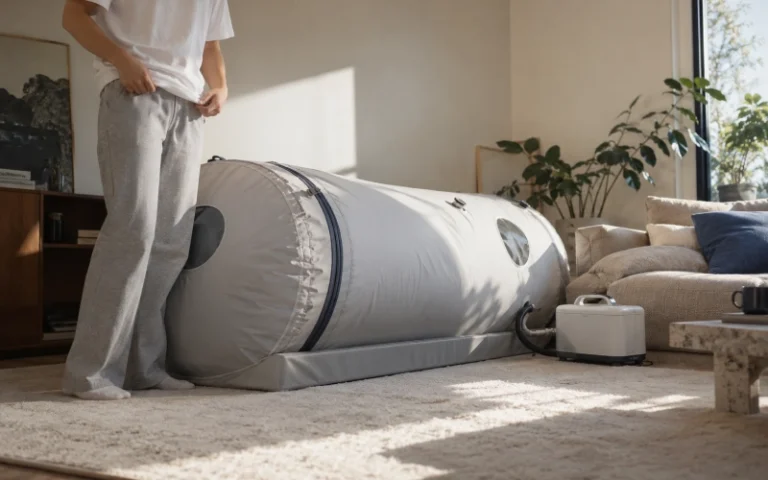
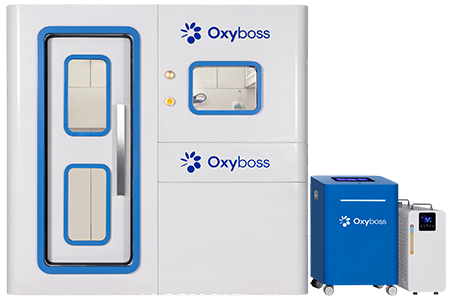
Any real product sits at one point in that three-dimensional grid. “All-in-one” by itself says nothing until the first two coordinates are also fixed. The setup we build, as a worked example, sits at concentrator / mask-fed / enclosure-integrated. Three coordinates filled, no ambiguity.
4. The piece those three coordinates still miss: heat
Here is what the coordinate system doesn’t capture, and what tends to be absent from the conversation entirely.
A hyperbaric chamber at 1.3–2.0 ATA stays at pressure for a typical session of around 60–90 minutes. Across that window the compressor is doing continuous work in most designs: pressure has to be held against seal leakage and user consumption, so new air flows in. Some systems manage this with continuous flow-through, others with intermittent cycling at a higher duty — the control strategy varies by model. What doesn’t vary is that whenever the compressor is running, compression generates heat. The adiabatic estimate for an ideal single-stage compression from a 20 °C starting point lays out the ceiling:
| Target pressure | Theoretical outlet air temperature |
|---|---|
| 1.3 ATA | ~43 °C |
| 1.5 ATA | ~56 °C |
| 2.0 ATA | ~84 °C |
Those are theoretical ceilings, with no inter-stage cooling. Real compressors cool between stages, so what actually enters the chamber is lower. The order of magnitude is the point, not the exact value — higher pressure means hotter supply air, every design, every time.
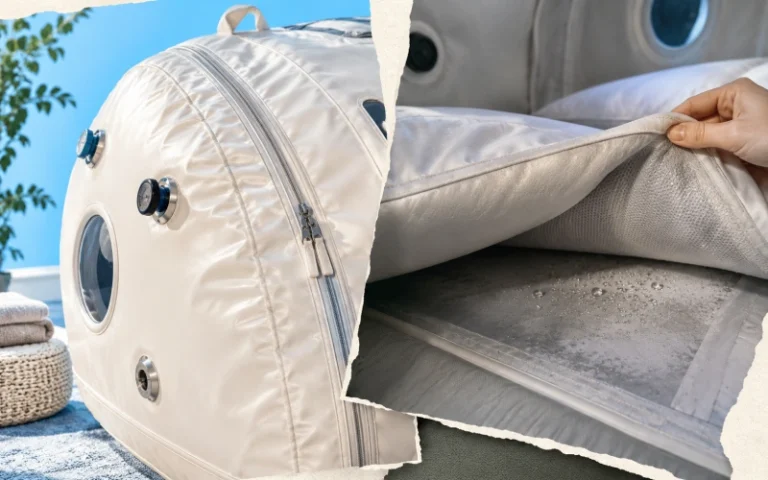
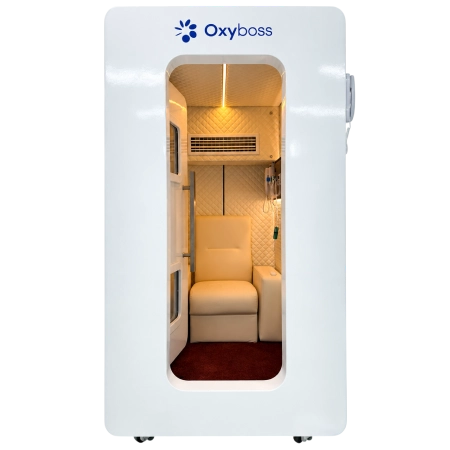
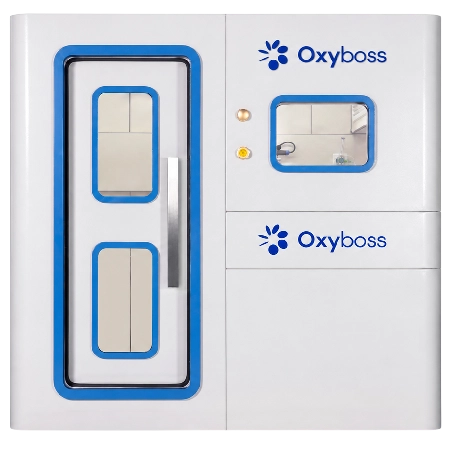
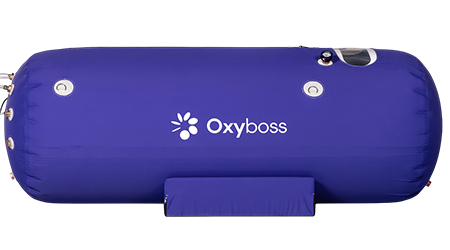
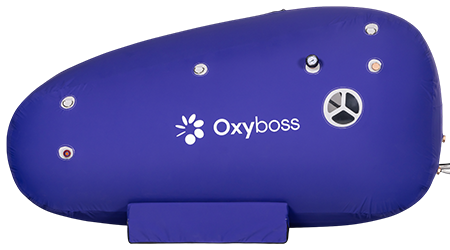
Where that heat ends up depends on the chamber body, the air-handling strategy, the compressor duty cycle, and the room the chamber sits in. As a rough physical pattern that we see repeatedly in the chambers we build: a soft-shell has a large flexible envelope and a high surface-area-to-volume ratio, so heat moves out through the shell and the exhaust port, and in our operating range passive dissipation carries the load without an added cooling stage. A hard-shell has rigid walls, a smaller surface-area-to-volume ratio, and higher operating pressures, so heat accumulates faster than the shell can shed it. In our line that leads to a split: soft-shell chambers offer active climate control as an option, hard-shell chambers include it as standard. This is a configuration decision for our models, not a universal rule — different cabin volumes, compressor duty cycles, and room-side ventilation can shift where the line falls. Where a chamber’s spec sheet doesn’t say what the cabin temperature does over a 60–90 minute session, that’s a worthwhile question to ask before buying.
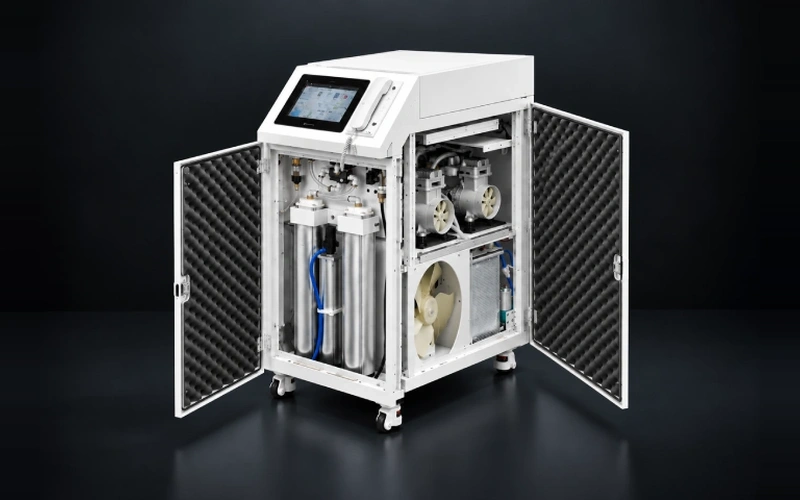
This is also the real argument for an integrated oxygen train. Integration isn’t about saving a few hours of setup time. It’s about who owns the thermal and air-handling envelope. In a separate-box arrangement the user owns room temperature, fresh-air exchange, noise, floor space, and the question of whether the compressor is exhausting hot air toward the chamber it’s feeding. In an enclosure-integrated arrangement, that envelope is specified and tested by the manufacturer. That shift of ownership is what the word “integration” is worth paying for. Scope, not convenience.
5. Pressure — three operating points, not three quality tiers
The three pressure settings commonly on offer — 1.3, 1.5, and 2.0 ATA — aren’t three quality tiers. They are three operating points, each with different engineering requirements for seal, flow, and thermal handling. 1.3 ATA sits in the lower-intensity end of the home-use range. 1.5 ATA is a middle operating point. 2.0 ATA is the upper end of what home-use chambers reach, and brings the thermal and flow demands laid out above. Which setting matches which use is a question for the user and their clinician, not for a product page.
A note on how the number gets interpreted. A standard clinical reference text, StatPearls (hosted on the NIH Bookshelf), characterizes hyperbaric oxygen therapy as taking place at pressures above 1.4 ATA. That’s a definitional threshold used in clinical literature. It isn’t a product-quality threshold for wellness use. A chamber running at 1.3 ATA isn’t “below spec”; it sits outside the clinical-protocol range by definition, which is a different statement.
Two separate things get mixed up regularly on this topic. One is chamber pressure, the ATA number on the spec sheet. The other is the inspired partial pressure of oxygen, called PiO₂ — the oxygen pressure in the gas entering the lungs — which depends on both the chamber pressure and the oxygen fraction being breathed. The working estimate, if useful: PiO₂ in mmHg is approximately (chamber ATA × 760 − 47) × fraction of oxygen breathed, where 47 mmHg accounts for water-vapor pressure at body temperature. At 1.3 ATA breathing room air, PiO₂ sits near 200 mmHg. At 1.3 ATA breathing roughly 93% oxygen through a well-fitting mask, that estimate climbs into the high 800s mmHg range. PiO₂ is the inspired number, before any adjustment for alveolar CO₂ or respiratory exchange — alveolar and arterial oxygen partial pressures are smaller, and depend on physiology, not on the chamber. The point of the arithmetic isn’t the exact figure; it is that the pressure dial alone doesn’t describe the exposure. The mask does a large share of the work.
6. How to size the flow
The common framing — “do I need a 5-liter or a 10-liter concentrator?” — reduces flow to the only variable. It isn’t. Five inputs together decide the right concentrator for a given setup:
- Where the oxygen goes. Mask-fed. If anyone offers a cabin-fed arrangement at the home-use range, the flow math is completely different and this list doesn’t apply.
- Mask type and fit. A nasal cannula at 2 L/min delivers very different inspired oxygen than a non-rebreather at the higher flows that type of mask typically runs. Masks also lose oxygen on the way to the user — room-air entrainment around the seal, exhalation back into the mask, and reservoir-bag dynamics all cut the fraction of delivered flow that actually gets inhaled. For a well-fitting non-rebreather, a conservative rule of thumb used in respiratory references puts the fraction of delivered oxygen that reaches the inspired breath somewhere near two thirds, with a wide published range (see the Breathe (Sheffield) review in the References). This is a delivery-efficiency figure, not an FiO₂ figure — the two are different quantities and shouldn’t be substituted for each other. Fit does more of the work than it looks like it should.
- Chamber pressure. Higher ATA means a smaller percentage boost from the same flow, in absolute PiO₂ terms, because the atmosphere inside the chamber is already denser.
- Session length. A 90-minute session with two short air breaks is standard, for reasons tied to delivery protocols, not to any limit of the oxygen supply.
- Steady-state purity at the stated flow. A concentrator rated “10 L/min” might deliver 90%+ at 6–8 L/min and drift toward the high 80s at full flow. Rated flow and rated purity are not independent numbers.
Rated flow on its own doesn’t describe compatibility. The pair “flow × purity at that flow” does.
7. Three concentrations that get mixed up
Keeping these three apart is the quickest way to read any oxygen-related spec sheet:
- Atmospheric oxygen — the fraction of oxygen in the air inside the room or inside the cabin. Normally 20.9%. The OSHA workplace thresholds for “oxygen-enriched” sit at 22.0% / 23.5%, as above. This is a cabin-side number.
- Supplied oxygen — the stream coming out of the concentrator, typically 90–96% at rated flow. This is a device-side number.
- Inspired oxygen — the actual fraction a person breathes in, after the mask has done whatever it’s going to do. This is a face-side number.
A product page that says “95% oxygen” without saying which 95% has left the most important column blank.
8. How to verify any of this without taking a seller at their word
None of this needs a lab. All of it can be done the week a chamber arrives, with hardware that costs less than a weekend of groceries.
- Measure outlet oxygen fraction at the mask port. A handheld oxygen analyzer runs under US$200. Run the concentrator at its rated flow for 15 minutes, then take the reading. Compare to the spec sheet.
- Confirm flow at the stated setting. An inline flow meter in the oxygen line, during a real session, catches undersized tubing, kinked lines, and over-optimistic ratings.
- Confirm pressure hold. Pump up to target ATA, note the time, and track how long the chamber holds within a defined band. A healthy system holds the setpoint; a leaky one drifts, and the compressor cycles continuously.
- Confirm temperature behavior. A battery-powered temperature logger placed inside the chamber across a full session shows what any cooling arrangement is actually doing. One caveat: any electronics taken inside a chamber should be approved by the manufacturer for the pressure and gas environment, since a mask-fed cabin is still at elevated pressure and local oxygen fractions near the mask port can be above room-air levels. Check the chamber manual before putting any battery device inside.
- Confirm regulatory status by specific model and clearance number. FDA Class II hyperbaric chambers are listed in the public FDA 510(k) database. Searching by product code (CBF, “Hyperbaric Chamber, Low Pressure”) and manufacturer returns the actual record. A 510(k) record is tied to a specific device and the use statement in its submission — a clearance on one model doesn’t automatically transfer to a different model, a reconfigured bundle, or a new intended use. “FDA cleared” against a specific record is a verifiable claim; vaguer phrasings aren’t.
A manufacturer willing to be measured against those five checks is holding the specification as a commitment. That’s the signal to look for.
9. What to put on a quote request
Short, mostly numbers.
- Concentrator rated flow and rated purity at that flow.
- Delivery device — mask (which type) or BIBS.
- Target ATA, and whether it’s the design maximum or the normal operating point.
- Compressor duty cycle at steady state — continuous or cycling — and noise level at that duty.
- Thermal management — active cooling, passive, or none; standard or optional on this configuration.
- FDA 510(k) number and product code for the chamber body.
- The specific compliance scope of any safety claim — which standard, which clause, measured where.
- Warranty terms, broken out separately for the concentrator, compressor, and chamber shell (service lives differ).
A quote that answers those eight cleanly is a complete quote. A quote that doesn’t is a quote in progress.
10. Where our line sits on all this
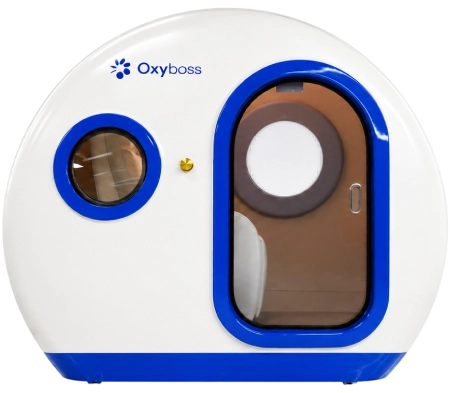
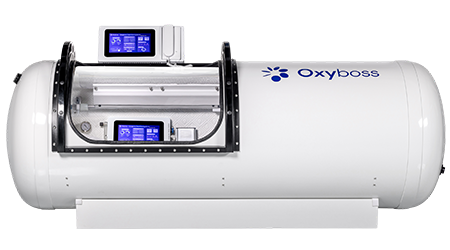
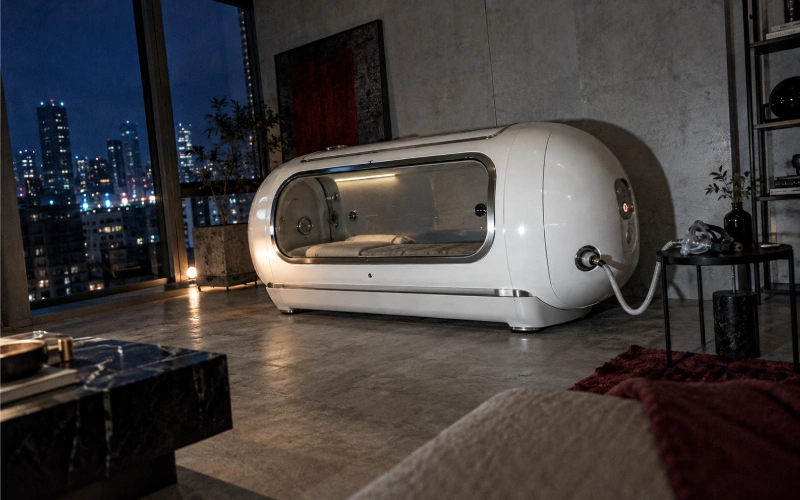
We build non-medical hyperbaric chambers for wellness use. Pressure range across our line is 1.3 to 2.0 ATA. Oxygen is produced on-site by an integrated concentrator and delivered through a mask or BIBS; the cabin is designed to stay close to normal atmospheric composition, with the oxygen path contained inside the breathing loop. On our hard-shell models, active climate control is standard; on our soft-shell models it’s available as an option. The split follows the structural pattern described in Section 4 for our configurations, and is not offered as a universal rule for every chamber on the market. The oxygen train, compressor, and climate module are packaged into the chamber enclosure, so the thermal and air-handling envelope is defined and tested on our side rather than left to the installation room.
We don’t sell therapy and don’t make clinical claims. The product is a chamber that pressurizes, a concentrator that produces, a loop that delivers, and a thermal envelope that keeps a 90-minute session comfortable. Whether to use it, and for what, stays with the user and their clinician.
For readers evaluating a configuration: pass the five verification checks in Section 8 through our quote, and anything that doesn’t survive the check gets fixed before shipping. Readers in a distribution or reseller role can request the full configuration-and-check sheet directly; it’s the same document used internally, with model numbers and clearance references.
FAQ
Can a standard home oxygen concentrator be connected to a hyperbaric chamber?
Mechanically, many of them connect without trouble. Operationally, home-use concentrators are designed to put out low continuous flow (1–5 L/min) through a nasal cannula; at the higher flow a mask-fed hyperbaric setup actually asks for, their rated purity drops. The limiting number is purity-at-flow, not the “L/min” badge on the front panel.
Is 1.3 ATA actually doing anything?
“Enough” is the wrong frame. 1.3 ATA is simply a lower operating pressure than 1.5 or 2.0 ATA, and sits outside the ≥1.4 ATA threshold used to define hyperbaric oxygen therapy in clinical literature. Whether a given pressure matches a given use is a question for the user and their clinician; the point of the arithmetic in Section 5 is only that the dial setting alone doesn’t describe the exposure — the oxygen fraction at the mask does a large share of the work on top of whatever ATA is on the chamber.
Why does a hard-shell model cost more than a soft-shell at a similar pressure?
Three factors, roughly in order of weight. First, the pressure vessel itself: heavier gauge, rated construction, certified fittings. Second, the thermal and air-handling package — active cooling, acoustically insulated compressor, enclosed oxygen train. Third, the duty profile: hard-shell units are designed for daily use at the top of the pressure range. None of that is captured by the ATA number alone.
What is the single safety fact worth knowing?
Oxygen enriches any atmosphere it’s released into. The OSHA workplace thresholds for “oxygen-enriched” are 22.0% (shipyard rule) and 23.5% (confined-space rule), well under the 90–96% a concentrator produces. A mask-fed design keeps the cabin close to normal composition by design — the oxygen is intended to stay inside the breathing loop — but that outcome depends on seal integrity, exhaust routing, and ideally some monitoring. Anything that lets the oxygen escape into the surrounding room — a leaking fitting, a running mask set down on a bench, a saturated garment — raises the local oxygen fraction nearby. Fittings and operational habits do a lot of the work here, and the FDA’s letter to health-care providers (cited below) makes the same point in the clinical context: ignition sources, grounding, and operator procedure matter.
Is “FDA cleared” the same thing people mean when they say “FDA approved”?
Not quite. Low-pressure hyperbaric chambers for home use are typically Class II devices that reach the market through the 510(k) pathway. That pathway produces a clearance record, which is different from a drug-style approval. The relevant record (product code, clearance number, manufacturer) is public on the FDA 510(k) database — see the Verification section above and the citation below. A listing records what the device is cleared for; it is not an endorsement of any outcome claim.
References
- U.S. Food and Drug Administration. Follow Instructions for Safe Use of Hyperbaric Oxygen Therapy Devices: Letter to Health Care Providers. https://www.fda.gov/medical-devices/letters-health-care-providers/follow-instructions-safe-use-hyperbaric-oxygen-therapy-devices-letter-health-care-providers
- U.S. Food and Drug Administration. 510(k) Premarket Notification Database. Searchable by product code (CBF for Hyperbaric Chamber, Low Pressure) and by manufacturer. https://www.accessdata.fda.gov/scripts/cdrh/cfdocs/cfpmn/pmn.cfm
- Occupational Safety and Health Administration. 29 CFR 1915.12 — Precautions and the order of testing before entering confined and enclosed spaces and other dangerous atmospheres (shipyard employment). https://www.osha.gov/laws-regs/regulations/standardnumber/1915/1915.12
- Electronic Code of Federal Regulations. 29 CFR 1910.146 — Permit-required confined spaces (definition of oxygen-enriched atmosphere at §1910.146(b)(3)). https://www.ecfr.gov/current/title-29/subtitle-B/chapter-XVII/part-1910/subpart-J/section-1910.146
- Hardavella G, Karampinis I, Frille A, Sreter K, Rousalova I. Oxygen devices and delivery systems. Breathe (Sheffield), 2019;15(3):e108–e116. PubMed Central article. https://www.ncbi.nlm.nih.gov/pmc/articles/PMC6876135/
- MedlinePlus — U.S. National Library of Medicine. Oxygen Therapy. https://medlineplus.gov/oxygentherapy.html
- Jain KK, Mathieu D, et al. Hyperbaric Oxygen Therapy — Indications and Protocols. StatPearls, National Center for Biotechnology Information Bookshelf, National Library of Medicine. https://www.ncbi.nlm.nih.gov/books/NBK441893/
- National Fire Protection Association. NFPA 99 — Health Care Facilities Code (chapter 14, Hyperbaric Facilities). Access via NFPA. https://www.nfpa.org/codes-and-standards/all-codes-and-standards/list-of-codes-and-standards/detail?code=99