Disclaimer: This content is for general informational and educational purposes only. It does not constitute medical advice, diagnosis, treatment, or a prescribed wellness protocol. Always consult a qualified healthcare professional before beginning or changing any wellness routine, especially if you have pre-existing health conditions. Always use any chamber in accordance with the manufacturer’s instructions and safety guidance.
The real answer is not a number pulled from thin air. A practical schedule depends on your chamber’s pressure range, your comfort level, your manufacturer’s instructions, and whether you can follow a routine consistently for weeks rather than just a few days.
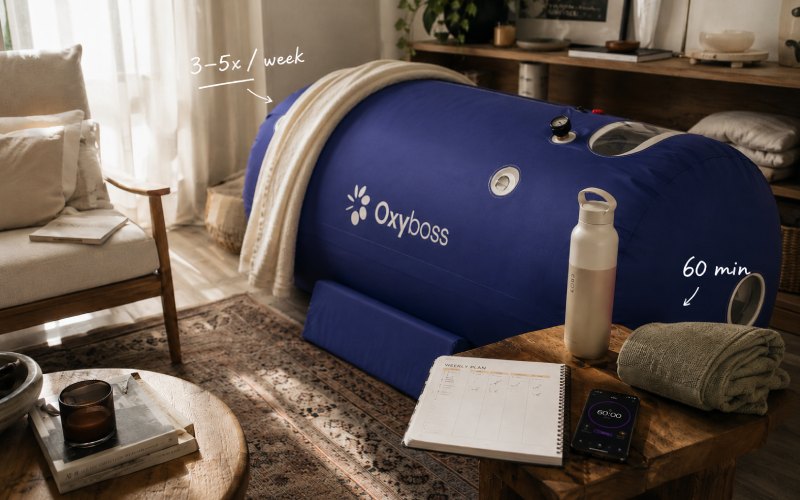
Quick answer: Many home users choose 3–5 sessions per week, 60 minutes per session, at mild pressures such as 1.3 to 1.5 ATA, subject to device instructions and professional guidance. Wellness facilities often use a 5-days-on, 2-days-off schedule for convenience and consistency. After an initial block, some users reduce frequency to 1–3 sessions per week for ongoing routine use.
What follows is a practical scheduling guide based on common usage patterns in home and wellness settings, not a medical treatment plan.
Why Session Frequency Often Comes Down to Consistency
For most people, consistency matters more than chasing an exact number. A routine that you can realistically maintain is usually more useful than an aggressive schedule you abandon after a week or two.
That is one reason sporadic use—once every ten days, whenever you remember—tends to be less useful from a routine-building standpoint. Irregular use also makes it harder to evaluate comfort, convenience, and whether the schedule fits your lifestyle.
A helpful mental model: the first several sessions are often about becoming familiar with the chamber, the setup, and your preferred schedule. After that, you can decide whether to keep the same rhythm, reduce it, or pause and reassess.
Recommended Hyperbaric Chamber Frequency by Use Case
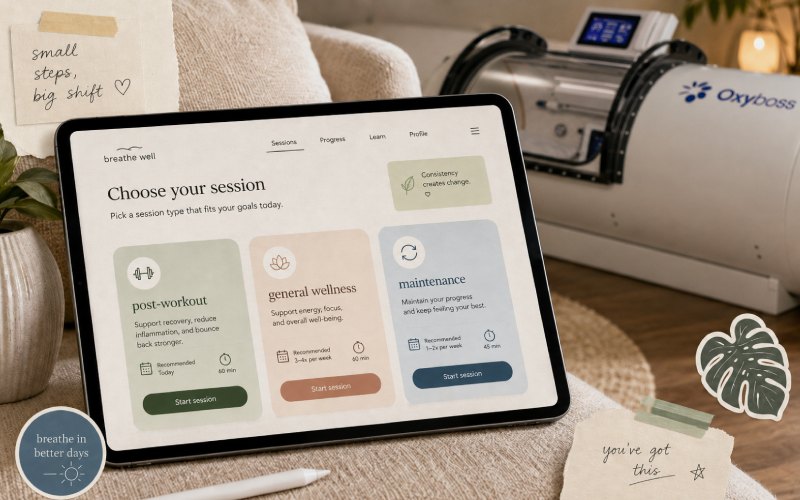
Here is a general breakdown often used by home users and wellness facilities for scheduling purposes:
| Use Case | Suggested Frequency | Typical Duration Per Session | Typical Session Block |
| Post-workout routine | 3–5 times per week | 60 minutes | Ongoing / cyclical |
| Short-term intensive routine | 5 times per week (weekdays) | 60–90 minutes | 10–20 sessions |
| General wellness routine | 2–3 times per week | 60 minutes | 20–40 sessions, then adjust |
| Longer-term routine | 3–5 times per week | 60–90 minutes | 30–60+ sessions |
| Maintenance after an initial block | 1–2 times per week | 60 minutes | Ongoing |
A few notes on this table: the five-days-on, two-days-off rhythm is common because it is simple, easy to schedule, and practical for many users. Weekend breaks can also be helpful for comfort, routine management, and equipment rest cycles, depending on the unit.
These are general scheduling examples, not medical prescriptions.
How Owning a Chamber vs. Booking Sessions Changes Your Frequency
This matters more than people realize.
If you are booking at a wellness facility, you are naturally limited by availability, location, and per-session cost. That often leads to fewer sessions spaced farther apart.
If you own a chamber, the scheduling barrier drops considerably. Many home users settle into four to five sessions per week during an initial block and then taper to two or three sessions per week for ongoing use. Convenience often has a bigger impact on frequency than theory does.
How Chamber Pressure Can Affect Session Frequency
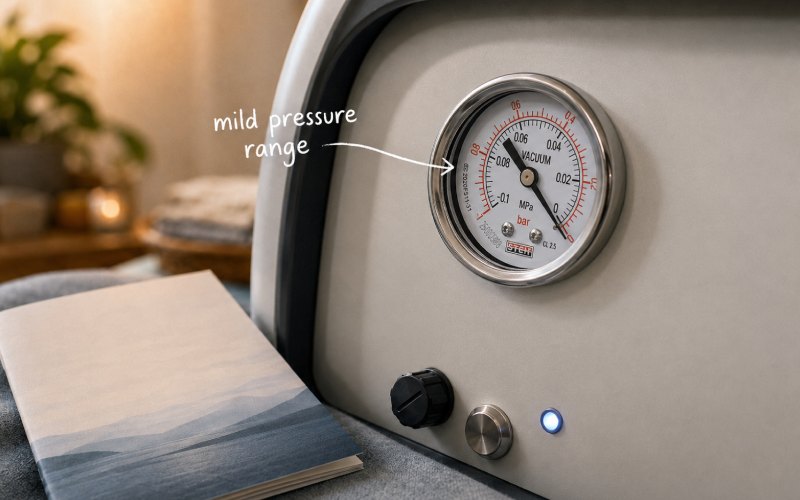
Frequency and pressure are connected. A session at 1.3 ATA is not the same experience as a session at 2.0 ATA, and higher-pressure units may call for a different pace depending on the device, the setting, and the user’s comfort.
At 1.3 to 1.5 ATA—which covers many home chambers and wellness units—regular use is often manageable for many users when they follow device instructions.
At higher pressures, some users prefer a more conservative schedule because of comfort considerations, especially around ear equalization and pressure changes. In those settings, a five-on, two-off rhythm can be a practical way to structure the week.
Whatever the chamber type, smooth pressurization, proper safety procedures, and adherence to the manufacturer’s instructions matter more than trying to force an aggressive schedule.
Why More Sessions Per Week Is Not Always Better
There is a temptation—especially among routine-driven users—to assume that more sessions automatically mean a better routine.
In practice, pushing beyond five sessions per week can make a schedule harder to sustain. It can also add unnecessary wear to the equipment and turn a manageable habit into a burdensome one.
For most home users, a steady, realistic weekly routine is more practical than an intensive schedule that is difficult to maintain. If someone is considering more frequent use, it should still remain within the device guidance and any advice provided by a qualified healthcare professional.
Hyperbaric Session Schedule: A 9-Week Framework
The best frequency is usually the one you can maintain consistently and comfortably.
Weeks 1–4: Commit to the highest frequency you can realistically sustain. For many people, that is three to five sessions per week. A 60-minute session is a practical starting point for many non-medical wellness routines.
Weeks 5–8: Evaluate the routine. Is it comfortable? Is it convenient? Are you able to keep up with it consistently? If so, you may continue at the same pace or reduce to two to three sessions per week if that better fits your schedule.
Week 9 onward: Settle into a maintenance cadence that feels sustainable. For many users, one to three sessions per week is easier to maintain over the long term than a more aggressive schedule.
If you take a longer break, many users simply restart gradually rather than jumping straight back into a full schedule.
When to Skip a Session: Safety Pause Triggers
Talking about frequency without covering when to pause would be incomplete. Here are situations where it is generally wise to skip a session and seek appropriate guidance:
Upper respiratory congestion or sinus blockage. If you cannot comfortably equalize ear pressure, do not enter the chamber. Pressurizing with blocked sinuses can increase discomfort.
Active fever or feeling unwell. If you are sick, it may be better to pause and resume when you are feeling normal again.
Untreated pneumothorax or recent thoracic procedures. Do not use a pressurized environment without medical clearance.
Claustrophobia or acute anxiety. If you are having a particularly difficult day mentally, skip the session and return when you feel more comfortable.
Immediately after scuba diving. It is generally prudent to wait at least 24 hours before using a pressurized chamber.
The point is not to make people nervous about the equipment. It is to make sure the chamber is used under appropriate conditions and according to safe operating guidance.
FAQ
Can I use a hyperbaric chamber every day?
Some users at mild pressures follow a five-days-on, two-days-off routine. Whether daily use is appropriate depends on the device, its instructions, the pressure range, and the user’s comfort.
How many sessions before I notice a difference?
That varies widely from person to person, and some users may notice very little day to day. Rather than chasing a specific number, it is usually better to focus on consistency, comfort, and a schedule you can realistically maintain.
Is there such a thing as too much hyperbaric chamber use?
An overly aggressive schedule can be uncomfortable, difficult to sustain, and unnecessary for many people. Staying within the device guidance and using a realistic weekly routine is usually the better approach.
Should I use the chamber before or after a workout?
Many users prefer to schedule sessions after a workout or on rest days simply because it fits their routine better. Either way, the most important factor is using the chamber according to the device instructions and your overall schedule.
How does session frequency change for older adults?
It does not always need to change dramatically. Some users simply prefer shorter sessions—for example, 45 minutes instead of 60—for comfort. A conservative starting schedule can make sense for anyone new to the routine.
Can two people share a home chamber on the same daily schedule?
Often yes, provided the unit is designed for repeated use and there is adequate time between sessions for venting, checks, and any cooling period recommended by the manufacturer.
What happens if I stop using the chamber for a month?
Many users who take a longer break simply restart gradually. A short pause does not necessarily mean you need an extreme catch-up schedule.
When should I NOT use a hyperbaric chamber?
Skip your session if you have congestion that prevents comfortable ear equalization, an active fever, untreated chest or lung issues, or if you have been scuba diving within the past 24 hours. When in doubt, consult your physician before resuming use.
Disclaimer
Hyperbaric chambers should be used in accordance with the manufacturer’s instructions and applicable safety guidance. The information in this article is provided for general educational purposes only and does not replace professional medical advice.
Your schedule should serve your routine, not the other way around. Start conservatively, stay consistent, adjust based on comfort and practicality, and keep your expectations realistic.