
Few topics in modern wellness and recovery science have attracted as much attention as the relationship between hyperbaric chamber stem cells research and what it may mean for the future of recovery-focused protocols. Over the past two decades, a growing body of published research has explored how breathing oxygen under increased atmospheric pressure may influence the behavior of stem and progenitor cells — the body’s own internal repair workforce.
This article explains the core principles behind this connection. Rather than making promises, the goal here is to provide biological context, walk through the key mechanisms that researchers have identified, and help you understand why hyperbaric chambers have become such a prominent feature in wellness centers, recovery studios, sports performance facilities, and home wellness environments around the world.
The Basics: What Happens Inside a Hyperbaric Chamber
A hyperbaric chamber creates a pressurized environment in which the user breathes air or oxygen-enriched air at pressures above normal atmospheric levels. Standard atmospheric pressure at sea level is defined as 1.0 ATA (atmosphere absolute). Inside a hyperbaric chamber, this pressure is increased — commonly to levels between 1.3 and 2.0 ATA, depending on the system and its intended application.
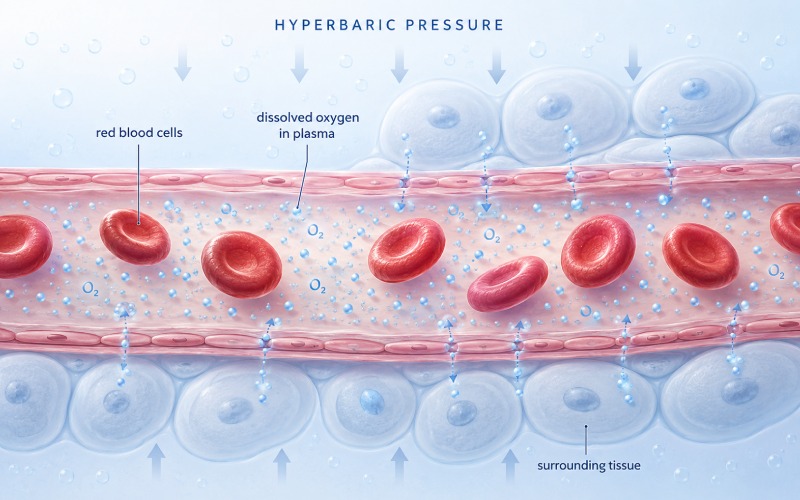
This increase in pressure has a direct physical consequence governed by well-established gas laws. Under higher pressure, more oxygen dissolves into the blood plasma, cerebrospinal fluid, and interstitial fluids throughout the body. This is not simply about breathing more oxygen — it is about increasing oxygen availability in body fluids at the molecular level. Under normal conditions, oxygen delivery depends largely on hemoglobin in red blood cells. In a pressurized environment, dissolved oxygen in the plasma itself becomes a meaningful delivery pathway, helping oxygen reach areas that may otherwise receive limited oxygen supply.
As noted in published literature, sessions carried out at pressures of 2.0 ATA and above can produce substantial elevations in tissue oxygen tension — far beyond what normal breathing achieves 1. Even at more modest pressures, such as 1.27 ATA with room air, researchers have calculated meaningful increases in oxygen partial pressures and observed measurable biological responses 2.
In plain terms: a hyperbaric chamber can increase the amount of oxygen dissolved in blood and body fluids compared with normal atmospheric breathing. The higher the pressure, the more oxygen can dissolve — and that oxygen may reach places it normally reaches less efficiently. This is the foundation for everything else discussed in this article.
Oxygen as a Signaling Molecule: Beyond Simple Breathing
One of the most important shifts in modern biology has been the recognition that oxygen is not merely fuel for metabolism — it is an active signaling molecule. When oxygen availability increases, particularly under hyperbaric conditions, the body generates reactive oxygen species (ROS) and reactive nitrogen species (RNS). While the word “reactive” may sound concerning, these molecules serve as essential messengers in cell signaling transduction cascades for a wide variety of growth factors, cytokines, and hormones 1.
This is a critical distinction: controlled increases in reactive oxygen species are not the same as harmful oxidative damage. Instead, they play a central role in coordinating cellular repair, activating antioxidant protective pathways, and influencing regeneration-related gene expression. Published research has established that ROS act in conjunction with several redox systems — including glutathione and thioredoxin — to coordinate these responses 1.
In plain terms: when your body encounters increased oxygen under pressure, it doesn’t just “use” the oxygen for energy. The oxygen also participates in internal communication signals that may help cells engage repair and protection programs. Think of it as oxygen influencing biological switches that are less strongly activated during normal breathing.
Nitric Oxide Pathways and Stem/Progenitor Cell Mobilization
Among the most studied mechanisms connecting hyperbaric oxygen stem cells research is the nitric oxide (NO) pathway. Nitric oxide is a gaseous signaling molecule produced by nitric oxide synthase (NOS) enzymes throughout the body, including within the bone marrow.
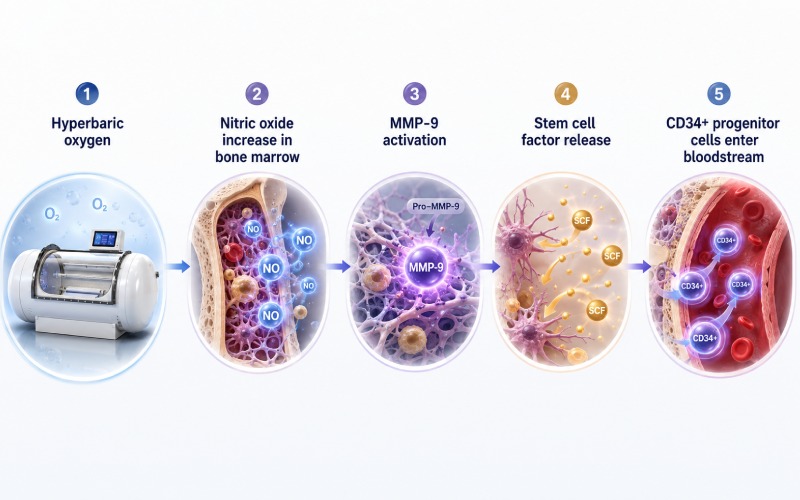
Research has shown that hyperbaric oxygen exposure can stimulate nitric oxide synthase activity under specific study conditions, leading to elevated NO levels in the bone marrow. This increase in NO is believed to play a role in triggering a cascade: activation of an enzyme called matrix metalloproteinase-9 (MMP-9), which releases a protein called stem cell factor from its anchored position. Once freed, this protein acts as a signal that facilitates the release of stem/progenitor cells (SPCs) from the bone marrow into the bloodstream 3.
A landmark study published in the American Journal of Physiology – Heart and Circulatory Physiology found that hyperbaric oxygen at 2.0 ATA was associated with rapid mobilization of SPCs in both humans and mice, and confirmed that this occurred via a NO-dependent mechanism. Studies using genetic knockout models and NOS inhibitors further supported this pathway — when NO synthesis was blocked, SPC mobilization was significantly diminished 3.
In plain terms: pressurized oxygen has been studied for its relationship with bone marrow signaling and the release of stem/progenitor cells into the bloodstream. The mechanism works through nitric oxide — a molecule your body already produces — and research at 2.0 ATA has provided important evidence for this pathway. It’s not about injecting anything from outside; it’s about understanding how the body may deploy its own recovery resources under specific oxygen-pressure conditions.
CD34+ Cells, Progenitor Populations, and What the Research Shows
Much of the published research on hyperbaric chamber stem cells has focused on a group of cells called CD34+ stem/progenitor cells. These cells are recognized for their role in blood cell formation, wound support, vascular repair, and the development of new blood vessel networks. They possess the ability to self-renew and differentiate into multiple cell types 4.
Studies have explored the dose-dependent relationship between oxygen pressure and SPC mobilization. Research has suggested that circulating CD34+ cells may increase in response to hyperbaric oxygen exposure, and that this mobilization has been observed across a range of pressures — from modest levels to protocols at 2.0 ATA, which produced some of the most well-documented responses in human subjects 3 4.
Interestingly, research has also demonstrated that even lower pressures can produce measurable effects. In a study of ten healthy volunteers exposed to 1.27 ATA room air for 90 minutes daily over ten sessions, one subpopulation of stem/progenitor cells was mobilized by nearly two-fold after nine sessions, increasing to three-fold 72 hours after the final session. This mobilization was confirmed as durable, meaning the effect persisted beyond the immediate exposure window 2.
These findings suggest a meaningful pressure-response relationship: observable effects may begin at relatively modest pressures, and the research at 2.0 ATA has produced some of the strongest documented results.
In plain terms: CD34+ cells are among the body’s important natural repair and maintenance cells. Research suggests that hyperbaric oxygen exposure — particularly at pressures around 2.0 ATA — may influence the number of these cells circulating in the bloodstream, and the effect has been observed beyond the session itself in certain studies. Even lower pressures have shown measurable responses, which suggests that the body may be responsive to this kind of oxygen stimulus across a meaningful range.
Angiogenesis, HIF Pathways, and the Bigger Recovery Picture
The relationship between hyperbaric oxygen and stem/progenitor cells extends into broader recovery biology. Research has explored how oxygen-driven signaling may stimulate growth factor production in stem/progenitor cells. This is believed to be related to the stabilization of hypoxia-inducible factors (HIFs) — proteins that regulate genes involved in forming new blood vessel networks, a process known as angiogenesis 1.
The mechanism is nuanced: hyperbaric oxygen elevates HIF-1 and HIF-2 levels in vasculogenic stem/progenitor cells through increases in reactive oxygen species, which in turn stimulate production of an antioxidant protein called thioredoxin. Thioredoxin then promotes the expression and activity of HIFs, which drive the transcription of genes responsible for new blood vessel development 1.
Published reviews describe this process through overlapping “waves” of biochemical activity — energy generation, cell signaling mediated by reactive species, and the interplay of ROS, lactate, and nitric oxide in coordinating the body’s repair responses 5.
In plain terms: beyond stem/progenitor cell mobilization, pressurized oxygen is also studied for its relationship with new small blood vessel formation and microcirculation. Better microcirculation can help tissues receive oxygen and nutrients more efficiently. This is why researchers increasingly view hyperbaric oxygen not as a single-effect stimulus, but as something that may influence multiple layers of the body’s recovery architecture.
What This Means for Wellness, Recovery, and Longevity-Focused Routines
The accumulating body of research provides a compelling scientific foundation for understanding why hyperbaric chambers have become central to so many recovery and wellness routines. Whether the context is sports recovery, post-exertion support, general wellness optimization, or longevity-focused protocols, the underlying biology points to meaningful physiological responses to pressurized oxygen environments.
Here is a summary of the core principles, based on published research:
- Increased dissolved oxygen reaches tissues through plasma-based delivery pathways beyond normal hemoglobin transport
- Reactive oxygen species generated under hyperbaric conditions serve as signaling molecules that coordinate cellular repair and protective pathways
- Nitric oxide synthesis in the bone marrow has been associated with stem/progenitor cell mobilization into circulation
- Growth factor production and HIF stabilization in stem/progenitor cells may support the development of new blood vessel networks
- Pressure-response relationship — studies at 2.0 ATA have produced robust, well-documented responses, while even lower pressures have shown measurable effects
- Durability of effects has been documented in certain research settings, with stem/progenitor cell mobilization persisting beyond exposure sessions
These principles provide biological context for why individuals, wellness centers, recovery studios, sports facilities, and spa environments increasingly integrate hyperbaric chambers for recovery into their service offerings. For wellness-focused users, this science is best understood as biological context rather than a promise of a specific outcome.
Why Chamber Engineering Matters: From Science to Session Quality
Understanding the biology is essential — but biology only becomes relevant when the chamber itself can deliver a consistent, reliable pressurized environment session after session. The research discussed above highlights why this matters: the cellular responses observed in published studies are tied to specific, sustained pressure levels and adequate oxygen delivery. A chamber that fluctuates in pressure, manages airflow poorly, or cannot maintain a stable environment may not provide the conditions that make these biological pathways practically relevant.
This is where thoughtful engineering becomes critical. Key factors include:
- Stable pressure delivery and maintenance — the ability to reach and hold a target pressure up to 2.0 ATA without unnecessary fluctuation throughout the session
- Oxygen system compatibility — effective integration with oxygen concentrators or delivery systems that support oxygen availability at pressure
- Airflow management — proper circulation inside the chamber to maintain a comfortable, breathable environment, especially during longer sessions
- Build quality and safety engineering — materials, seals, and structural integrity designed for repeated pressurization cycles at meaningful pressures
- User experience — comfort, noise management, ease of entry/exit, and interior space that encourages users to complete full sessions consistently
Without these engineering fundamentals, the gap between “what research suggests is possible” and “what actually happens inside the chamber” can be significant.
Oxyboss: Engineered for Stable, Comfortable Pressurized Oxygen Sessions
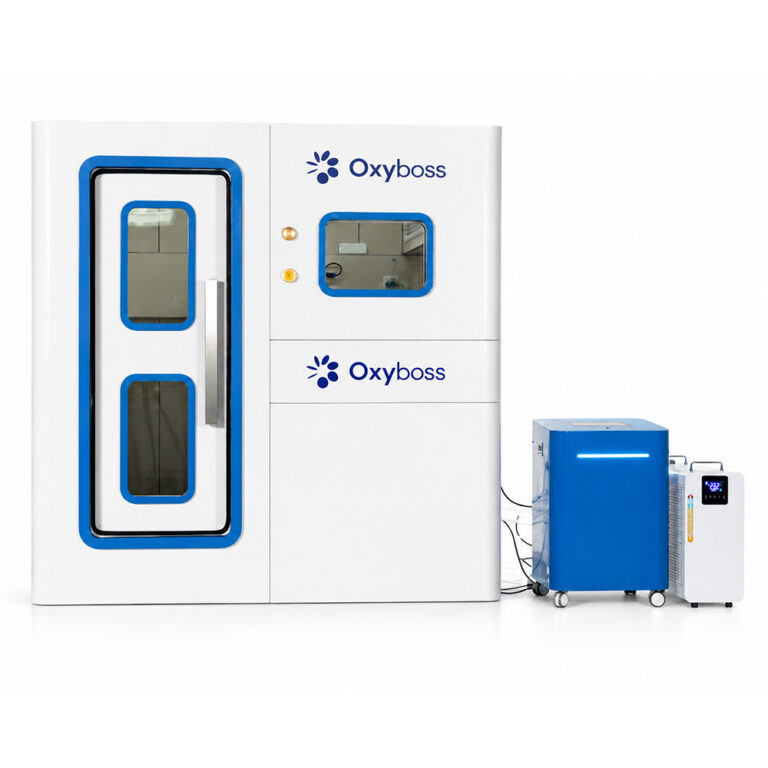
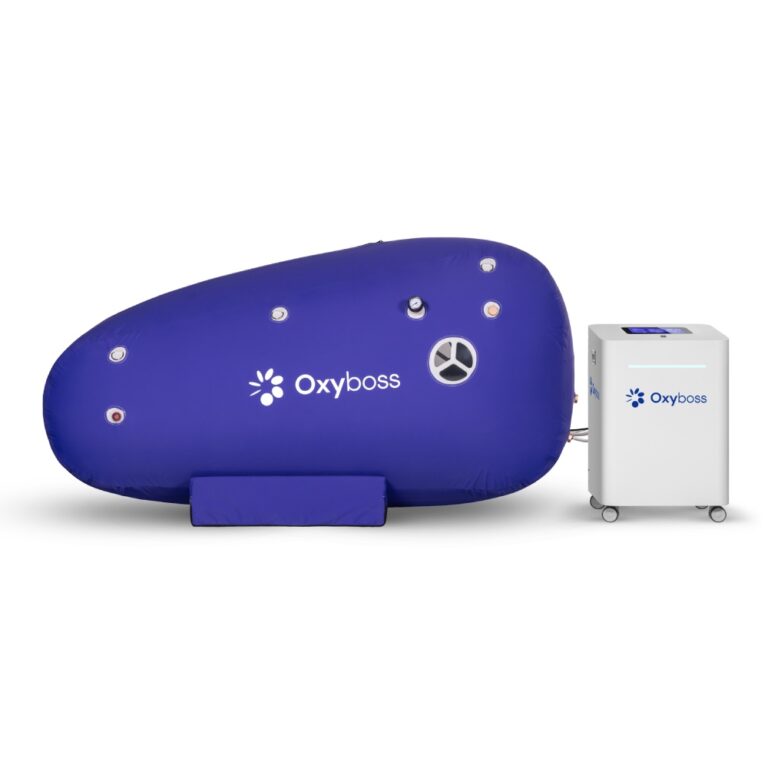
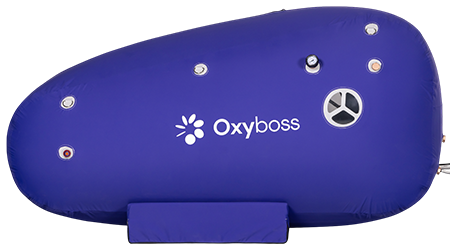
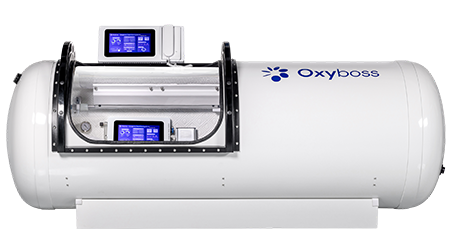
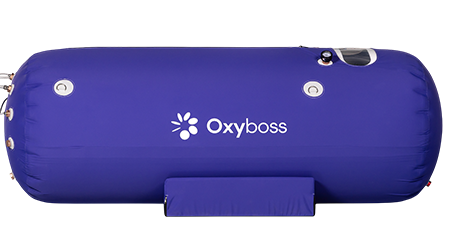
Oxyboss hyperbaric chambers are designed around exactly these principles. With the ability to operate at pressures up to 2.0 ATA, Oxyboss chambers are built to support the stable, consistent pressurized oxygen environment that wellness and recovery applications often prioritize.
Every Oxyboss chamber is engineered with attention to:
- Precise, stable pressure output up to 2.0 ATA — ensuring the chamber reliably reaches and maintains meaningful pressure levels for structured pressurized-oxygen sessions
- Oxygen system compatibility — designed to integrate smoothly with oxygen delivery systems for effective oxygen enrichment under pressure
- Advanced airflow engineering — internal circulation systems that maintain comfort, manage CO₂, and support breathability throughout full-length sessions
- Safety-conscious construction — materials and structural design built for repeated pressurization cycles at operating pressure
- User-friendly operation — intuitive controls, comfortable interiors, and thoughtful design details that make consistent daily use practical for both operators and users
Oxyboss chambers are built for modern wellness environments — recovery studios, wellness centers, spas, sports facilities, longevity clinics, and home wellness spaces — as well as for distributors and business partners who need a product that performs reliably at scale.
Oxyboss does not claim that its chambers produce guaranteed biological outcomes. What Oxyboss does provide is a well-engineered hyperbaric chamber built to deliver stable pressure, oxygen compatibility, airflow management, user comfort, and session consistency — session after session, year after year.
Final Thoughts
The scientific conversation around hyperbaric chamber stem cells is grounded in real, published research exploring how pressurized oxygen environments influence cellular signaling, stem/progenitor cell behavior, and recovery-related biology. From nitric oxide-mediated mobilization of CD34+ cells to HIF-driven angiogenesis pathways, the mechanisms are well-characterized and continue to be the subject of active investigation — with some of the most referenced studies conducted at 2.0 ATA.
For anyone exploring hyperbaric technology — whether for personal wellness, a recovery studio concept, a spa expansion, or a distribution opportunity — understanding these underlying principles is essential. And equally essential is choosing a chamber engineered to deliver the pressure, oxygen, and consistency that make these principles practically relevant.
The pressurized oxygen environment is not a magic solution. It is a well-studied physiological stimulus with documented relationships to oxygen delivery, cellular signaling, and stem/progenitor cell dynamics. That is why the conversation around hyperbaric chambers continues to grow — and why the quality of the chamber itself matters more than most people realize.