Key Takeaways
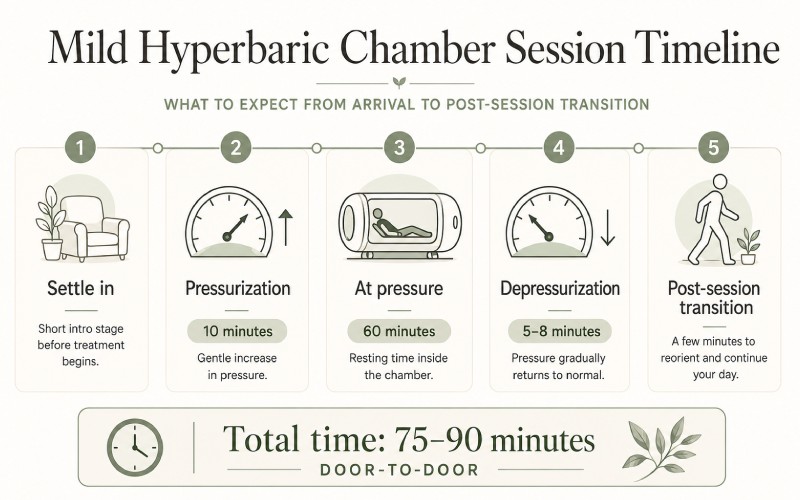
- A single mild hyperbaric chamber session takes 75–90 minutes door-to-door plan accordingly.
- Three to five sessions per week in a home hyperbaric chamber is a common rhythm; consistency usually matters more than intensity at 1.3 ATA.
- Session timing (morning vs. evening) can change how a session feels — pick based on your goal, not just your convenience.
You already own the chamber. Or you’re booking sessions at a studio nearby. Either way, you’re past the “what is it” stage and into the part that actually matters — how does a mild hyperbaric chamber fit into a real week, and how do you keep it from becoming another thing you forget about after three weeks?
Here’s the operating manual nobody writes.
How Long Does a Mild Hyperbaric Chamber Session Actually Take?
A single session runs 60 minutes at pressure. But nobody talks about the other minutes. Pressurization takes roughly 10 minutes. Depressurization runs 5–8. Getting in, getting settled, equalizing your ears — some days your left ear just won’t cooperate and that adds three more minutes of swallowing and jaw-wiggling.
Real total per session: 75 to 90 minutes, door to door.
That’s the same time commitment as a gym visit including the commute. Block it in your calendar like you would a workout, not like a podcast you’ll “squeeze in.”
How Often Should You Use a Hyperbaric Chamber per Week?
Most people running a mild hyperbaric chamber at home or hitting a wellness studio settle into one of three rhythms. What works depends less on some abstract optimum and more on what you’ll actually keep doing past week six.
| Weekly Pattern | Sessions Per Week | Who It Suits | What You’ll Likely Notice |
| Loaded Front | 5 sessions (Mon–Fri) for 4–8 weeks, then taper | Someone with a specific short-term recovery window | Faster familiarity with the routine; some people feel mildly fatigued around week 2 before leveling out |
| Steady State | 3 sessions (e.g., Mon / Wed / Fri) | The long-haul person building a sustainable habit | Gradual shifts in energy, routine, and sleep over 4–6 weeks |
| Weekend Anchor | 2 sessions (e.g., Sat + Sun or Tue + Sat) | Busy schedule, limited chamber access, or supplementing other modalities | A lighter rhythm that often works best after completing an initial block of regular sessions |
The loaded front approach gets a lot of attention because it mirrors how facilities structure their packages. But it quietly burns people out. If you miss a Tuesday and feel like the streak is broken and the whole week is ruined — that’s a setup problem, not a discipline problem. Pick the pattern you can sustain without white-knuckling it.
Why 1.3 ATA Still Has a Place in a Home Hyperbaric Chamber Routine
A reasonable question: is 1.3 ATA actually doing anything, or is it just expensive relaxation?
The answer starts inside a gas law from 1803. Under normal atmospheric pressure (1.0 ATA), most oxygen in your blood rides on hemoglobin inside red blood cells. A much smaller fraction dissolves directly into blood plasma. Hemoglobin is already near-saturated at sea level — you can’t load much more oxygen onto it by simply increasing pressure.
But plasma is a different story. As pressure rises, the amount of gas that can dissolve into a liquid also rises. At 1.3 ATA, that increase is still modest compared with higher-pressure clinical protocols, but it’s directionally meaningful: more oxygen can dissolve into plasma than at normal atmospheric pressure.
Why does this matter? Plasma-dissolved oxygen isn’t locked inside a red blood cell. It moves wherever fluid moves — into muscle tissue, through smaller capillary beds, and into tissues with high oxygen demand. Your brain, for example, uses a disproportionate share of your body’s oxygen relative to its size.
Is 1.3 ATA the same as sitting in a 2.0 ATA hard-shell chamber breathing pure oxygen? No. That’s a completely different category of exposure. But that comparison also misses the point of a home routine. At 1.3 ATA, many people find the chamber practical to use regularly, and repeated use over weeks and months is the whole idea. For wellness-oriented goals, consistency at mild pressure is often the deciding factor.
Think of it as the difference between sprinting once a month and jogging three times a week. The jogger wins over a year.
Best Time of Day to Use a Hyperbaric Chamber: Morning vs. Evening
There’s often a noticeable difference in how a session lands depending on when you do it.
Morning sessions (before 10 AM) often feel mentally cleaner and quieter through midday. Some of this is the forced stillness — you can’t doom-scroll for an hour. Some people also prefer this slot for focus-heavy work blocks.
Evening sessions (after 5 PM) tend to feel more calming. Heart rate often drops. The chamber is quiet. Many people fall asleep inside, which is fine. If your sleep onset is consistently past midnight and melatonin hasn’t solved it, this slot is worth testing. One caveat: the 15-minute post-session fog is real for some people. Don’t schedule it right before you need to be somewhere sharp.
Post-workout sessions can pair well with already-elevated circulation. There’s a practical synergy there. One nuance: if your primary goal is building muscle mass, you may prefer separating the chamber session from strength work by a few hours rather than stacking everything immediately.
Stacking a Hyperbaric Chamber With Other Wellness Modalities
If you’re the kind of person reading this article, you probably also own or use an infrared sauna, a cold plunge, a red light panel, or some combination. The question isn’t whether to combine them. It’s the order.
A practical framework:
- Red light (10–15 min) — skin is dry, easy to do first
- Mild hyperbaric chamber (60 min) — the anchor session
- Infrared sauna (15–20 min) — heat after stillness
- Cold exposure (2–4 min) — if you like finishing with a sharper reset
You don’t have to do all four every time. That’s a two-and-a-half-hour commitment most weeks won’t tolerate. But if you have one day a week where you stack everything — say, a Saturday — and keep the other two to three days as chamber-only sessions, the week has both depth and consistency.
One thing to avoid: if comfort and circulation are your priorities, don’t cold plunge immediately before a hyperbaric chamber session. Most people find cold works better after, or at least separated by an hour.
What to Do Inside a Hyperbaric Chamber During a Session
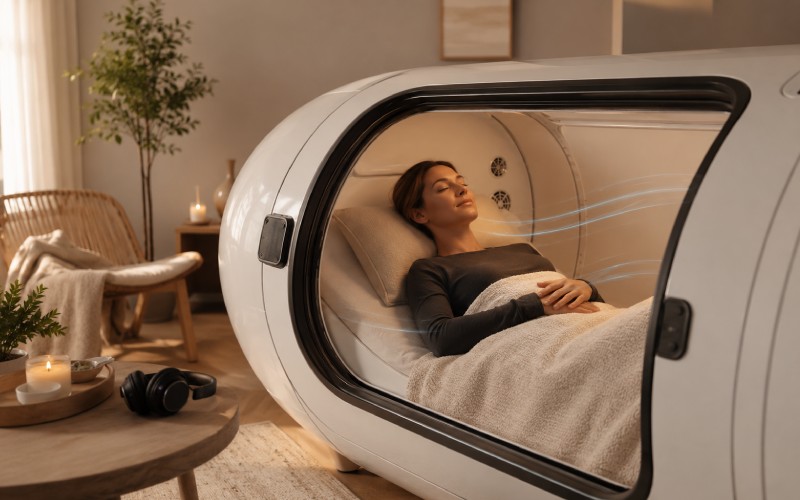
The inside of a mild chamber is not exciting. Pressurized space. Compressor hum. Slightly warm air. You’re lying or sitting still.
This is actually the point.
The people who get the most from their sessions tend to use the time for one of three things:
- Breathwork. Not intense hyperventilation protocols — slow, nasal, diaphragmatic breathing. 4-count inhale, 6-count exhale, repeat. The pressurized environment naturally encourages deeper, slower breaths. The calming effect compounds.
- Sleep or rest. Genuinely useful. If you fall asleep, you needed it.
- Low-stimulus input. Audiobooks, podcasts, music without lyrics. Avoid work emails. Cognitive load from stressful content cancels some of the recovery benefit.
Leave your phone outside or put it on airplane mode. And before bringing any electronics into the chamber, check your specific manufacturer’s instructions. Mild chambers do not use the same setup as high-pressure medical oxygen systems, but permitted items still vary by device. Leave the phone out anyway because the hour is yours, and scrolling under 1.3 ATA is an absurd waste of a good session.
How to Equalize Ear Pressure in a Hyperbaric Chamber
At 1.3 ATA, you’re experiencing pressure equivalent to roughly 10 feet of water depth. Not extreme, but enough that your middle ear needs to equalize. If you’ve flown on a plane, you know the feeling.
Techniques that work:
- Swallow repeatedly
- Yawn (real or fake)
- Gentle Valsalva — pinch your nose, close your mouth, exhale softly. Softly. Do not force it.
- Chew gum during pressurization
If you have a cold, sinus congestion, or any upper respiratory issue — skip the session. Forcing equalization through swollen tissue is how you end up with ear discomfort that sidelines you for a week or more. One skipped session costs nothing. One ear problem costs several.
How to Track Results From a Hyperbaric Chamber Routine
People get obsessive about metrics. Pulse oximeters, HRV readings, blood panels. Most of that data won’t shift meaningfully from mild hyperbaric sessions alone over a short timeframe, and watching numbers that don’t move is demotivating.
Track these instead:
- Sleep quality — not just duration, but how you feel in the first 30 minutes of waking. Use a simple 1–5 scale.
- Afternoon energy — the 2–4 PM window is where most people feel a drop. Note whether it’s less severe on session days vs. off days.
- Recovery between workouts — if you exercise regularly, track how quickly you return to baseline. A training log captures this.
- Subjective mental clarity — sounds vague, but over 4–6 weeks of consistent journaling, patterns emerge.
Give it at least 10 sessions before forming any opinions. Mild hyperbaric sessions tend to be cumulative in feel, which means the first three or four might feel like nothing. That’s normal. The routine effect builds with repeated exposure, not single doses.
When to Take a Break From Hyperbaric Chamber Sessions
More is not always more. After 30–40 consecutive sessions (roughly 8–10 weeks of steady use), some people like taking a full week off. The body adapts to repeated stimuli. A short break can make the routine feel fresh again when you resume.
This mirrors the concept of hormesis — a mild stress that triggers an adaptive response. Like training periodization: load, recover, adapt, repeat. The people who’ve been doing this for years often cycle on and off. The ones who run 365 days a year often report diminishing subjective returns after a few months.
FAQ: Hyperbaric Chamber Weekly Routine
How many hyperbaric chamber sessions before I notice results? Most people who stick with the routine report a clearer shift somewhere between session 8 and 15. If you’re looking for a dramatic overnight change, mild hyperbaric sessions aren’t the right tool. The effects reveal themselves gradually — like a consistent meditation practice — then become obvious.
Can I use a mild hyperbaric chamber every day? Some people do, especially during a focused block. Whether you should depends on your goals, your tolerance, and your device’s instructions. For many people, three to five times per week with periodic rest weeks is an easier long-term structure.
Is 1.3 ATA enough to produce real effects? It can be enough to make a mild chamber feel worthwhile in a wellness-oriented routine. At 1.3 ATA, pressure is higher than normal atmospheric breathing, and oxygen availability in plasma may increase modestly compared with baseline. It’s not the same as higher-pressure clinical protocols, but many people choose it because the setup is more practical for regular use.
What should I avoid before a hyperbaric chamber session? Alcohol, heavy meals within an hour, petroleum-based skin products if your manufacturer advises against them, and anything that congests your sinuses. Caffeine is fine if you normally drink it — withdrawal headaches in a pressurized environment are worse than the caffeine itself.
Can I bring electronics into a mild hyperbaric chamber? Sometimes, depending on the chamber and the manufacturer’s instructions. Do not assume every soft-shell chamber has the same rules. If you must bring something in, keep it low-stress and low-stakes.
Should I hydrate before or after a session? Both, but especially after. Pressurized environments can feel mildly dehydrating. A full glass of water post-session is a good habit.
What’s the difference between a soft-shell and hard-shell hyperbaric chamber? Soft-shell chambers typically operate at lower pressures and use ambient or mildly enriched air. Hard-shell chambers operate at higher pressures and may use concentrated oxygen under supervision. For a weekly wellness routine at home, soft-shell is the practical option — portable, lower cost, and easier to use consistently.
How much does a home hyperbaric chamber cost? Home units vary widely depending on diameter, build quality, and included accessories. Compared with recurring studio sessions, a home unit can make more financial sense for someone planning to use it regularly.
This article is for informational and educational purposes only. It does not constitute medical advice, treatment, or diagnosis, and it is not a claim that mild hyperbaric chambers provide the same outcomes as clinical hyperbaric oxygen therapy. Individual needs vary. Consult a qualified provider before beginning any new wellness practice, especially if you have pre-existing conditions.