Two setups get shelved next to each other in wellness shops and confused for the same thing. You wear a mask and pedal a bike in one. You sit inside a pressurized tube in the other. Both are sold as “oxygen therapy,” both are sold without a prescription, and both turn up in the same sentence when someone asks what to buy.
They are not variations of one machine. They differ in the air pressure, in what the pressure does, and in what you have to do to make it work.
The three products sharing two names
Getting these straight is most of the work, because the vocabulary overlaps.
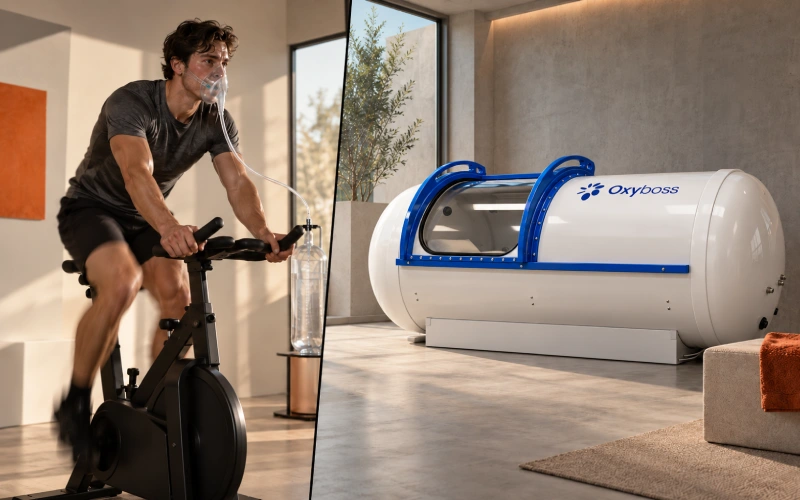
EWOT — Exercise With Oxygen Therapy. A concentrator makes oxygen at 90–95% purity, a reservoir bag holds it, and a mask delivers it while you exercise. Air pressure stays at normal atmospheric level, so nothing is pressurized and there is no enclosure. Sessions run 15–20 minutes.
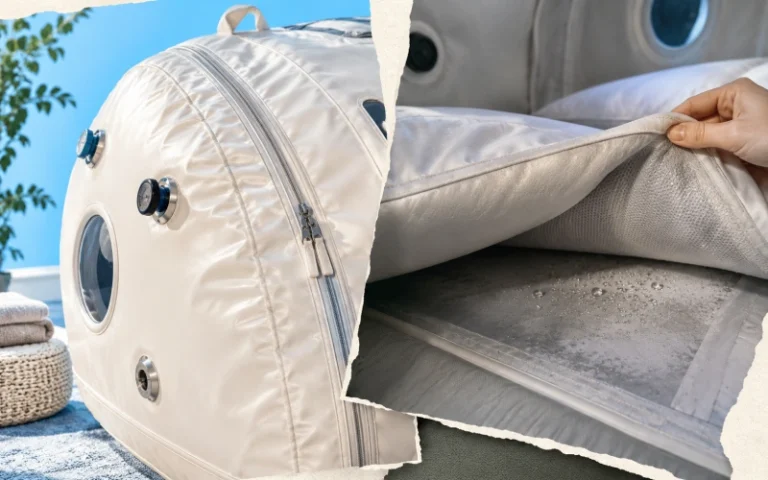
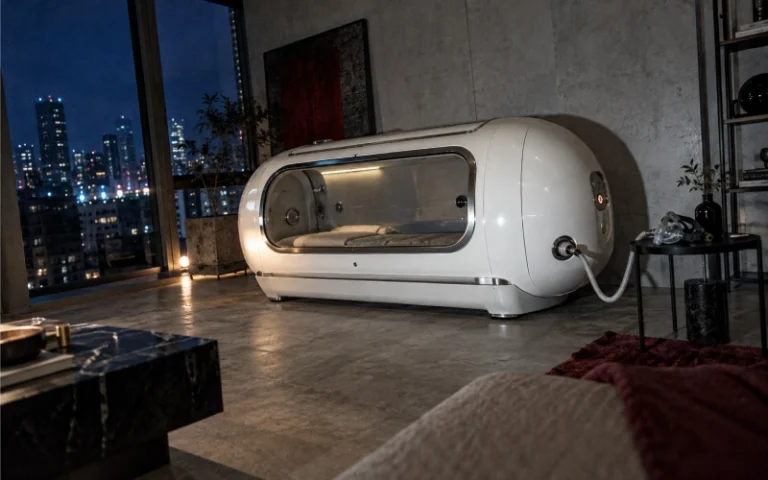
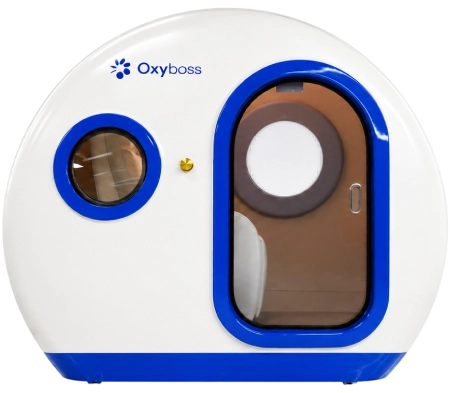
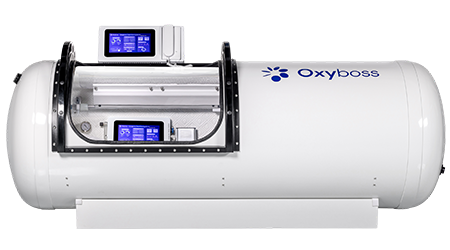
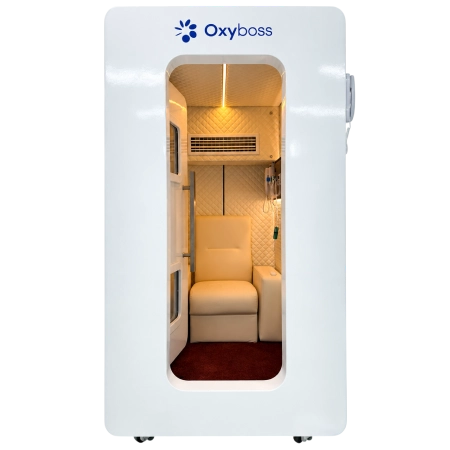
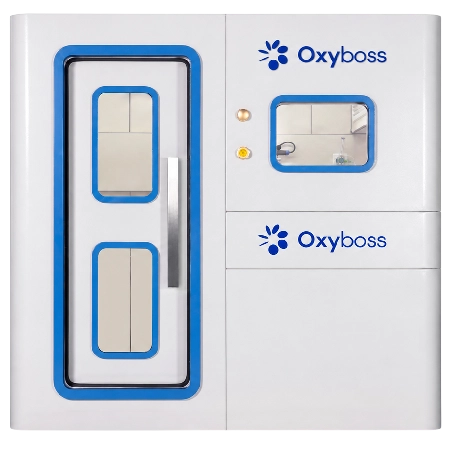
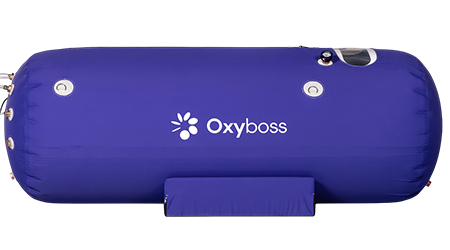
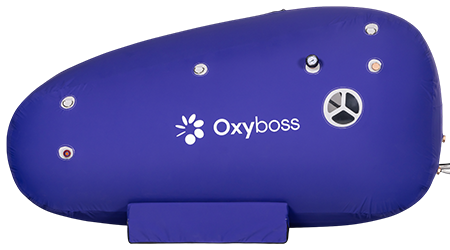
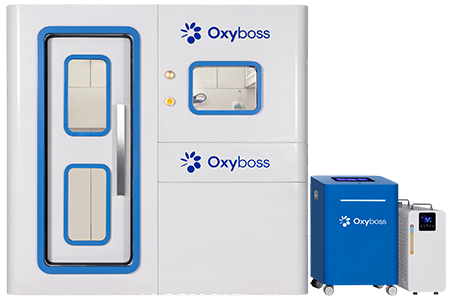
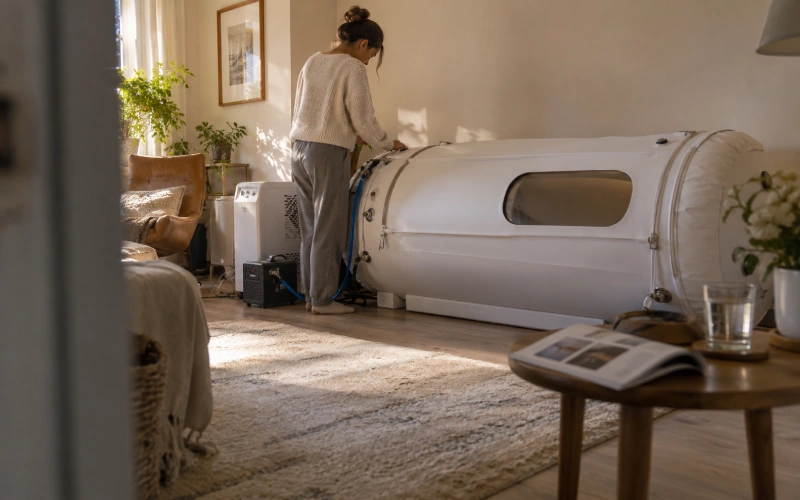
Hyperbaric chamber — a soft-shell or hard-shell unit you sit or lie inside while the surrounding air is pressurised. Used here to mean the mild, consumer kind: typically 1.3–1.5 ATA, no prescription required, no medical condition being treated. Some units deliver plain room air, some feed you oxygen through a mask or a hood, and which one you get matters more than most spec sheets admit.
Medical hyperbaric is a separate product at a separate pressure, running 1.5–3.0 ATA under a prescription for the conditions listed by the Undersea & Hyperbaric Medical Society. It appears here as a reference point and nothing more. The line that separates it from a mild chamber is pressure, and it matters: a unit quoted at 1.4 ATA with no prescription attached is a wellness device, and a unit quoted at 2.0 ATA with none attached is a question you should walk away from.
Pressure is the whole difference
The number that separates a mild chamber from EWOT is atmospheric pressure, and pressure does something specific: it pushes more oxygen out of the air and into the fluid of your body. Oxygen dissolved in liquid obeys a simple rule — more pressure above the liquid, more gas dissolved in it. That is the entire mechanism, and it is the reason a chamber isn’t just EWOT with a nicer seat.
Roughly how much oxygen reaches the alveoli in each setup:
| Setup | Pressure | Breathing | Alveolar O₂ (approx.) |
|---|---|---|---|
| Resting, room air | 1.0 ATA | 21% | ~150 mmHg |
| EWOT | 1.0 ATA | ~95% | ~680 mmHg |
| Mild chamber, room air | 1.4 ATA | 21% | ~290 mmHg |
| Mild chamber + oxygen | 1.4 ATA | ~100% | ~980 mmHg |
Those last two rows are worth sitting with. A mild chamber running on ordinary room air at 1.4 ATA gives you roughly twice the alveolar oxygen of breathing normally, and less than half of what EWOT gives you. The same unit with oxygen fed in gives you more than either. So the honest comparison is not “chamber versus EWOT.” It is room air versus oxygen, and pressure versus movement.
The movement part, which is the half people skip
At normal atmospheric pressure your blood is already carrying oxygen close to saturation. Breathing 95% oxygen at sea level adds less to that than most marketing suggests — what genuinely changes is the demand side, because exercise drives heart rate, blood flow, and oxygen extraction upward at exactly the moment supply is high.
That is EWOT’s real mechanism: not more oxygen arriving, but more oxygen arriving while tissue is actively pulling it. Train hard enough during a session and the exercise itself is a large part of what you bought.
A chamber takes the opposite route. Pressure moves oxygen into plasma, cerebrospinal fluid, and interstitial fluid — fluid that red-cell transport reaches poorly. Harvard Health describes this as the reason pressurised oxygen reaches tissue that ordinary circulation struggles to serve. The mechanism is indifferent to whether you pedal.
Both are legitimate. They load different systems. Neither is a substitute for the other, and the fact that both are sold as “oxygen” hides a difference in kind.
Why the “15 minutes equals 90 minutes” claim falls apart
You will see this one everywhere:
15 minutes of EWOT equals 90 minutes of hyperbaric therapy.
Look at what it is actually asserting — that time spent at 1.0 ATA while moving, with oxygen added, is interchangeable with time spent at elevated pressure while sitting. Those are different quantities of a different variable. A minute at 1.4 ATA is not a stronger minute than a minute at 1.0 ATA; it is a minute at a different pressure, and the dissolved-oxygen term in Henry’s law does not linearise across that range. You cannot convert one into the other without knowing the oxygen delivery method, the pressure, and the physiology of the person doing it.
We looked for controlled evidence behind that ratio and found none. Treat it as marketing arithmetic rather than a finding.
What each one is actually good for
EWOT earns its money if you are training. The oxygen attaches to a session you were going to do anyway. Endurance work, intervals, return-to-sport rehab after an injury cleared by a clinician — in those cases the exercise is the point and the oxygen is the addition.
It also suits a small space and a tight budget. A concentrator, a bag, a mask, and a bike occupy a corner of a room. Sessions are short enough to do before work. You are alone, you are in control, and nobody else is involved.
A mild chamber earns its money if you want pressurised exposure without a prescription. Post-exercise recovery, general relaxation, the specific experience of breathing oxygen at elevated pressure. If you have bought sessions at a wellness studio and felt something from them, a home unit is the same exposure without the travel.
Two honest limits. The evidence for mild pressures is thin — most hyperbaric research was conducted at 1.5 ATA and above, and pressure has a dose-response relationship, so results at 2.0 ATA do not transfer down to 1.4. And most of what people notice is subjective, which is a real experience and still not a measured outcome.
Neither is a medical treatment, and neither is prescribed or covered by insurance. When a clinician prescribes hyperbaric therapy for a wound or a gas-related condition, that is a different product at a different pressure with a different evidence base. Medicare covers it as a medical intervention. A home EWOT kit is not a substitute for it, and substituting one for the other is a decision to make with a doctor, not a shopping decision.
The practical differences that decide it
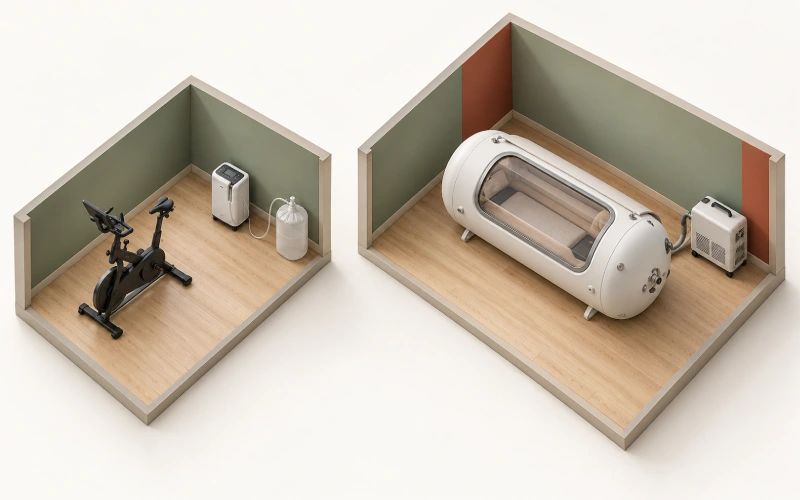
Space. Soft-shell chambers need roughly 2.2 m by 1.5 m of floor and clearance to sit upright, plus somewhere for the compressor to vent. Hard shells are larger. EWOT needs a bike footprint. This decides more purchases than any other factor and it is almost never discussed before buying.
Session length and what it does to your week. Twenty minutes versus sixty to ninety, three times a week for a month adds up to a real number of hours. A person training for a race and a person recovering from one have completely different schedules.
Who is in the room. EWOT is a solo activity. Chambers are built for one or two people, so a partner or training partner can share the cost and the session.
Delivery method. Ask specifically what your chamber breathes. Room air, oxygen-enriched air, and 100% oxygen are three different units at the same price point, and the difference is worth roughly 700 mmHg of alveolar oxygen.
Who runs it. With EWOT you run it, alone, and the main risk is the exercise rather than the oxygen. With a chamber, a trained operator and an emergency procedure are worth paying for, especially if anyone else uses it.
Cost
Ballpark U.S. ranges. Your region will differ and treat all of this as a starting point, not a quote.
EWOT, home
- Concentrator $800–$2,000
- Reservoir bag $200–$400
- Mask and tubing $50–$100
- Bike or bench if you have none $300–$2,000
- Roughly $2,000–$5,000 to start, then electricity
Mild chamber, home
- Soft-shell $5,000–$10,000
- Hard-shell $10,000–$25,000
- Delivery and room preparation often add a few hundred more
Mild chamber, rented
- Wellness studio, $50–$150 a session
- Buy one session before you buy a unit
Medical hyperbaric, for reference
- $200–$400 a session uninsured, 20–40 sessions typical
Before you commit
Ask how the pressure is verified. A unit claiming 1.4 ATA should say how it is measured, how often it is calibrated, and what the cut-off is. Gauge accuracy, safety valves, and the oxygen delivery hardware should all be documented. A seller who cannot answer those three questions is selling a tube.
Ask what happens if someone panics or feels unwell. A protocol, a door that opens from inside, and someone who knows the answer.
Fire safety is not a formality. Concentrated oxygen makes ordinary materials burn far more readily — clothing, bedding, hair products, the grease on a bike chain. This applies to a mask at 95% and to a room full of oxygen. Rules about what may be in the chamber, and what may not, are worth reading before the first session, not after.
Ear pressure is the practical hurdle. Any chamber means equalising in your middle ear like on a plane. Chronic sinus problems or eustachian tube dysfunction can make it flatly impossible. EWOT has no such step at all.
Some things rule both out. Untreated pneumothorax is an absolute contraindication for any pressurised exposure. Some chronic lung conditions, and certain chemotherapy drugs, are reasons to stay away from both. EWOT carries ordinary exercise contraindications on top of that. Take a medication list to a clinician rather than to a seller.
Oxygen toxicity is a pressure phenomenon, and it is manageable. It shows up in prolonged exposure at elevated pressure with high oxygen concentration, which is why clinical sessions are time-limited. At 1.0 ATA with a mask the risk is low. At 1.4 ATA it stays low for typical session lengths and rises if you run long sessions every day. Follow the session limits you are given, and get them from a clinician if nobody has told you.
If you only buy one
Training, limited space, a budget under $5,000, and you want oxygen attached to effort — EWOT. It is cheaper, faster, and the mechanism is well matched to what you are already doing.
Chasing recovery or pressurised exposure at home with $10,000 or more to spend — a mild chamber, after you have bought a few sessions at a studio to confirm the experience is one you want to keep paying for.
Recovering from an injury or managing a diagnosed condition — neither. That conversation goes through a doctor who can prescribe something with evidence behind it.
For any of it, the research that exists is indexed in PubMed under hyperbaric oxygen therapy and exercise with supplemental oxygen. Spend an hour reading before spending five thousand dollars.
Questions worth asking
Can EWOT and a mild chamber be used together?
Nothing stops you. One is exercise plus oxygen at ambient pressure, the other is pressurised exposure at rest, and they work through different mechanisms, so combining them is additive in principle. No large trials have tested the combination, so it is a reasonable personal choice rather than a protocol with a number attached.
Is a 1.4 ATA chamber the same as a medical one?
No. The pressure is below the clinical range, the unit isn’t a medical device, and no condition is being treated. You are getting a fraction of the dissolved-oxygen exposure that clinical hyperbaric therapy delivers, and it should be judged on wellness expectations rather than medical ones.
How long should an EWOT session be?
Common protocols are 15–20 minutes. There is no good evidence that stretching a session to an hour buys a proportionate amount — the extra time mostly adds fatigue.
Do I need a prescription for either?
Usually not, in most jurisdictions, since neither is delivered as a medical intervention at the pressures involved. What may be sold, and what claims may be made about it, varies by country and by pressure rating. Worth checking locally before you spend anything.
Does insurance cover either?
No. Neither is prescribed, so neither is covered. That is also the honest answer to whether a home unit is a reasonable substitute for prescribed hyperbaric therapy — the mechanism differs, the pressure differs, and the clinical version is the one with a research base for specific conditions.
Can I use EWOT with asthma or COPD?
Ask a clinician. High-flow oxygen while exercising changes breathing patterns, and reactive airways sometimes object. Some people with well-controlled asthma manage it without trouble; others cannot. Not something to test by accident.
How serious is oxygen toxicity at home?
At EWOT pressures it is low. At mild chamber pressures it stays low over normal session lengths and climbs with long daily sessions. Clinical practice time-limits exposure for exactly this reason. Stay inside the session limits for your device, and if nobody has told you what they are, that is worth asking.
What is the first question to ask any seller?
How the pressure is measured and verified, what the oxygen delivery method is, and what the emergency procedure is. Three questions. Anyone who cannot answer them is not ready to take your money.