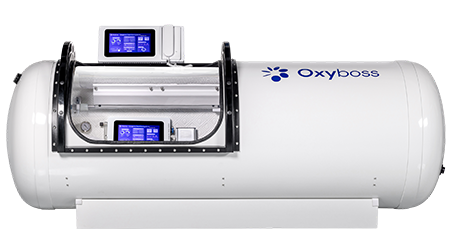
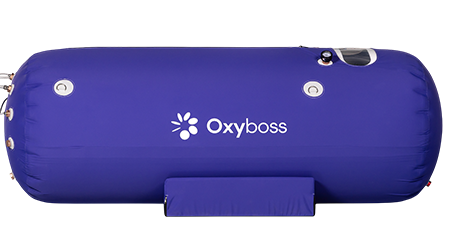
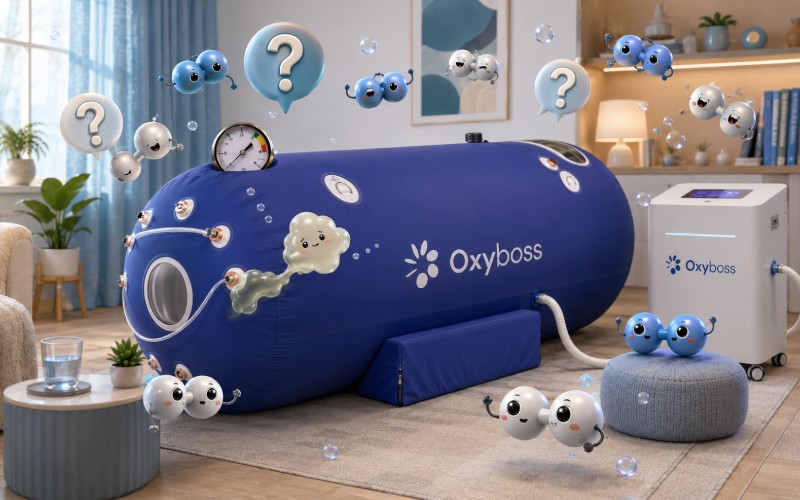
The question everyone types into Google but nobody wants to ask the technician standing next to the zipper seal.
The Short Answer
Passing gas in a hyperbaric chamber is generally not considered a primary safety hazard when the chamber is operated according to the manufacturer’s instructions. It is not generally expected to cause a fire or explosion on its own. Pressure changes do affect gas volume inside your gut — compression shrinks it, decompression expands it — but the main practical issue in a sealed space is usually odor and comfort. The rest of this article explains the basic gas physics, the fire-safety context, and practical considerations for both commercial operators and home users.
What’s Actually in a Fart — And Why It Matters at Pressure
Your intestinal bacteria produce a mix of gases during digestion. The exact composition shifts based on diet and microbiome, but it generally falls within well-established physiological ranges often cited in discussions of intestinal gas:
| Gas Component | Approximate % | Flammable? | Notes |
| Nitrogen (N₂) | ~59% | No | Inert; dominant component |
| Hydrogen (H₂) | ~21% | Yes | Can ignite at concentrations as low as 4% in air |
| Carbon Dioxide (CO₂) | ~9% | No | Metabolic byproduct |
| Methane (CH₄) | ~7% | Yes | Only ~30–62% of people produce it |
| Oxygen (O₂) | ~4% | Supports combustion | Trace; from swallowed air |
| Hydrogen Sulfide (H₂S) | <1% | Yes | Responsible for the smell |
These values reflect standard physiological ranges commonly referenced in general discussions of intestinal gas.
A meaningful fraction of flatulence can be flammable. Hydrogen alone can vary widely in a single emission depending on diet and digestion. Whether you produce methane at all depends on whether your gut hosts the specific archaea responsible for it — roughly a third to two-thirds of people do.
This matters because you’re releasing these gases into a sealed, pressurized space.
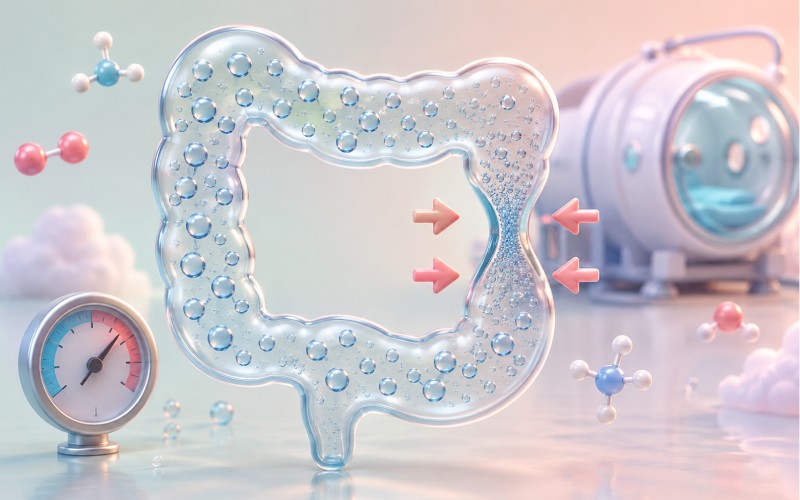
Boyle’s Law and Your Gut
Inside any hyperbaric chamber, ambient pressure rises. Many mild wellness chambers operate around 1.3 ATA, while some hard-shell systems can go higher. Boyle’s Law governs what happens to gas pockets:
P₁ × V₁ = P₂ × V₂
Pressure goes up, gas volume goes down — inversely, proportionally. That intestinal gas you walked in with? At 2.0 ATA, it occupies half its original volume. The urge to pass gas often fades during pressurization because the gas is literally getting squeezed smaller inside your intestines.
The flip side hits during decompression. As the chamber returns toward 1.0 ATA, that compressed gas re-expands. If you swallowed air during the session — common, especially when equalizing ears — the total volume at surface can exceed what you started with.
This is why belching or passing gas during depressurization can be normal. Controlled, gradual pressure reduction gives your body time to off-gas more comfortably. Rushing it can increase discomfort and make pressure changes feel more noticeable.
| Chamber Pressure (ATA) | Gas Volume (% of Surface) | What You’ll Likely Feel |
| 1.0 (surface) | 100% | Normal |
| 1.3 | ~77% | Mild compression; reduced bloating |
| 1.5 | ~67% | Noticeable compression; gas urge often fades |
| 2.0 | 50% | Gas at half its original volume |
| 2.4 | ~42% | Significant compression |
During decompression back to 1.0 ATA, if bacteria produced additional gas during the session, the total volume at surface may exceed baseline.
The Fire Question
This is the part that makes people nervous. It should make you thoughtful — not scared.
Hyperbaric environments vary. Some medical systems use much higher oxygen concentrations, while many mild soft-shell wellness chambers primarily use compressed ambient air and may deliver supplemental oxygen through a mask or cannula. In some setups, that can create a localized oxygen-enriched breathing zone.
Oxygen doesn’t burn. But it is an aggressive oxidizer. In oxygen-enriched environments:
- Ignition energy thresholds drop
- Flame spread rate increases
- Materials that would not easily ignite in normal air may ignite more readily
Flatulence can contain hydrogen and potentially methane — both flammable. In normal room air, the tiny volume of a single emission (roughly 33–125 mL, averaging around 100 mL) disperses and dilutes quickly. Inside a pressurized enclosed space, dispersion can be slower, and oxygen enrichment can lower ignition thresholds in some settings.
But the key issue is still ignition.
In a properly designed and properly operated chamber, standard safety protocols are intended to minimize ignition sources. That is why operating guidance typically restricts electronics, ignition sources, inappropriate fabrics, and petroleum-based products, and may require cotton clothing depending on the system.
A fart introduces a trace amount of fuel. Oxygen may also be present to varying degrees depending on chamber type. But without an ignition source, combustion is not generally expected. In practice, the more meaningful fire concerns are usually related to prohibited items or unsafe use, not normal digestive gas.
Home Users: Soft-Shell Chamber Specifics
If you’re using a soft-shell wellness chamber at home in the 1.3–1.5 ATA range with a concentrator delivering oxygen through a mask, the overall risk profile is generally different from a hard-shell setup that uses much higher oxygen concentrations. The chamber atmosphere is often largely compressed ambient air rather than pure oxygen, with any enrichment more localized around the breathing zone.
The same clothing and material rules still matter. Cotton-only requirements, restrictions on lotions or hair products, and bans on devices inside the chamber should be followed exactly as stated in the manufacturer’s instructions. In this context, flatulence is typically more of a comfort issue than a safety issue.
Still, safety rules should not be treated casually. They exist to reduce avoidable risk.
The Smell Factor
Inside a sealed chamber, you’re in a small space. Possibly with a technician in a multiplace setup. The sulfur compounds responsible for the odor — primarily hydrogen sulfide — don’t disappear under pressure. And the enclosed volume means less dilution.
It’s going to smell. At depth, it may linger.
Chambers typically use airflow and ventilation to help manage CO₂ buildup, humidity, and airborne compounds — which can include odor. If you’re evaluating a chamber for a commercial wellness space with multiple daily sessions and rotating users, ventilation throughput belongs on your spec sheet.
For home users, follow your operating manual. If your system allows airflow adjustment within normal operating parameters, that may help refresh the internal air without meaningfully affecting pressure maintenance.
Pre-Session Diet: What Goes In Comes Back Out
High-fiber meals, legumes, cruciferous vegetables, carbonated drinks, and sugar alcohols (sorbitol, xylitol) can all increase fermentation gas production. Eat a bowl of chili two hours before your session and you’re giving intestinal bacteria the raw material to produce more hydrogen and CO₂. Under compression that gas may sit quietly. During decompression, it often wants out.
A practical pre-session approach:
- Eat a light meal 2–3 hours before — not immediately prior
- Avoid known gas-producing foods for 4–6 hours if you know they affect you
- Skip carbonated beverages on session days
- Stay hydrated with still water — dehydration can slow gut motility and worsen gas retention
This is mostly about comfort. Expanding gas plus sluggish digestion can make a session feel less relaxing than it should.

Don’t Hold It In
Holding in gas during a session can create abdominal pressure with no productive outlet. As the chamber depressurizes, trapped gas expands. If you’re clenching through it, you’re more likely to end up with:
- Bloating and discomfort
- Cramping sharp enough to interrupt relaxation
- Unnecessary strain, especially if you already know you have digestive sensitivity
You’re in a wellness chamber. The whole point is recovery and relaxation. If you need to pass gas, pass gas. Any technician who’s worked around chambers for long has probably heard it before. Breathe normally and let your body do its thing.
If you have a diagnosed digestive condition or another medical concern, follow the manufacturer’s instructions and use your own clinical judgment with input from a licensed clinician as appropriate.
For Commercial Operators: Session Turnover Hygiene
Build a 5–10 minute buffer between sessions. This is not just equipment cooldown time — it also gives the previous user’s off-gassed atmosphere time to fully vent before the next person enters.
Clients notice air quality. The ones who don’t say anything may still notice it.
If you’re running a high-volume wellness center, ventilation rate and air cycling matter, especially when sessions are scheduled back to back.
FAQ
Is it dangerous to fart in a hyperbaric chamber?
Generally, no — not when the chamber is properly operated and the manufacturer’s safety instructions are followed. The volume of flammable gas in a single emission is very small, and the larger practical issue is usually smell and comfort rather than combustion.
Will the smell be worse inside a chamber?
It can be. The enclosed space means less dilution. Good ventilation design helps. Pre-session dietary adjustments usually help even more.
Should I avoid eating before a session?
Don’t go in overly full, and don’t go in right after a heavy meal. If you know certain foods make you gassy, avoid them for several hours beforehand. A light meal 2–3 hours before is usually more comfortable than eating immediately before.
Does intestinal gas expand when the chamber depressurizes?
Yes. Boyle’s Law: gas volume increases as ambient pressure decreases. That is one reason gradual, controlled depressurization tends to be more comfortable than rushing the process.
Can I use a hyperbaric chamber if I have chronic bloating?
Some people with chronic bloating may still be able to use wellness chambers comfortably, but ongoing digestive concerns should be considered alongside the manufacturer’s instructions and, where appropriate, advice from a licensed clinician.
Does chamber type matter?
Yes. Soft-shell wellness units in the 1.3–1.5 ATA range that primarily use compressed ambient air with supplemental oxygen generally present a different environment from hard-shell systems that operate at higher pressures or oxygen concentrations. In mild-pressure wellness chambers, flatulence is usually more of a comfort issue than a major safety concern. Both types still require careful attention to operating instructions, clothing, and prohibited materials.
What if someone passes gas in a multiplace chamber?
The biggest issue is usually social awkwardness, not safety. In multiplace chambers with proper ventilation and air cycling, trace gases should dissipate over time.
This content reflects general operational and educational considerations around hyperbaric wellness systems. It is intended for informational purposes only and does not constitute medical advice. Always follow your chamber’s operating instructions and seek qualified guidance for specific medical concerns.