
A hyperbaric chamber does not work like a surface-level beauty tool. It does not sit on top of the skin and do something cosmetic from the outside. Pressure changes oxygen transport first. Skin is downstream from that. Then the chemistry starts. Then, maybe later, structure.
So the real sequence is not glow first. It is pressure, dissolved oxygen, signaling, matrix work, and only then the visible part.
Pressure first. Skin second.
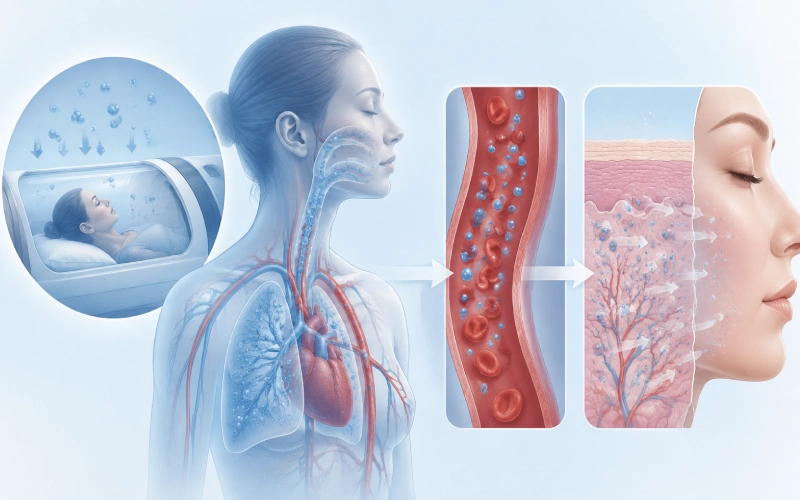
At normal pressure, oxygen transport leans heavily on red blood cells. Inside a hyperbaric chamber, pressure shifts the math. More oxygen dissolves directly into plasma. That matters because dissolved oxygen can move through tissue by diffusion without waiting on the usual bottleneck.
That is the first real change.
Not collagen. Not radiance. Not some vague “cell boost.”
Transport.
Skin notices transport before it shows anything worth photographing.
The skin response runs on three different clocks
1. The fast clock: oxygen availability
This is the immediate layer. More dissolved oxygen means the gradient into tissue changes. Skin gets access to a different oxygen environment for a short window.
That can affect how the skin looks in the near term. Brighter. Less flat. Sometimes just less dull.
Not because the face suddenly became younger. Because tissue optics and circulation-related behavior can shift before structure does.
2. The middle clock: signaling
Cells do not read oxygen like a simple fuel meter.
Short bursts of high oxygen can also act as a signal. Then the return toward baseline matters too. That change in direction seems to be part of the story. Not only the peak.
This is why the chamber conversation gets messy. People assume the effect comes from “a lot of oxygen.” Sometimes the more useful idea is fluctuation. The rise. The drop. The repeated contrast.
Skin architecture responds to signals long before it fully rebuilds itself.
3. The slow clock: matrix assembly
This is the part that gets reduced to “collagen,” which is lazy but not completely wrong.
Collagen is not just produced. It has to be processed, stabilized, and organized. Some of those steps depend on oxygen. If oxygen handling changes, the matrix environment can change with it.
That still does not mean a hyperbaric chamber prints fresh skin on command. It means the conditions for stronger assembly can improve. Slower than people want. Slower than headlines imply.
Texture lives here. Elastic behavior too. So does that harder-to-name difference between skin that looks briefly lit and skin that looks more settled.
Why “glow” is a bad word, but still useful
Glow is one of those words that survives because nobody wants to explain the layers.
Usually it means three different things at once:
- a short-term change in light reflection
- a circulation or vessel-related shift
- a slower change in the skin matrix
Those are not the same event. They do not run on the same timeline. They should not be judged the same way.
A same-day change is mostly not the same as a structural change. A camera-friendly change is mostly not the same as a lasting one. And a chamber session is not skincare in the usual sense, even when the outcome gets talked about that way.
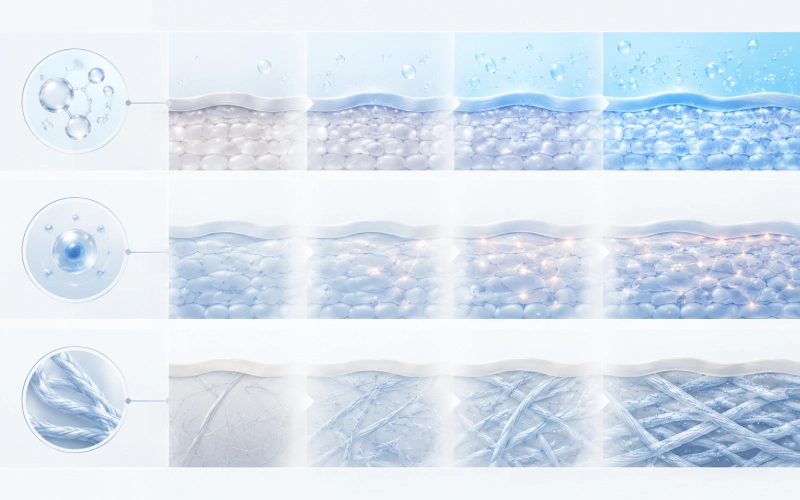
What the chamber may be changing under the surface
The interesting part is not “oxygen in.” The interesting part is what skin does with that change.
Dissolved oxygen changes the delivery route
That sounds technical. It is actually the simplest part.
A pressurized oxygen session changes how oxygen is carried, not only how much is inhaled. Delivery route matters. Skin at the far end of the microvascular map notices route changes more than beauty language does.
Repeated exposure may alter signaling patterns
One isolated session is mostly a short event.
Repeated sessions are different. Not magical. Just different. Skin is a remodeling system. Repetition tends to matter more than intensity in one afternoon.
Matrix behavior depends on more than “making more collagen”
This is another common miss.
Even when collagen-related pathways are involved, the visible result depends on balance: build, breakdown, organization, fiber quality, and the surrounding scaffold. If one article tells the whole story with the phrase “boosts collagen,” that article is taking a shortcut.
A convenient shortcut. Still a shortcut.
What current skin-focused evidence really supports
The strongest skin-specific signal so far is not “everyone glows.”
It is narrower than that.
A small skin-sample study in older adults reported shifts that leaned structural rather than purely cosmetic: denser collagen, longer elastic fibers, more small vessels, and fewer senescent cells after a long run of sessions. Useful. But still narrow. Small sample. Specific group. Repeated exposure over time.
So yes, there is a real mechanism case here.
No, that does not turn every chamber session into an instant beauty event.
The honest frame is simpler: the physics are strong, the biology is plausible, the skin-facing human data is promising but still limited.
That is enough. It does not need decoration.
What changes first, what changes later
| Layer | What is happening | What you may notice | How fast it tends to show |
| Oxygen transport | More oxygen dissolves into plasma under pressure | Skin can look less flat or less tired | During or soon after a session |
| Signaling | Short hyperoxic exposure and the return toward baseline create a signaling pulse | Harder to “see” directly, but this is where repeat exposure starts to matter | Session to session |
| Matrix assembly | Oxygen-dependent chemistry supports collagen handling and fiber organization | Texture and firmness-type changes, if they happen, belong here | Slower |
| Repeated remodeling | Small human skin data suggests structural shifts after many sessions | More meaningful than a one-day glow | Weeks to months |
What a hyperbaric chamber does not do
It does not replace daily skin basics.
It does not erase sun history.
It does not make every bright-looking selfie meaningful.
And it does not turn one good session into a permanent skin event.
A lot of the disappointment around hyperbaric oxygen therapy for skin comes from timeline confusion. People expect the slow clock to behave like the fast clock. Then they overread the mirror.
A better way to judge results
Keep the conditions boring.
Same lighting. Same time of day. Same camera distance. Same hydration habits. Same lens. No “I just slept nine hours and drank two liters of water” cheating.
Then split your observations into two bins:
Bin one: quick appearance shifts
This is the immediate look. Brighter. Fresher. Less gray. Sometimes real. Sometimes just context.
Bin two: slower structural shifts
This is the part worth more attention. Texture. Surface smoothness. Bounce. The look of skin when it is not trying to impress the camera.
Those two bins should never be merged. Most bad content merges them on purpose.
Why the hyperbaric chamber conversation keeps getting overstated
Because “oxygen” sounds simple.
It is not simple. It is dose, pressure, timing, repetition, tissue context, and biological response. Too many moving parts for a one-line promise.
That is why the smartest way to talk about glowing skin here is also the least glamorous one:
A hyperbaric chamber may improve the conditions that skin uses to organize itself.
That is the real mechanism.
Not sparkle. Not instant transformation. Conditions.
FAQ
Does a hyperbaric chamber make skin glow after one session?
It can change how skin looks in the short term because oxygen transport changes right away under pressure. But the slower, more structural shifts sit on a different timeline. One session and repeated sessions should not be judged by the same standard.
Is hyperbaric oxygen therapy for skin mostly about collagen?
Not only. The bigger picture includes oxygen diffusion, signaling patterns, matrix organization, fiber behavior, and small-vessel changes.
Why does pressure matter so much?
Because the chamber changes how oxygen dissolves into plasma. That is the mechanism that makes it different from simply breathing oxygen at regular pressure.
Is “glowing skin” the right way to describe the effect?
Only partly. “Glow” is a catch-all word. It mixes short-term brightness with slower structural change. Those are separate things.
Are repeated sessions more meaningful than a single session?
Usually that is the more serious frame. Skin is not a switch. It is a remodeling system. Repetition tends to matter more than one isolated peak.
Is this the same as putting oxygen on the skin from the outside?
No. A hyperbaric chamber changes oxygen delivery through the lungs, blood, and tissue gradient. Surface oxygen approaches use a different route.
What is the most realistic expectation?
Think in layers. A quick appearance shift may happen first. A slower texture shift, if it happens, comes later. The visible story is downstream from the transport story.
Final word
If you want the cleanest explanation, it is this:
A hyperbaric chamber does not make skin glow by “feeding” it in some vague cosmetic way. It changes oxygen handling under pressure. That shift can alter signaling. Repeated exposure may then support slower matrix-level changes.
Glow is just the loose human word for that chain of events.