
If you want the short answer first, here it is:
- 5 to 10 sessions is usually a test block
- 10 to 20 sessions is a real starting range
- 20 to 40 sessions is where most serious chamber plans sit
- 40+ sessions only makes sense when the chamber output, session length, and weekly rhythm are all tight
That is the clean version.
The less clean version, which is the real one, is this: session count by itself means almost nothing. A hyperbaric chamber session is not a magic unit. Twenty weak sessions do not equal twenty strong ones. Ten scattered sessions do not behave like ten tightly grouped sessions. Same number on paper. Different block in real use.
From our side, we look at four things before we even talk about total sessions:
- Pressure
- Minutes at working pressure
- Sessions per week
- How the full block is grouped
Miss one of those, and the session count turns into decoration.
The Range Most People Actually Work Inside
Here is the range we use when we talk about chamber planning in plain language.
| Session Range | What It Usually Means | Common Weekly Rhythm | What You Should Check First |
| 5–10 sessions | Trial block | 2–5 per week | Is the chamber output even worth repeating? |
| 10–20 sessions | First real block | 3–5 per week | Are pressure and working time consistent? |
| 20–40 sessions | Full working block | 4–5 per week | Is the schedule dense enough to make the block coherent? |
| 40+ sessions | Extended plan | Usually phased | Is there a reason for the extension, or just habit? |
That table is not a universal law. It is a planning frame. Still useful.
Because this is where people get lost: they compare package size before they compare chamber output. That is backwards.
The Number Is Not the Number
A chamber provider says “20 sessions.”
Fine. Twenty sessions at what pressure? For how long at working pressure? How many days per week? How much of the booking is just compression and decompression? Are those sessions packed into four weeks, or stretched across three months?
That is why one person hears 10 sessions and another hears 40. Neither number is wrong on its own. The missing context is the whole story.
In our shop, we treat session count as the last variable, not the first.
What Actually Changes the Session Count
1) Pressure changes the pace
This one is obvious. People still skip it.
A lower-pressure hyperbaric chamber usually needs a longer runway if the goal is a heavier block. A higher-pressure chamber can compress the calendar, or reduce the number of sessions needed to build the same kind of block. Not always. Often enough that it matters.
So when someone asks, “Do I need 20 sessions or 40?” the first reply should be, “At what ATA?”
Without that, you are guessing.
2) Booked time and working time are not the same thing
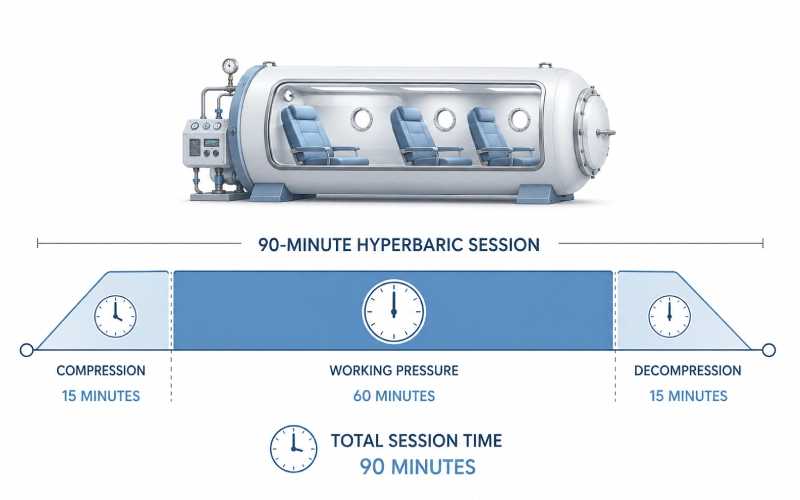
A 90-minute booking is not always 90 minutes of real chamber work.
Some sessions have long ramp-up and ramp-down periods. Some do not. Some operators count the whole appointment as session time. Others focus on the middle, where the chamber is already settled and holding at target pressure.
That middle section is the part that carries most of the weight.
So before you compare session counts, compare minutes at working pressure. That one detail clears up a lot of fake confusion.
3) Weekly density matters more than people admit
Ten sessions in two weeks is one kind of block. Ten sessions spread across ten weeks is another.
People like to talk about total count because it sounds neat. Real chamber planning is not neat. It is clustered. Or it should be.
When sessions are too far apart, the block loses shape. The chamber may still run. The calendar may still look full. But the structure gets soft. You are no longer building with repetition. You are just collecting visits.
That is usually where weak plans go wrong.
4) First block and maintenance are not the same thing
This gets mixed together all the time.
An initial block is where people try to establish rhythm, tolerance, consistency, operator fit, and chamber fit. A maintenance rhythm is different. Smaller. Looser. Sometimes much looser.
So when someone says, “I only do one session a week,” the real question is: one session a week after what?
After a solid front-loaded block, maybe that makes sense. As the whole plan from day one, maybe not.
When 10 Sessions Is Enough
Sometimes 10 sessions is enough to answer the practical question.
Not the philosophical one. The practical one.
Can you hold the schedule?
Does the chamber cycle fit your week?
Is the operator reliable?
Is the pressure class what you thought it was?
Is the working-pressure window long enough to justify coming back?
That is what a 10-session block is good at.
A short block can tell you whether the setup is real. It cannot always tell you whether the full runway should stop there.
When 20 to 40 Sessions Starts Making Sense
This is where the conversation gets more serious.
Once a chamber plan is built around repetition rather than curiosity, the block usually moves into the 20 to 40 session range. Not because 20 and 40 are magic numbers. Because that is where pressure, duration, and schedule density start behaving like a system instead of a sample.
There is a difference between trying the chamber and actually running a chamber block.
People feel that difference fast. So do operators.
And yes, there are cases where the count goes beyond 40. But that only holds together when the chamber output is clear, the schedule is disciplined, and the extension is being done for a reason. Not just because the package exists.
A Better Way to Think About the Right Number
Do not ask for the perfect number. There usually is not one.
Ask for the right block shape.
- If pressure is lower, the block often gets longer
- If working time is shorter, the block often gets longer
- If the weekly rhythm is loose, the calendar gets longer
- If the initial block is dense and well-run, the total count may not need to drag
That is the logic. It is not glamorous. It is useful.
And honestly, useful is enough.

What We Tell Buyers From the Manufacturing Side
We tell them this:
Do not buy sessions like coupons.
Do not compare packages by count alone.
Do not assume every hyperbaric chamber session is built the same way.
And do not let a round number make the decision for you.
A chamber block should be measured by output, not by brochure language.
That sounds obvious. Then people ignore it and buy the cheaper “20-session package” anyway.
Later they find out the pressure is lower than expected, the working segment is shorter than expected, and the block is spread too thin to hold shape.
The number looked good. The structure was bad.
FAQ
How many hyperbaric oxygen therapy sessions do most people start with?
Most people start with 5 to 10 sessions as a trial block or 10 to 20 sessions as a real first block. That is usually enough to judge schedule fit, chamber output, and whether the block should be extended.
Is 10 hyperbaric chamber sessions enough?
Sometimes yes. Sometimes no.
Ten sessions is often enough to test the setup. It is not always enough to judge a longer chamber plan built around repetition.
Is 40 sessions too many?
Not automatically.
But once you move past 40, the reason should be clear. Higher counts make more sense when pressure, working time, and weekly rhythm are all being managed tightly. If those parts are loose, adding more sessions usually does not fix the underlying problem.
Does chamber pressure affect how many sessions you need?
Yes. A lower-pressure hyperbaric chamber usually requires a longer block to build the same kind of cumulative workload. Pressure changes the pace. It changes the math too.
Are all 90-minute sessions the same?
No.
A 90-minute appointment can include very different amounts of real time at working pressure. That is why booked time alone is a weak comparison point.
How often should sessions be scheduled each week?
For a serious first block, most chamber plans are tighter than people expect. Three to five sessions per week is common for a structured block. Once sessions get spaced too far apart, the block often loses coherence.
What is more important: session count or session quality?
Session quality. Every time.
A smaller block with the right pressure, real working time, and a disciplined weekly rhythm is often more coherent than a larger block built on weak session design.
What should I ask before choosing a hyperbaric chamber package?
Ask for:
- target ATA
- minutes at working pressure
- total appointment length
- compression time
- decompression time
- sessions per week
Without those six numbers, a session count is just a sales label.
Final Word
If you want one number to hold onto, use this:
Most serious hyperbaric chamber plans land somewhere between 10 and 40 sessions.
But do not stop there.
Because the real answer is never just the number.
It is the pressure. The working time. The weekly rhythm. The shape of the full block.