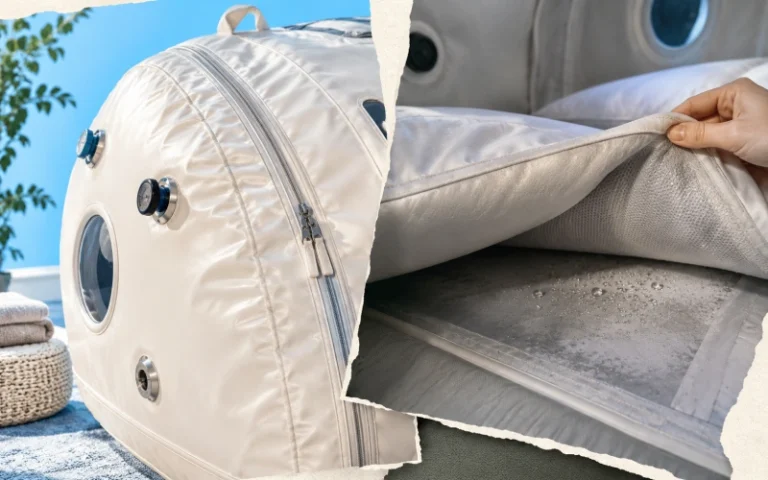


Most damage we see on hyperbaric chambers doesn’t come from age. It comes from someone doing the right thing — cleaning the chamber — with the wrong product, on the wrong part.
Grab whatever’s under the sink, wipe down the whole chamber the same way, and you’ve probably just started a slow problem: a viewport that goes cloudy, a door seal that turns tacky, a soft-shell hull that stops looking new. None of that shows up on day one. It shows up eight months in, when you’re wondering why the acrylic looks scratched even though you “cleaned it every week.”
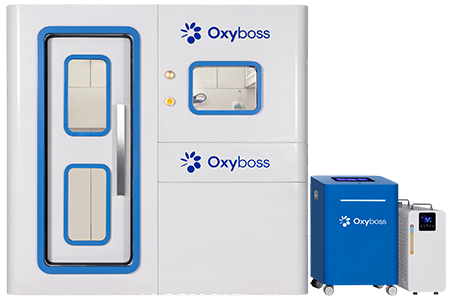
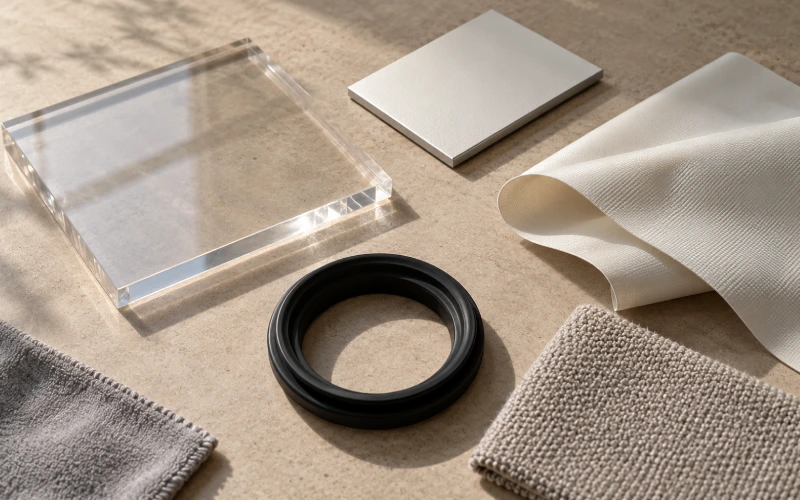
The truth is a hyperbaric chamber isn’t one surface. It’s several different materials bolted together — rigid acrylic or polycarbonate viewports, painted or coated metal shells, TPU or PVC soft-shell hulls, rubber door seals, fabric-covered padding, and a compressor filtration system — and each one has a different list of things that will quietly ruin it. This page is that list, organized by part, so you can look up what you’re about to clean before you clean it, not after.
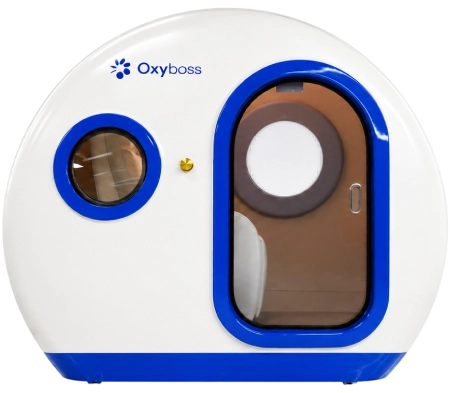
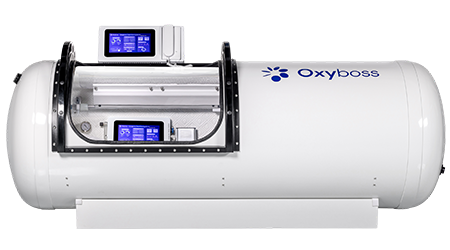
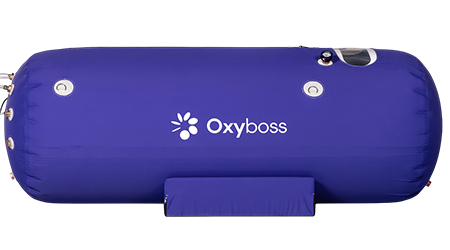
We build both rigid hard-shell chambers with acrylic viewports and flexible TPU soft-shell chambers, so we’ve split the guidance where the two genuinely differ, and kept it together where they don’t.
Why “just wipe it down” isn’t really a routine
Ask five chamber owners how they clean their chamber and you’ll get five different half-answers — a damp cloth, a spray bottle of whatever’s on the shelf, “I don’t really, it looks fine.” That’s not a criticism; it’s just what happens when nobody ever laid out which surface tolerates which product. Compare that to how any pressure vessel is actually documented: there’s no single universal recipe covering every chamber, every material, and every cleaning product on the market — the right method always depends on what the manufacturer’s own instructions for that specific chamber say. What is consistent, and what actually matters for you, is the material science: certain chemicals interact badly with certain plastics regardless of who made the chamber. That part we can talk about plainly.
So instead of a one-size formula, think in ranges and rules of thumb, then match them to your chamber’s material — that’s a far more reliable way to keep a chamber both clean and intact.
The part everyone skips: know what your chamber is made of
Before touching any cleaner, check two things: what your viewport is made of, and what your hull or shell is made of. That’s it — those two answers change almost everything else on this page.
- Rigid acrylic (PMMA) viewports and cylinders — the clear, hard viewing panels on hard-shell chambers.
- Polycarbonate windows — used on some models instead of, or alongside, acrylic; looks similar, behaves differently under chemical exposure.
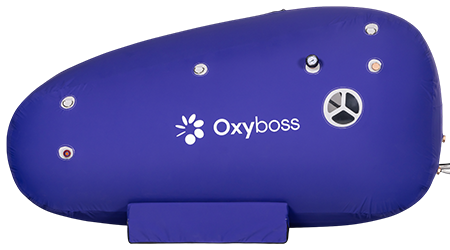
- TPU or PVC soft-shell hulls — the flexible fabric-like material on portable, inflatable chambers.
- Painted or coated metal shells — the hard exterior body on rigid chambers.
- Rubber and silicone seals — door gaskets, zippers on soft-shell units, and O-rings.
If you don’t know which one you have, the honest answer is: ask before you spray. A cleaner that’s perfectly fine on painted metal can leave a rigid acrylic viewport permanently clouded, and a product that’s gentle on acrylic can still swell or discolor a TPU soft shell over time.
Acrylic and polycarbonate viewports: the one rule that matters most
This is the single most expensive mistake we see, so it gets its own section before anything else.
Never use high-concentration alcohol — ethanol, isopropanol, benzyl alcohol — or strong solvent-based cleaners on acrylic or polycarbonate. Repeated exposure causes a fine network of hairline cracks called crazing, along with clouding, whitening, and loss of clarity. It doesn’t happen after one wipe. It happens after the twentieth wipe, which is exactly why it catches people off guard — by the time you notice, the damage is already done and it isn’t reversible with more cleaning.
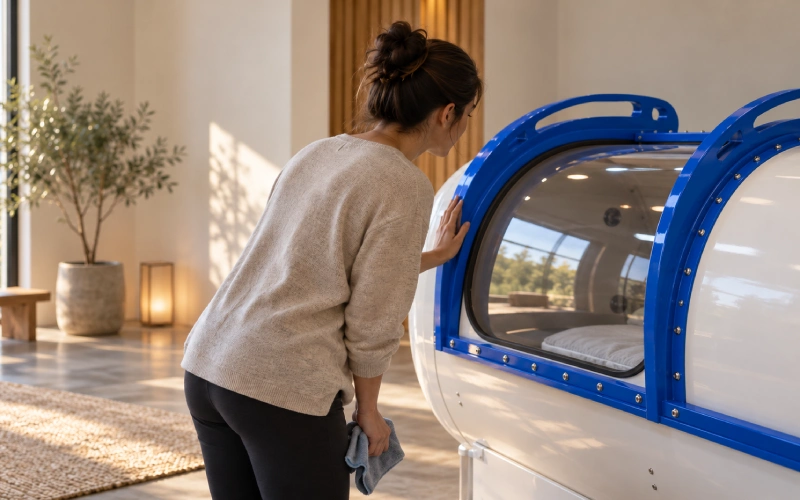
What actually works: a soft, lint-free cloth with warm water and a small amount of mild soap, or a cleaner your chamber’s documentation specifically lists as viewport-safe. Apply the product to the cloth, never spray it straight onto the surface, and never use abrasive pads, scouring tools, or power buffers — acrylic scratches easily and every scratch is permanent. Keep UV-C light sources away from acrylic entirely; UV-C exposure is a known cause of long-term acrylic degradation.
One more detail that trips people up: acrylic and polycarbonate are not interchangeable when it comes to chemical tolerance. A cleaner that’s fine on one is not automatically fine on the other, and neither is automatically fine across different chamber brands or acrylic grades. If your documentation doesn’t say it’s safe for your specific viewport, treat it as not safe.
What to look for: hold the viewport under bright, angled light and check for fine surface cracking, a hazy or whitened film, discoloration, or edge damage. Any of these is a sign to stop using whatever product was last applied — a compromised viewport is a structural issue, not just a cosmetic one, since it’s part of what holds pressure.
TPU and PVC soft-shell chambers: same care, different chemistry
Soft-shell chambers get treated too casually, probably because they look less “technical” than a rigid steel or aluminum unit. The material still has real limits.
For weekly maintenance, wipe the interior mattress and the TPU or PVC hull with a damp cloth and a mild, unscented, non-toxic dish soap, or a hydrogen-peroxide-based cleaner rated safe for hyperbaric use. After cleaning, leave the zipper open so the interior can fully air-dry — sealing a damp chamber closed is one of the more common causes of the musty smell owners complain about months later.
The material-specific warning here: ozone cleaning cycles, which work well on hard-shell chambers, are not a good fit for soft-shell units. Ozone can react with flexible polyurethane or vinyl over repeated exposure, causing premature yellowing and a loss of that clean, new-looking finish. It’s not a structural failure, but it’s permanent and it’s avoidable — stick to liquid cleaners on soft-shell chambers instead.
The zipper and seam area deserves its own check. This is where moisture collects and where a damp cloth alone doesn’t reach. Run your fingers along the seam after cleaning and feel for lingering dampness before you close the chamber back up.
Door seals, gaskets, and zippers: small parts, expensive consequences
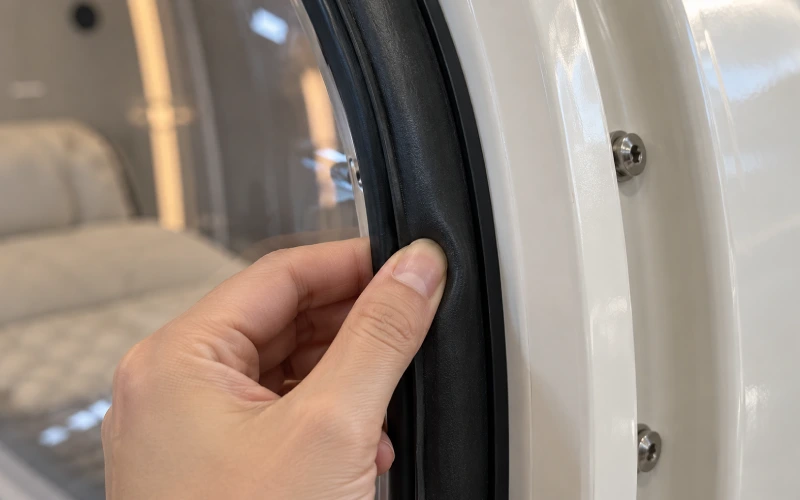
Seals fail quietly. Nobody notices a gasket going tacky or slightly flattened until the day the chamber won’t hold pressure properly, and by then the seal has usually been degrading for weeks.
Wipe seals and gaskets with a mild, manufacturer-approved cleaner on a damp cloth, working soil out of the grooves without stretching or pulling the material. Skip petroleum-based lubricants unless your documentation explicitly says a specific lubricant is safe for that seal in an oxygen environment — the wrong lubricant can be an ignition risk in oxygen-rich conditions, not just a maintenance shortcut gone wrong.
Alcohol-based products deserve a second mention here because they show up twice on this page for a reason: repeated alcohol exposure can swell, harden, or crack rubber and some plastic seal materials, the same way it damages acrylic. What’s convenient for a quick wipe today can shorten the seal’s working life over months.
What to look for: cracks, flattening, a sticky or tacky texture, swelling, or a seal that no longer springs back to its original shape after you press it. Any of these means the seal is on its way out — inspect it at every use if you can make a habit of it, because a failed seal shows up as a pressure or lock problem, not as a visible mess.
Mattress, padding, and fabric surfaces
Fabric holds onto moisture and odor longer than any hard surface, which is why it needs its own routine rather than an afterthought pass with whatever you used on the shell.
Remove covers where possible and launder them separately. For padding that can’t be removed, clean with a mild soap solution and make sure it’s fully dry — not just surface-dry — before the chamber goes back into use. Pay attention to seams, folds, zippers, and the underside of cushions, since that’s where moisture and odor actually build up, not on the flat top surface everyone remembers to wipe.
What to look for: a persistent odor even after cleaning, visible staining, compressed or lumpy padding, or a cover that’s torn or worn through. A torn cover isn’t just cosmetic — once the inner foam is exposed, it absorbs moisture and becomes much harder to keep clean, and at that point replacing the cover is cheaper than fighting the smell every week.
Compressor filters and air intake: the part almost nobody thinks to check
If there’s one section on this page most people have never read anywhere, it’s this one. Filters get mentioned in passing everywhere and detailed almost nowhere.
Two filter types matter here: the intake filter, which cleans the air going into the compressor, and the exhaust path, which needs to stay clear so air can leave the chamber properly. Filter media itself shouldn’t have liquid cleaner applied directly to it — spraying cleaner into a filter doesn’t clean it, it just clogs it faster and can push residue into the air path. Instead, inspect the filter housing regularly for dust, moisture, or visible contamination, and replace the filter element itself on a schedule based on how often you use the chamber, not a fixed calendar date. A chamber run daily needs filter checks far more often than one used twice a week.
Keep exhaust vented away from doors, windows, and foot traffic, and make sure nothing — bags, towels, furniture — is blocking either the intake or the exhaust path. Restricted airflow is one of the more common causes of a chamber that “just doesn’t smell as fresh” as it used to, and it’s usually not the cleaning routine at all — it’s a filter overdue for replacement.
What to look for: visible dust buildup on the housing, unusual compressor noise, a musty smell that cleaning the interior doesn’t fix, or a filter that looks discolored or damp. Any of these is a sign it’s time to check the filter, not reach for more cleaner.
Controls, handles, and touch surfaces
The parts you touch most are the parts that get cleaned least carefully, usually because people are worried about liquid getting into a switch or display.
That worry is reasonable — apply cleaner to the cloth, never spray it directly onto a control panel, keyboard, or display. Wipe visible soil off first before cleaning further, since wiping dirt around with a wet cloth just spreads it. Isopropyl alcohol is fine for small electronic touch points like sensor cables, but keep it away from any area near oxygen delivery components, since it’s flammable while wet.
What to look for: liquid residue inside seams or around buttons, a control that feels sticky after cleaning, or a display that’s harder to read than it used to be. Liquid that gets into a control housing doesn’t always cause immediate failure — sometimes it just causes an intermittent fault weeks later that’s hard to trace back to a cleaning session.
How often, really
There’s no single number that fits every household, every wellness setting, and every usage pattern, so use the following as starting ranges to adjust based on how heavily your chamber gets used, not as a fixed rule.
For a chamber used by one person at home a few times a week: wipe the interior mattress and hull weekly, check the compressor intake filter monthly, and give seals and the viewport (or soft-shell seams) a closer visual inspection at the same time. For a chamber that sees daily use or gets shared between more than one person, tighten that to wiping high-touch surfaces after each session and checking filters more frequently — the exact interval depends on your specific model’s documentation, but “more people, more sessions” always means “shorter intervals,” never longer.
Keeping a simple record actually pays off
This part gets skipped constantly, and it’s the cheapest insurance on this entire page.
You don’t need anything elaborate — a notebook or a simple spreadsheet works. For each cleaning session, note the date, what was cleaned, what product was used, and anything you noticed (a seal that felt slightly stiff, a filter that looked dusty). The point isn’t paperwork for its own sake. It’s that when something does go wrong six months from now, you’ll be able to tell whether it’s new or something you’d already noticed — and if you ever need to make a warranty claim or resell the chamber, a maintenance record is the difference between “trust me” and having something to actually show.
Frequently asked
How often should a home hyperbaric chamber be cleaned? As a starting point, wipe the interior weekly for regular home use, and inspect seals, viewports, and filters at the same time. Adjust upward if more than one person uses the chamber or if it’s used daily.
Can ozone be used to clean a hyperbaric chamber? It’s commonly used on hard-shell chambers but generally avoided on soft-shell units, since it can cause the flexible material to yellow over repeated exposure. If you have a soft-shell chamber, stick to liquid cleaners instead.
What can be used to clean acrylic chambers safely? A soft, lint-free cloth with warm water and mild soap, or a cleaner specifically listed as acrylic-safe in your chamber’s documentation. Avoid high-concentration alcohol and solvent-based products — they’re the leading cause of the hairline cracking (crazing) that permanently clouds acrylic over time.
Do hyperbaric chambers require professional servicing? Routine cleaning is something most owners handle themselves. Anything involving the internal compressor, oxygen delivery components, or a pressure-related fault should go to a qualified technician — those parts aren’t meant for at-home disassembly.
Is it safe to use bleach on a hyperbaric chamber? Diluted bleach is sometimes used on hard, non-acrylic surfaces, but it must never touch acrylic or polycarbonate viewports unless your specific chamber’s documentation explicitly approves it, and it can corrode nearby metal fittings if left in contact too long. When in doubt, use a milder product instead — the risk of getting the dilution or contact time wrong usually outweighs the benefit.
Can I use the same cleaner on every part of the chamber? No — that’s really the whole point of this page. A product that’s safe on a painted metal shell or a fabric cover is not automatically safe on acrylic, polycarbonate, or seal material. Match the product to the part, every time.
What’s the biggest mistake people make cleaning a chamber? Reaching for an alcohol-based or solvent-based product on acrylic, polycarbonate, or rubber seals because it seems like the strongest option. It’s the single most common cause of the clouding and seal damage owners run into — and it’s completely avoidable once you know which surfaces can’t tolerate it.
Quick reference
| Part | Safe to use | Avoid | Watch for |
| Acrylic / polycarbonate viewports | Mild soap and warm water on a soft cloth; a documented viewport-safe cleaner | High-concentration alcohol, solvents, abrasive pads, UV-C exposure | Hairline cracking (crazing), clouding, whitening |
| TPU / PVC soft-shell hull | Mild unscented dish soap, or a hydrogen-peroxide cleaner rated safe for hyperbaric use | Repeated ozone cycles, harsh solvents | Yellowing, stiffening or tackiness at seams |
| Door seals, gaskets, zippers | Mild approved cleaner on a damp cloth | Alcohol, petroleum-based lubricants unless documented safe | Cracking, flattening, tackiness, swelling |
| Painted / coated metal shell | Mild soap and water | Abrasive scouring, undiluted bleach | Rust spots, coating loss, corrosion near fittings |
| Mattress, padding, fabric | Mild soap solution; full air-dry before reuse | Reusing torn or soaked covers | Persistent odor, staining, compressed padding |
| Compressor intake / exhaust filters | Dry inspection, scheduled replacement | Spraying liquid cleaner directly onto filter media | Discoloration, dampness, reduced airflow |
Sources referenced
The material-compatibility notes above reflect general polymer and surface-chemistry findings published by independent researchers and public regulatory bodies — not brand-specific claims:
- Nature Portfolio / Heritage Science — peer-reviewed study on solvent effects on PMMA (acrylic), confirming that alcohols cause surface crazing and stiffening with prolonged contact: https://www.nature.com/articles/s40494-023-00881-z
- U.S. Environmental Protection Agency (EPA) — registered antimicrobial cleaning product database and label requirements: https://www.epa.gov/pesticide-registration/selected-epa-registered-disinfectants
- ASTM International — material and gas-service compatibility standards, referenced for oxygen-environment component cleanliness: https://www.astm.org
This page is general maintenance guidance for our chambers. It doesn’t replace the specific care instructions for your model — when the two disagree, always follow what’s documented for your unit.