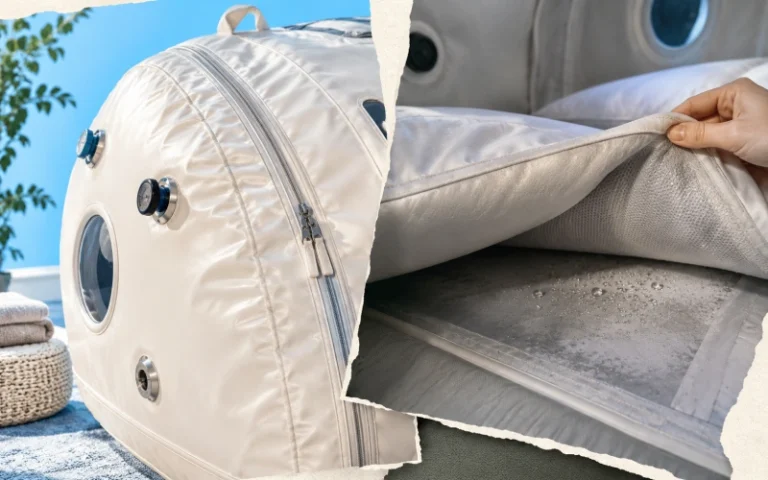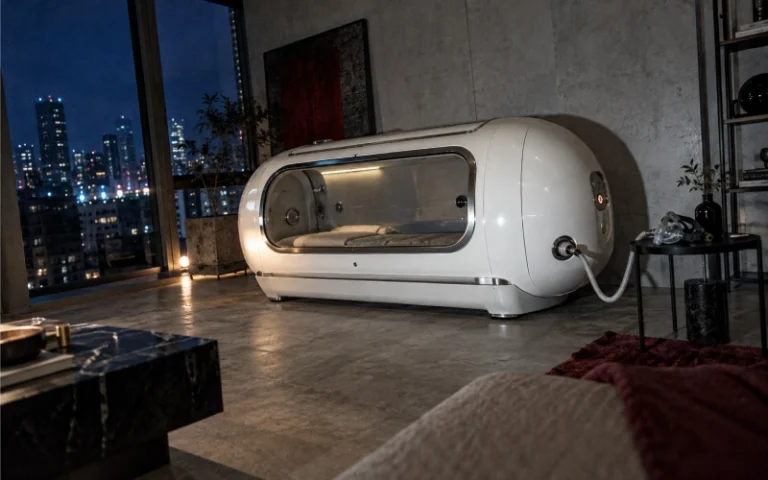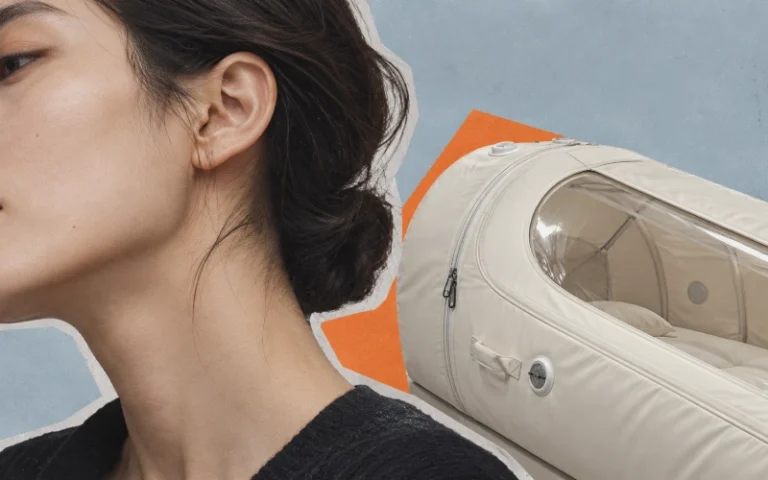
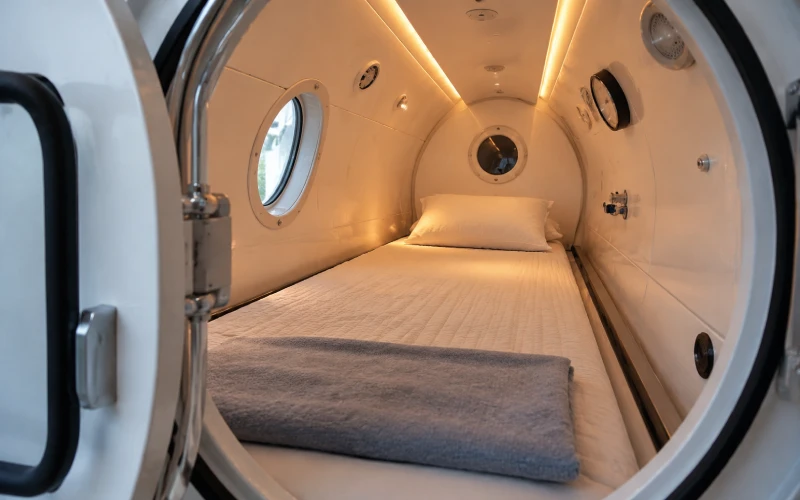
A hyperbaric chamber mattress isn’t one thing—it’s three layers working together. Each layer has its own hygiene rules. Get the layers wrong and you’ll either chase contamination you can’t fix, or replace things that didn’t need replacing. This guide breaks down which rule belongs where.
The three-layer model
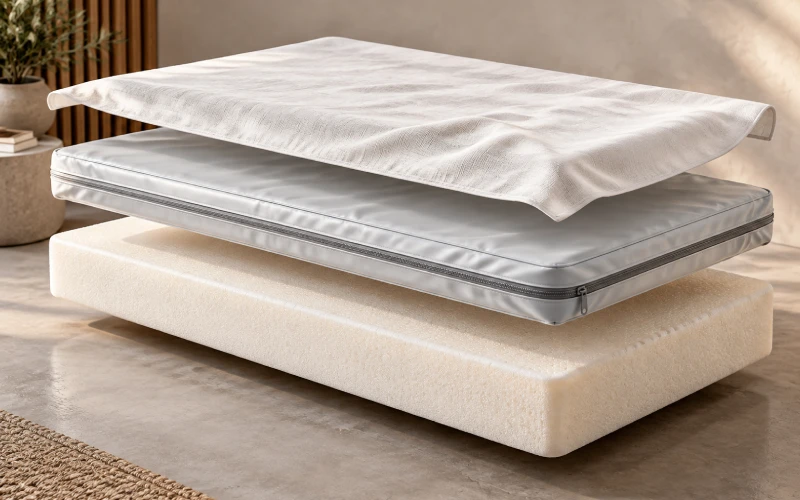
Most confusion about mattress hygiene comes from mixing up what belongs to which layer. Here’s the structure:
| Layer | What it does | How you maintain it | When you replace it |
|---|---|---|---|
| Linen layer (sheets, pillowcases, patient clothing) | Direct skin contact | Machine washable · Remove after every session | When worn or no longer washes clean |
| Cover layer (the mattress protector) | Keeps liquid away from the foam · Wipe-cleanable surface | Wipe with facility-approved disinfectant · Not routinely laundered | When liquid reaches the foam core, or the cover shows cracks/tears/pinholes |
| Core layer (foam pad, contoured insert) | Cushioning and fit | Never washed · Protected by the cover | If liquid penetrates through the cover and contaminates it |
Why this matters: You’ll see claims online that say “only 100% cotton items” should go in a chamber, and other places selling vinyl or polyurethane zippered covers. Both are describing real constraints—but they’re talking about different layers. Cotton belongs to the linen layer (static and flammability control). Vinyl or PU laminate belongs to the cover layer (fluid resistance and wipe-clean requirements). Mixing the two is what creates the false conflict.
What drives the material rules
The reason certain materials are restricted in hyperbaric environments isn’t the pressure—it’s the chamber atmosphere. If your chamber supplies supplemental oxygen, static buildup and flammability become governing factors. If your chamber runs on compressed air (same composition as room air), those constraints don’t apply the same way.
The “100% cotton” recommendation you’ll find on supplier websites comes from linen distributors, not from a published regulation. It’s an industry practice grounded in oxygen-enriched safety principles, but it’s not codified. Check your chamber manufacturer’s manual for the specific material requirements that apply to your setup.
The cover layer: what “fluid-proof” actually means
A mattress cover’s only job is to prevent liquid from reaching the foam core. Once liquid gets to the foam, the core has to be replaced—there’s no practical way to disinfect porous foam after contamination.
The cover must be:
- Fluid-resistant or fluid-proof: No liquid penetration under normal use
- Wipe-cleanable: Smooth enough to disinfect with EPA-registered disinfectants
- Anti-static: Won’t build up charge in the chamber environment
- Seam-sealed: Inverted or taped seams so fluid can’t wick through stitching
- Zippered encasement: Full coverage—not just a fitted sheet
Common cover materials include vinyl (PVC), polyurethane-laminated fabric, and thermoplastic polyurethane (TPU). Each has tradeoffs in breathability, durability, and disinfectant compatibility.
What you should ask before you buy a cover
When you’re sourcing a replacement cover, here’s what to request from the supplier:
| Ask for | Why it matters |
|---|---|
| Material composition & SDS | Confirms what the cover is made of and whether there are off-gassing or compatibility concerns |
| Flammability test report and test conditions | A claim like “meets 16 CFR Part 1632 (Class A)” only tells you it passed a test done at sea level in normal air—not whether it’s safe in your chamber’s atmosphere |
| Antimicrobial test method (if claimed) | ISO 22196 and similar standards are tested at ambient conditions. An antimicrobial claim doesn’t eliminate the need for routine disinfection |
| Cleaning instructions | Can it be machine washed? Autoclaved? Is ozone safe? What disinfectants are compatible? |
| Zipper & seam type | Look for inverted seams and fully enclosed zippers—these prevent liquid from sneaking through stitching |
A note on test conditions: Flammability and antimicrobial tests are typically performed at 21% oxygen and normal atmospheric pressure. Those results don’t automatically transfer to oxygen-enriched or pressurized environments. The Undersea and Hyperbaric Medical Society (UHMS) Safety Committee has noted that limited oxygen index tests are not designed to predict material behavior in hyperbaric oxygen conditions. If your chamber uses supplemental oxygen, this gap matters.
How to inspect and when to replace
Visual inspection is the most practical way to catch problems before they turn into contamination events. After each session, or at least daily:
- Check the cover surface for cracks, tears, pinholes, snags, or stains
- Inspect seams and zippers for separation or wear
- Look for moisture underneath—if the foam feels damp, liquid has already breached the cover
- Bed bug inspection (for shared-use settings): Use a high-lumen flashlight to check folds, creases, and zipper edges for dark spots, shed skins, or live insects
The replacement trigger is simple: If liquid reaches the foam core, the cover has failed. Replace both the cover and the foam. Surface-level damage (minor scuffs, discoloration) doesn’t necessarily mean the cover has lost its barrier function, but cracks and tears do.
What about bed bugs?
Bed bugs are a mattress problem, not a chamber-surface problem. Standard disinfectants don’t kill them. The only reliable approaches are:
- Physical inspection (as described above)
- Heat treatment of linens (wash at ≥130°F / 54°C)
- Encasement-style covers that trap bugs inside and prevent them from reaching users
If you’re in a multi-user or institutional setting, routine bed bug inspection should be part of your standard handoff checklist—not something you wait to do until someone reports bites.
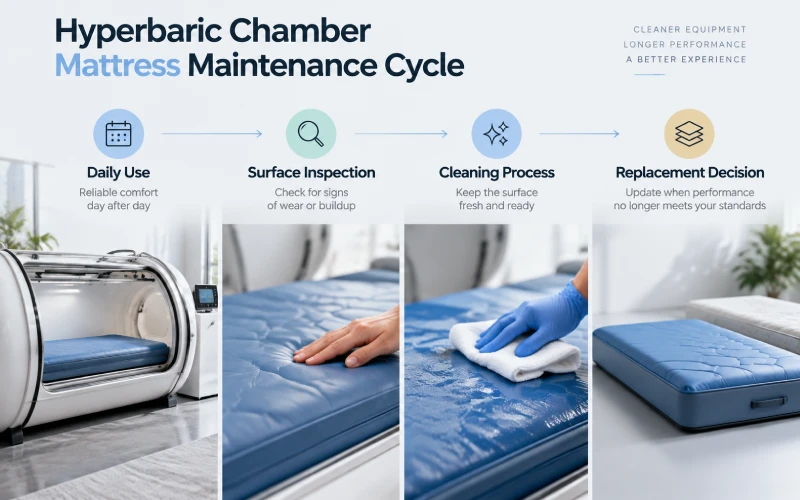
Cleaning: which disinfectant for which surface
Different surfaces in a chamber require different cleaning agents. The mattress cover is wipe-cleanable; chamber walls may have their own restrictions.
| Surface | Compatible disinfectants | What to avoid |
|---|---|---|
| Vinyl or PU mattress cover | Quaternary ammonium compounds (quats), phenolics, diluted bleach (follow label), hydrogen peroxide | Abrasive scrubbing, solvents that degrade plastic |
| Acrylic chamber walls | Mild detergent, approved acrylic-safe cleaners | Alcohol-based disinfectants (can cause crazing), ammonia |
| Cotton linens | Standard laundering with detergent; optional bleach | Fabric softener (leaves residue) |
Contact time matters. Most disinfectants need 1–10 minutes of wet contact to be effective. Spraying and immediately wiping doesn’t disinfect—it just moves contamination around. Check the product label for the required dwell time.
Ozone and UV-C: Ozone generators are sometimes used for chamber disinfection, but ozone can yellow or degrade certain synthetic fabrics and plastics over time. UV-C (ultraviolet germicidal irradiation) requires line-of-sight and doesn’t penetrate fabrics. Neither replaces wipe-cleaning for high-touch surfaces. If you’re using either, make sure it’s compatible with all materials in the chamber.
Sizing and fit
Most chamber mattresses fall into three size ranges:
- Small/Pediatric: Approximately 19″ × 80″ × 4″
- Standard: Approximately 23″ × 80″ × 4″
- Large/Bariatric: Approximately 26″ × 96″ × 4″
Measure your chamber’s interior dimensions and existing mattress before ordering. An oversized mattress can obstruct access hatches or interfere with seals; an undersized one shifts during use. Some chambers (like certain models in the C4 series) use contoured or segmented pads instead of flat rectangles—make sure you’re ordering the right profile.
What institutional and clinical settings track (and why home users might care)
Clinical hyperbaric facilities typically follow infection control protocols that include cleaning logs, pre-use inspection checklists, and documented handoff between operators. These aren’t just regulatory formalities—they’re how you prove a problem was caught before it reached the next person.
Even if you’re running a single-user chamber at home, a simple log (date, who used it, visible condition of the cover, any cleaning done) gives you a way to spot patterns. Did that stain show up after a specific session? Has the zipper been catching for three weeks? Documentation turns vague impressions into actionable data.
What the UHMS says about standards
The UHMS Safety Committee has stated that it is not aware of a global infection control code or standard specifically addressing the surfaces of a monoplace or multiplace hyperbaric chamber. That means you’re working from a patchwork: chamber manufacturer instructions, facility infection control policies, and general medical equipment hygiene principles.
If you’re operating in a clinical or institutional setting, you may also need to reference:
- NFPA 99 (Health Care Facilities Code) — covers fire safety in oxygen-enriched environments, which influences material selection
- CDC Guidelines for Environmental Infection Control in Health-Care Facilities — general laundry and bedding protocols
- State or facility-specific regulations — varies widely
For home or wellness use (non-clinical settings), you’re not bound by medical facility codes. Your main reference is the chamber manufacturer’s manual and basic contamination prevention principles.
Cost structure: what you’re actually paying for
Mattress cover pricing varies widely depending on material, custom sizing, and whether it’s a commodity item or a chamber-specific part. When you’re evaluating cost, consider:
- Initial price vs. service life: A cheaper cover that fails after 50 uses costs more per session than a durable one that lasts 500
- How many you need on hand: If you run multiple sessions per day, you need spares for rotation
- Repairability: Some covers can have zippers replaced; others are dispose-and-replace
- Replacement foam cost: If a cover fails and liquid contaminates the foam, you’re replacing both—that’s the hidden cost of a low-quality cover
- Custom sizing fees: Off-the-shelf sizes are cheaper than made-to-order
A mattress cover is not a consumable you should be replacing every month. If you are, something upstream is wrong—either the cover quality is poor, the cleaning process is too harsh, or the usage pattern is exceeding the design spec.
Frequently asked questions
Can I use a regular hospital or household mattress protector?
Not unless it’s confirmed to meet your chamber’s material requirements. Standard hospital and household covers are usually blended or synthetic fabrics, which may not be suitable for oxygen-enriched environments. Even if the material is acceptable, standard covers often aren’t fully fluid-proof—they’re splash-resistant at best.
How often should I replace the cover?
Replace it when it fails its barrier function (liquid reaches the foam), or when you see structural damage (cracks, tears, zipper failure, seam separation). Replacement intervals are driven by inspection results, not by a fixed schedule.
Can I machine-wash the mattress cover?
Most mattress covers (the vinyl or PU protectors) are wipe-clean only and should not be machine washed—heat and agitation can degrade the seals. Mattress linens (sheets, pillowcases) are machine washable. Check the manufacturer’s care instructions for your specific cover.
What’s the difference between “antimicrobial” and “disinfected”?
An antimicrobial-treated surface resists microbial growth between cleanings. Disinfection is the active process of killing microorganisms with a chemical agent. An antimicrobial claim doesn’t eliminate the need for routine disinfection.
Should I open or close the zipper when cleaning?
During use and during disinfection, keep the zipper closed so the cleaning agent contacts the entire exterior surface. After cleaning, unzip and air-dry to let interior moisture evaporate. Different moments, different positions.
Can I use alcohol-based disinfectants?
Not on acrylic chamber walls—alcohol can cause crazing (fine cracks). For vinyl or polyurethane covers, check the manufacturer’s approved cleaner list. Alcohol evaporates quickly, which can be good (fast turnaround) or bad (not enough contact time). More importantly, alcohol-based products in oxygen-enriched spaces are a fire risk. Use facility-approved, non-flammable disinfectants.
The pressure level doesn’t determine the hygiene category
It’s worth saying explicitly: a chamber’s operating pressure (1.3 ATA, 1.5 ATA, 2.0 ATA, etc.) doesn’t determine whether it’s cleared or approved for any particular use, or what infection control standards apply. Those classifications are determined by regulatory status, intended use, and how it’s marketed—not by the pressure number itself.
This guide is written for equipment operators and facility staff who need practical contamination control guidance. It’s not medical advice, and it doesn’t replace your chamber manufacturer’s instructions or your facility’s infection control policies. When in doubt, follow the more conservative standard.
References and further reading
- Undersea and Hyperbaric Medical Society. Safety Committee Resources. Available at: https://www.uhms.org/
- Centers for Disease Control and Prevention. Guidelines for Environmental Infection Control in Health-Care Facilities. 2003 (updated 2024). Available at: https://www.cdc.gov/infection-control/
- National Fire Protection Association. NFPA 99: Health Care Facilities Code. Available at: https://www.nfpa.org/
- U.S. Consumer Product Safety Commission. 16 CFR Part 1632 — Standard for the Flammability of Mattresses and Mattress Pads. Available at: https://www.cpsc.gov/
Disclaimer: This guide provides practical information for equipment maintenance and contamination control. It is not medical advice, and it is not a substitute for your chamber manufacturer’s instructions, facility infection control policies, or applicable regulations. Operating pressures and features mentioned are for informational context only and do not imply medical claims or regulatory status. If your use case is subject to clinical or institutional standards, consult the relevant authorities and your facility’s compliance officer.