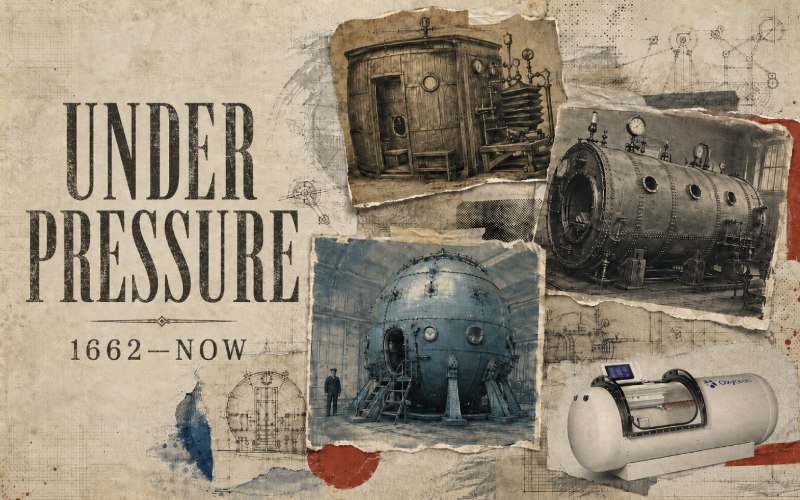
No single person invented the hyperbaric chamber. The technology accumulated across 360 years through a chain of engineers, physiologists, and physicians — each solving one piece of a much larger puzzle. What exists today is the result of all of them.
If you’re researching the history of hyperbaric chambers, that history matters more than you might think. Every pressure rating, safety interlock, and decompression curve used in modern chamber design traces back to specific discoveries made along this timeline.
1662: Henshaw’s “Domicilium” — Concept or Working Device?
The standard story starts with Nathaniel Henshaw, a British clergyman who in 1662 proposed a sealed room he called a “domicilium.” Using organ bellows, it would raise or lower air pressure around the occupants.
Here’s what most accounts leave out: whether Henshaw actually built a functioning device remains historically contested. Some academic and institutional sources describe the domicilium as the first documented medical hyperbaric chamber. Others, based on close reading of Aero-Chalinos, argue the proposed room had structural problems — no viable door seal, windows unlikely to hold pressure, and bellows too weak to meaningfully pressurize a full-sized room — suggesting it may have remained a proposal.
We note this not to diminish Henshaw. His real contribution was conceptual: he was the first to put in writing that manipulating air pressure around a human body might produce beneficial effects. That idea, regardless of whether his room ever held pressure, launched everything that followed.
The Real Timeline
The gap between Henshaw’s concept and a modern chamber is not one invention — it’s dozens. Each row in this table solved a specific engineering or physiological problem that still shapes chamber design today.
| Year | Who | What Changed | Why It Still Matters |
| 1662 | Nathaniel Henshaw (England) | Proposed the “domicilium” — first conceptual pressure room | Established the idea of pressurized environments around the human body |
| 1670 | Robert Boyle (Ireland) | Observed gas bubble formation in a snake’s eye during depressurization | First recorded observation of decompression effects — informs pressure cycling principles |
| 1832 | Emile Tabarie (France) | Designed a cast-iron pneumatic chamber with hydraulic compressor and ventilation tube | First structurally viable sealed pressure vessel with airflow management |
| 1834 | V.T. Junod (France) | Built a chamber reaching 2–4 ATA | First working chamber capable of meaningful pressure |
| 1837 | Pravaz (France) | Built the largest chamber of the era — seated 12 people in Lyon | Demonstrated that multi-person pressurized enclosures were feasible |
| 1877 | Fontaine (France) | Developed the first mobile hyperbaric operating theater | Proved chambers could be transported |
| 1878 | Paul Bert (France) | Published La Pression Barométrique — mapped oxygen toxicity thresholds | Defined the upper safety limits associated with oxygen exposure under pressure |
| 1891 | J. Leonard Corning (USA) | Built an early North American hyperbaric chamber in New York | Helped establish hyperbaric chamber use in the United States |
| 1899 | J. Lorrain Smith (Scotland) | Described pulmonary effects of prolonged oxygen exposure in animals | Established that extended oxygen exposure at elevated pressure affects lung tissue — the “Smith Effect” |
| 1908 | J.S. Haldane (Scotland) | Developed staged decompression tables for the Royal Navy | Created the foundational protocol for safe pressure cycling — still the basis of depressurization curves |
| 1917 | Bernhard & Heinrich Dräger (Germany) | Devised an early system for diving accidents that included oxygen breathing under pressure | Marked an early step toward oxygen-specific pressurized treatment systems |
| 1918–1928 | Orval J. Cunningham (USA) | Developed early compressed-air chambers in Kansas and later built the “Steel Ball” — a five-story, 64-foot-diameter steel sphere in Cleveland | Proved that large steel pressure vessels for human occupancy were structurally buildable |
| 1937 | Behnke & Shaw (USA) | First deliberate use of hyperbaric oxygen for decompression sickness | Marks the beginning of modern oxygen-based pressurized environments |
| 1956–1960 | Ite Boerema (Netherlands) | Demonstrated that oxygen dissolved in plasma under elevated pressure could sustain biological processes | Helped establish the physiological mechanism underlying pressurized oxygen delivery |
| 1967 | Founding of an international non-profit scientific society focused on undersea and hyperbaric science | Formalized education, accreditation programs, and safety standards for the field | Created the professional knowledge base that informs modern best practices |
| 1990 | Igor Gamow (USA) | Invented the portable Gamow Bag — a single-person inflatable chamber | Opened the door to portable chamber engineering |
The dates and attributions above follow the most commonly cited historical sequence in standard references. A few early items — especially Henshaw and Cunningham — vary somewhat by source, so they are stated here in the most conservative form.

The Cunningham Story: What Large-Scale Failure Taught Us
During and after the 1918 influenza pandemic, a physician named Orval Cunningham began developing pressurized chambers in Kansas using compressed air — not oxygen — and reported striking improvements in some cases.
Then a mechanical failure caused rapid depressurization, and occupants died. Rather than stopping, Cunningham doubled down. With financial backing, he later built a massive steel sphere in Cleveland: five stories high and 64 feet in diameter.
The problems:
- No controlled data. Cunningham refused to share protocols with oversight bodies.
- No oxygen delivery. Compressed ambient air only.
- No understanding of pressure dosing. Duration, frequency, and pressure levels were based on intuition.
The American Medical Association, finding no scientific justification for his approach, forced its closure around 1930. The sphere was dismantled for scrap metal during World War II.
But the structural engineering worked. The sphere held pressure. The welds held. The concept of a large, habitable pressure vessel was proven — even if the science behind its use wasn’t. Every hard-shell chamber built today descends, in part, from the engineering lessons of that era.
Three Threads That Had to Converge
A modern hyperbaric chamber isn’t one invention. It’s three separate engineering threads braided together:
Thread 1: Structural Engineering. From Tabarie’s cast-iron sphere in 1832 through Cunningham’s steel sphere in 1928, engineers gradually figured out how to build enclosed vessels that could hold meaningful pressure differentials safely. Modern chambers use stronger materials, more precise joints, and more reliable sealing systems, but the core challenge has remained the same for nearly 200 years: build an enclosure that can hold pressure without failure.
Thread 2: Gas Physics. Boyle’s law (P₁V₁ = P₂V₂) is built into the logic of every chamber. Henry’s law — the solubility of a gas in a liquid is proportional to the pressure of that gas above the solution — explains why breathing oxygen under pressure increases oxygen availability in blood and tissues. Bert mapped the toxicity ceiling. Lorrain Smith described how extended exposure at elevated pressure affects lung tissue. Haldane mapped safe decompression rates. Without these, a pressurized room is just a room.
Thread 3: Controlled Oxygen Delivery. This didn’t arrive until the 20th century. The Dräger brothers devised an early pressurized oxygen system for diving accidents in 1917, but it did not enter production. In 1937, Behnke and Shaw actually used hyperbaric oxygen for the treatment of decompression sickness. That moment — pairing a working pressure vessel with deliberate oxygen management — is arguably when the modern hyperbaric chamber was truly “invented” as a system, not just a structure.

Why This History Still Matters
This history matters because it shows that the hyperbaric chamber was never the product of a single breakthrough. It developed through the convergence of vessel design, gas physics, and safety protocol.
Understanding that lineage also helps explain why certain design questions keep reappearing across generations of chambers: structural integrity, pressure control, decompression management, oxygen handling, and human factors. Those are not modern marketing talking points. They are the accumulated engineering consequences of the last three and a half centuries.
Quick Reference: The Physics Inside a Chamber
Two laws govern what happens during pressurization:
Boyle’s Law: As pressure increases, gas volume decreases proportionally. At 1.3 ATA, a volume of gas is compressed to roughly 77% of its sea-level size. At 2.0 ATA, roughly 50%. This is why ear equalization matters during pressurization, and why gradual pressurization curves matter.
Henry’s Law: The amount of gas dissolved in a liquid is proportional to the pressure of that gas above the liquid. Under elevated pressure, more oxygen dissolves into blood plasma than at normal atmospheric pressure. This is one of the central physical mechanisms behind pressurized oxygen environments.
FAQ
Q: Who actually invented the hyperbaric chamber? No single inventor. Nathaniel Henshaw proposed the concept in 1662, but whether he built a functioning device is historically contested. The first structurally viable chambers appeared in France in the 1830s. The first deliberate pairing of a pressure vessel with controlled oxygen delivery emerged in the early 20th century, and the first actual use of hyperbaric oxygen for decompression sickness is generally credited to Behnke and Shaw in 1937. The “invention” was cumulative across centuries.
Q: Was Henshaw’s domicilium ever built? This is debated. Some academic and institutional sources describe it as having been created; others argue that engineering analysis of his original treatise reveals fundamental structural problems that suggest it remained a proposal. The historical record is not fully settled.
Q: Why does this history matter? Because the engineering principles found in modern chambers — maximum operating pressure, decompression rates, oxygen management, and shell integrity — all trace back to specific historical discoveries. The chamber is best understood as the endpoint of a long chain of engineering and physiological work, not as a single moment of invention.
Q: What did the Cunningham “Steel Ball” teach the field? Two things. First, that large steel pressure vessels for human occupancy are structurally achievable. Second, that operating without scientific data, controlled protocols, or professional oversight is dangerous. Both lessons shaped later development.
We’ve been engineering hyperbaric chambers long enough to know that the real story isn’t about who thought of it first. It’s about how the engineering came together.
For readers comparing modern non-medical chambers, the most useful takeaway from this history is simple: pay attention to structure, pressure control, and safety systems first.