A hard shell rental usually goes wrong before the first cycle starts.
Not because the vessel is bad. More often because the decision was shallow. The room was guessed at. The support package looked fine on paper. The site was treated like empty floor space instead of what it is: a pressure-vessel install with real utility demands, real operating discipline, real consequences for sloppy setup.
That is how we look at rentals on the factory side.
So this guide does not begin with shiny features. It begins where the problems begin. Selection. Delivery. Air system quality. Floor conditions. Seal wear. Power layout. Service access. The small mechanical things that do not stay small for long.
Rent first, buy later? Sometimes. Sometimes not.
A hard shell rental makes sense when the timeline is defined, the site is still being proven out, or the operator team has not settled into a permanent workflow yet. Renting is also useful when you want to test real-world fit before committing capital to a fixed asset.
But not every rental is a smart rental.
If the hyperbaric chamber is going to sit in one place, run on a regular schedule, and become part of normal operations, ownership often starts making more sense sooner than people expect. Freight, setup, recommissioning, return handling, service delays, and repeat logistics all add weight. Quietly.
A lot of buyers get distracted by the shell itself. We do not. We start with duty pattern, room conditions, operator consistency, utility readiness, and serviceability. Then we talk about the vessel.
That order saves time.
What actually matters when selecting a hard shell rental
The easiest mistake is choosing by headline pressure rating and stopping there.
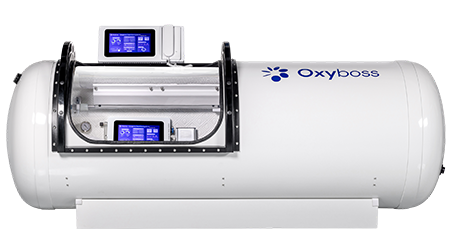
A serious hard shell package is not just the chamber body. It is the vessel, closure system, pressure controls, relief path, air delivery components, support equipment, site interface, and the way all of that behaves under repeated use. If one section is weak, the rental feels weak.
We look at the following first.
1. Pressure behavior, not just pressure capability
A hyperbaric chamber that can reach a target number is not automatically a good rental. We care more about how cleanly it climbs, how steadily it holds, and how predictably it returns to ambient. Pressure that wanders, hunts, or feels coarse during control changes usually points to a larger systems issue.
Smooth behavior matters more than a marketing number.
2. Door closure and seal condition
Returned rental units tell their story at the door first.
Seals age. Compression memory builds. A closure can still function and still tell you, very clearly, that it has lived a hard life. If the door feels imprecise before pressure assists the seal, or the latch feel has changed from crisp to vague, we inspect deeper. A hyperbaric chamber should not need excuses during loading.
That is one of those details people miss because the shell still looks clean.
3. The air path
The air system decides whether a rental feels disciplined or improvised.
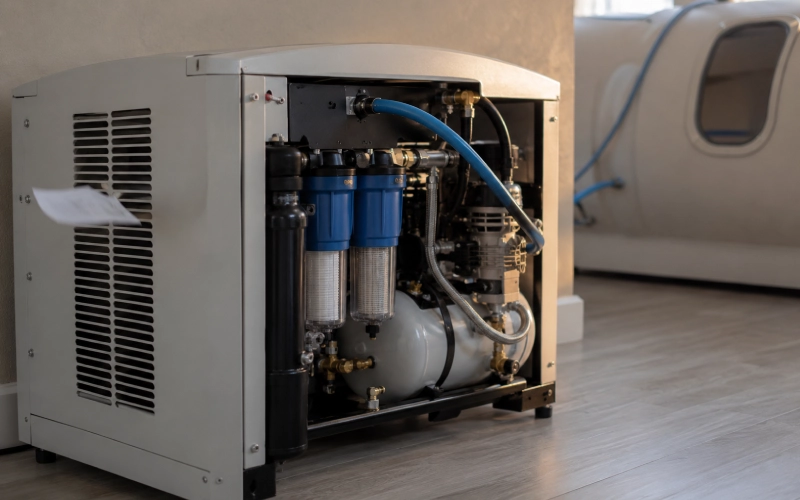
Not just the compressor. The full path. Intake location. Filtration. Drying. Hose condition. Connector wear. Heat around the support package. How the system behaves after it has already been running for a while, not just during the first few minutes when everything is cool and cooperative.
Support equipment placed in a dusty corner, near soft flooring, near chemicals, near poor airflow, or in a hot room will not stay invisible. Those choices show up later as nuisance faults, unstable performance, dirty internals, and service calls that should never have existed.
4. Site fit
A hard shell hyperbaric chamber is not difficult in the abstract. It is difficult in a real building.
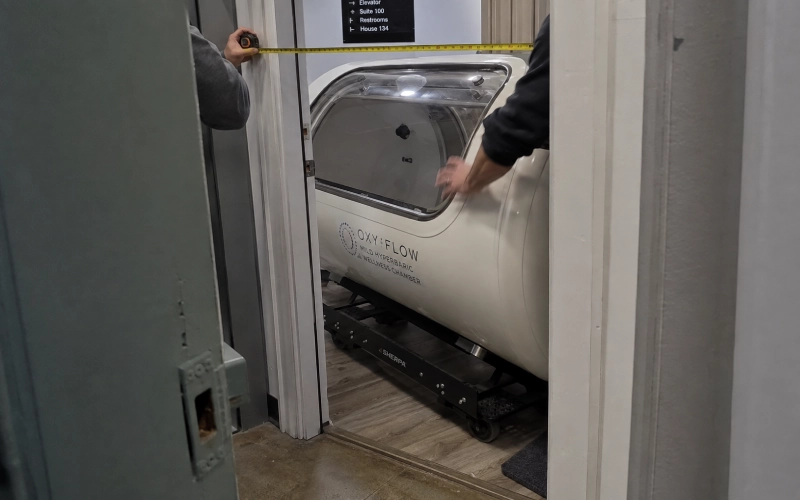
Door clearance. Turning radius. Floor transitions. Elevator limits. Thresholds. Ceiling height around fittings. The path from truck to final position. Whether the chamber arrives with enough room to be installed without awkward handling. Whether the support equipment will end up cramped against a wall because someone only measured the vessel and forgot the rest of the system.
A rental becomes annoying when the site was treated like a sketch instead of a place.
The room matters more than people think
A room can make a good hyperbaric chamber look bad.
We see this often. The vessel is fine. The room is the problem.
Deep carpet holds lint and dust. Busy utility rooms collect clutter. Mixed-use spaces invite random items, unstable traffic, and bad habits. Hot rooms stress support equipment. Tight wall spacing traps heat. Poor intake placement drags contamination into the system. People call these small details right up until they become recurring maintenance.
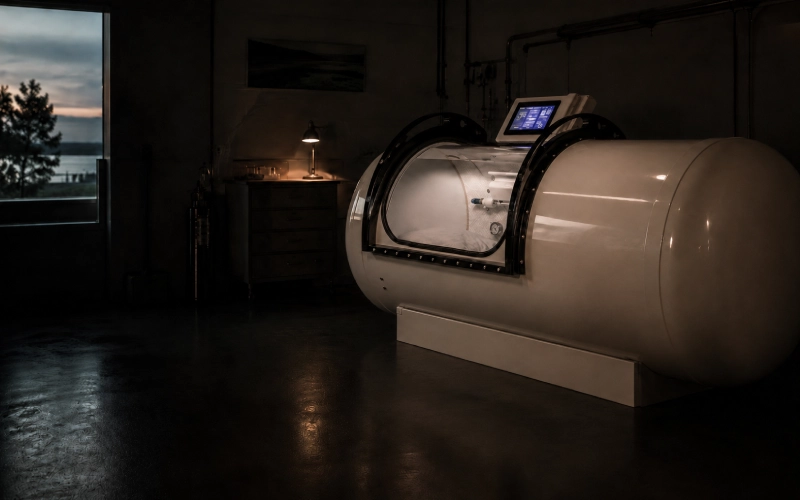
The best chamber rooms are plain.
Not luxurious. Not packed with extras. Plain.
Clear floor. Hard surface if possible. Sensible ventilation around support equipment. Stable power. Enough access for service. No casual storage. No improvisation. No “we’ll fix that later.”
That last phrase causes more downtime than most mechanical faults.
What to inspect when the rental arrives
Do not let first impressions do all the work. A fresh exterior tells you almost nothing by itself.
At handover, we look for baseline behavior. Not just appearance.
| Inspection area | What we want to see | What starts to concern us |
| Door and seal | Clean closure feel, even contact, no awkward forcing | Inconsistent latch feel, visible seal fatigue, obvious compression set |
| Pressure controls | Stable response, no erratic movement, predictable adjustment | Sticky response, sudden jumps, vague control feel |
| Relief path | Clean, repeatable release behavior | Harsh transitions, inconsistent vent response, signs of prior tampering |
| Air hoses and fittings | Flexible lines, sound connectors, no surface breakdown | Stiffness, cracking, connector fatigue, visible aging |
| Acrylic and viewing surfaces | Clear enough for easy inspection, no suspicious stress patterning | Crazing, edge stress, hardware-adjacent defects |
| Compressor behavior | Smooth running tone, manageable heat, normal vibration profile | Harsh noise, metallic note, unusual heat buildup, rough startup |
| Gauges and indicators | Readable, consistent, no obvious drift or hesitation | Sticky movement, poor reset behavior, inconsistent reading |
That table is not a sales device. It is a filter.
And yes, some wear is normal on rental equipment. The question is not whether the unit has been used. The question is whether the wear is controlled, understood, and reflected in the way the machine still behaves.
Thermal load is real. People underthink it.
Compress air and the system gains heat. That part is obvious. What people miss is how quickly the room starts participating in the problem.
Warm room. Tighter equipment spacing. Poor airflow around the support package. Long operating windows. All of that stacks.
A well-prepared site leaves the equipment room to breathe. A poorly prepared one makes the chamber work harder than necessary, then blames the machine for feeling strained.
Same chamber. Different room. Different outcome.
That happens all the time.
Power planning should be boring
If the electrical plan feels clever, it is probably wrong.
Hard shell rentals should go into a space where the support equipment can run without borrowed fixes, overloaded circuits, or last-minute workarounds. We prefer clean power planning done before delivery, not after the compressor is already in place and somebody starts guessing which outlet belongs to which branch circuit.
A reliable install is usually unremarkable. That is the goal.
No daisy-chained accessories. No awkward cable paths across walkways. No “temporary” solution that somehow becomes permanent. The hyperbaric chamber should arrive into a room that already knows what it is being asked to support.
Rental fleet wear is not mysterious
Machines coming out of rental service age in recognizable ways.
Seals lose crispness. Hoses tell you where they have been stored. Connectors show habits. Surfaces show whether routine cleaning was disciplined or cosmetic. Support equipment reveals whether it has lived in a controlled room or a neglected one. None of this requires drama to interpret. It just requires someone who has seen enough returns to notice the pattern early.
That is why we care less about polished language and more about mechanical honesty.
A provider should be able to tell you:
- how returned units are inspected
- which wear items are routinely replaced
- how pressure controls are verified between rentals
- what gets serviced before redeployment
- which parts are treated as consumables
- how field issues are classified
If those answers come back vague, the rental will probably become vague too.
Safety is mostly about removing nonsense from the process
Good chamber safety is rarely theatrical. It is procedural.
Most preventable problems start when the area around the chamber gets casual. Unapproved items drifting into the room. Extra materials left nearby. Poor housekeeping. Operators relying on memory. Support equipment wedged into a corner where nobody can inspect it easily. Service logs half-kept, then ignored.
We run the opposite way.
The chamber area should stay controlled. The process should stay repetitive. The operating checklist should match the installed configuration. Any abnormal sound, abnormal control feel, unusual heat pattern, or irregular pressure behavior should be logged and reviewed, not rationalized away because the unit “still works.”
That habit matters. A lot.
Serviceability is part of selection, not an afterthought
Many rentals look acceptable until something small needs attention.
Then the real design shows up.
Can common wear items be accessed cleanly? Can the provider support troubleshooting without confusion? Are replacement parts easy to identify? Can the chamber be recommissioned efficiently if the site changes? Is there a clear line between operator checks, field service, and factory-level service?
A rental package that is painful to maintain is not a good package, even if the shell itself is solid.
Serviceability is not secondary. It is one of the selection criteria.
How we judge whether a rental package is actually ready
We do not green-light a chamber because it arrived.
We green-light it when the whole package makes sense together:
- the site is suitable
- the vessel fits the workflow
- the support equipment is placed correctly
- the controls behave cleanly
- the room stays controlled
- the operator routine is clear
- the service path is defined
If even one of those is fuzzy, the rental is not ready yet. It may still be close. But close is not the same thing.
FAQ
How do I know whether renting is the right move or whether I should buy?
Rent when the operating window is still being tested, the site is not fully proven, or the workflow is still settling. Buy when the chamber is going to become fixed infrastructure and repeated rental logistics begin creating more friction than value.
What is the most common selection mistake?
Choosing based on shell headline specs while ignoring the support package, site conditions, and service path. The vessel gets the attention. The rest of the system decides whether the rental is easy or difficult.
What part of the chamber usually shows rental wear first?
Usually the closure system, seals, hoses, fittings, and the small control-touch components that get handled repeatedly. Not always visibly. Often by feel first.
Is room setup really that important?
Yes. A poor room can create heat buildup, contamination issues, access problems, awkward service conditions, and inconsistent operating habits. Good equipment still suffers in a careless space.
What should I inspect on delivery day?
Start with closure feel, seals, hoses, controls, relief behavior, gauges, viewing surfaces, and support equipment behavior under baseline operation. You are not just checking whether the unit turns on. You are checking whether it behaves like a disciplined machine.
What should a rental provider be able to answer clearly?
Inspection process, replaced wear items, service boundaries, expected maintenance rhythm, field support scope, recommissioning conditions, and response path if the site proves unsuitable.
What usually causes avoidable downtime?
Poor site prep. Bad equipment placement. Inconsistent housekeeping. Deferred maintenance. Operators working from habit instead of checklist. Nothing exotic. Mostly preventable things.
What makes one rental package stronger than another?
Not one big feature. Usually a collection of smaller ones: stable controls, clean air handling, sensible service access, better inspection discipline, and a provider that speaks in mechanical specifics rather than sales language.
Final word
A hard shell hyperbaric chamber rental should not feel like a gamble dressed up as a product.
It should feel settled. Mechanically coherent. Easy to inspect. Easy to service. Hard to misuse.
That is what we build toward. Not just a pressure vessel that can be delivered, but a rental package that still makes sense once it is in the room, under load, on a real schedule, with real operators, and no room left for vague thinking.
Because that is where rentals stop being brochures and start becoming equipment.