Recovery after a stroke rarely moves in a straight line. Some weeks feel like progress. Others feel stuck. For a long time the accepted wisdom was blunt: whatever function returns tends to return early, and after a few months the window quietly closes.
That view is being questioned. Not by wishful thinking, but by imaging studies and controlled trials looking at what extra oxygen, delivered under pressure, does to brain tissue that survived a stroke but stopped working properly. This piece walks through the physiology and the research plainly — and, just as importantly, it draws a hard line between the pressures used in research settings and the pressures a general-wellness chamber actually reaches. Those are not the same thing, and most write-ups blur them.
A note before anything else: what follows is educational, not advice, and nothing here replaces guidance from a qualified professional who knows your history.
Why oxygen under pressure behaves differently
Breathe normal air and your red blood cells do almost all the work. They’re already close to full. Under normal atmospheric conditions, almost 97% of the available haemoglobin is saturated with oxygen. Push more at them at sea level and there’s nowhere to put it — the seats are taken.
Plasma is the interesting part. The clear fluid your blood cells float in carries barely any oxygen at rest, but it follows a different rule. The calculations for these phenomena are based on the ideal gas laws, particularly Henry’s law, which states that the amount of gas dissolved in a liquid is proportional to the partial pressure of the gas above the liquid’s surface. Raise the pressure, raise the oxygen concentration, and plasma starts dissolving far more of it.
The numbers climb steeply, and they climb with pressure — which is exactly why the setting matters. Under standard pressure and breathing air conditions, free oxygen in the blood is around 0.32 mL/dL; however, the administration of 100% oxygen at normobaric conditions increases oxygen concentration in the blood to 2.09 mL/dL and at 3 atm this value increases to around 6.8 mL/dL. That last figure requires both high pressure and pure oxygen. Strip either one out and the number falls off a cliff.
Here’s why any of it matters for the brain. Once oxygen is in solution, it is capable of improving tissue oxygenation where red blood cells cannot reach and in the case of impaired hemoglobin function or concentration. After a stroke some of the plumbing is damaged; oxygen dissolved in plasma isn’t stuck riding red blood cells through narrowed vessels, so it can slip into spaces the cells can’t easily get to.
Pressure and oxygen — what actually changes the numbers
| Setting | Approx. pressure | Oxygen source | Free oxygen in plasma | Where it appears |
|---|---|---|---|---|
| Ordinary air, sea level | 1.0 ATA | Room air | ~0.32 mL/dL | Baseline |
| Pure oxygen, no added pressure | 1.0 ATA | 100% oxygen | ~2.09 mL/dL | Research reference point |
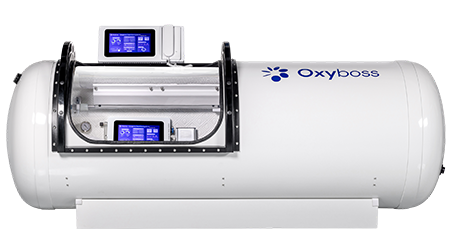
| Research protocol (the trial below) | 2.0 ATA | 100% oxygen | Between the two extremes | Controlled facilities |
| Research physiology maximum | ~3.0 ATA | 100% oxygen | ~6.8 mL/dL | Physiology studies |
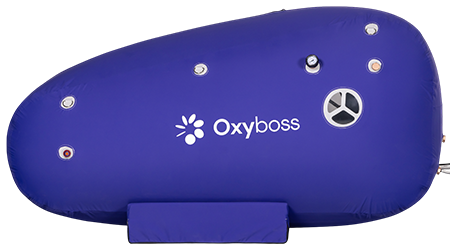
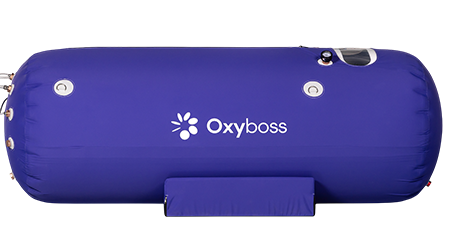
| General-wellness chambers | commonly ~1.3–1.5 ATA | air or light enrichment | far below the figures above | Consumer settings |
Plasma figures at 1.0 and 3.0 ATA are drawn from published hyperbaric physiology reviews [4][5]. The general-wellness row is included for contrast — it is not where the trial data below came from.
The table exists to make one point hard to miss: the headline dissolved-oxygen numbers belong to high-pressure, pure-oxygen conditions. A consumer chamber is a different animal.
The “stunned” brain — the idea driving the research
After a stroke there’s the dead tissue, and then there’s a gray zone around it — cells that didn’t die but stopped doing their job.
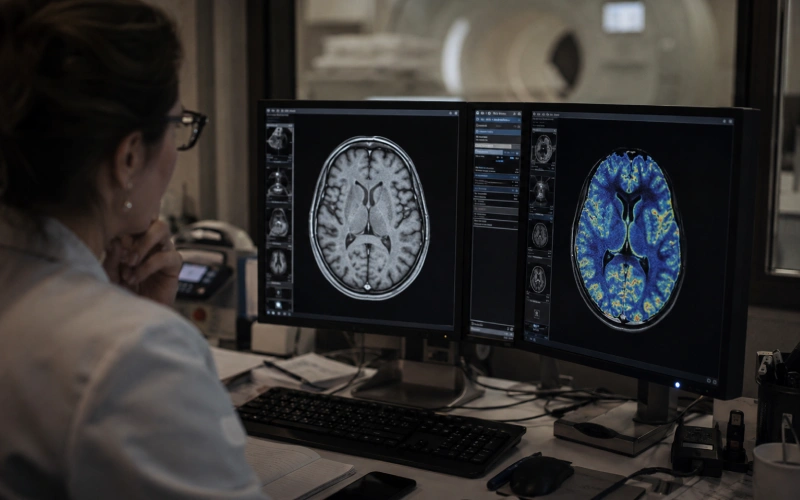
Researchers describe this precisely. The terms “chronic penumbra” and “stunned brain” refer to regions with critically reduced cerebral blood flow, abolished synaptic activity, and preserved structural integrity. The structure is intact, the wiring is there, the lights are just off. And that gray zone may not close as fast as once assumed. Advanced imaging techniques further reveal that stunned brain tissue can persist for months to years following an acute ischemic event. Which reframes the recovery-window conversation. If tissue is alive but idling a year later, the interesting question becomes whether anything can wake it.
What the best-known trial found
The most-cited work here deliberately looked at people well past the usual recovery window. A prospective, randomized, controlled trial including 74 participants. All had a stroke 6–36 months prior to inclusion and had at least one motor dysfunction. So — the plateau group, whose progress had already flattened.
The protocol ran at 2.0 ATA with pure oxygen, which is worth stating plainly since the physiology headline of 6.8 mL/dL came from a higher pressure. Different number, different setting.
The design used a crossover — a clean way to check whether time alone was doing the work. One group did the sessions right away; the other waited through a control period first. If mere passage of time explained the gains, the waiting group would have improved during their idle stretch. They didn’t. Neurological functions and life quality of all participants in both groups were significantly improved following the sessions, while no improvement was found during the control period of the participants in the cross group.
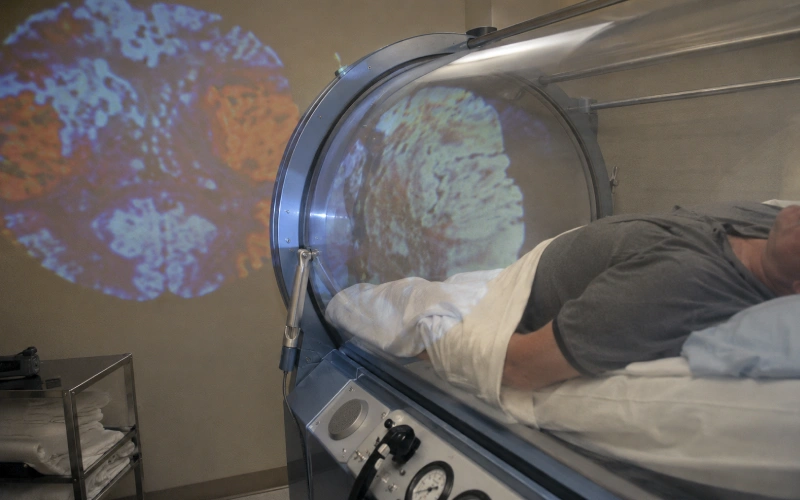
The imaging lined up with what people reported. Results of SPECT imaging were well correlated with clinical improvement. Elevated brain activity was detected mostly in regions of live cells with low activity — regions of noticeable discrepancy between anatomy and physiology. That mismatch — normal on a structural scan, quiet on a functional one — is the stunned tissue described earlier.
The authors’ read was cautious but pointed. The results indicate that the sessions can lead to significant neurological improvements even at chronic late stages. Newer reviews echo the direction without pretending the story is finished. These findings challenge the notion of a limited post-stroke recovery window, supporting the hypothesis that neuroplasticity can be reactivated months to years after the acute event through targeted neuromodulation.
What seems to happen at the cellular level
The “more oxygen, more better” version is too simple. The pressure environment appears to act more like a signal than a fuel top-up — it nudges cellular machinery.
A mechanistic review lays out the moving parts. Hyperbaric oxygen affects multiple primary pathways and cellular functions including mitochondrial biogenesis and function, neurogenesis through upregulation of Wnt-3 and VEGF/ERK signaling, synaptogenesis through elevated GAP43 and synaptophysin expression, and anti-inflammatory responses through reduced TNF-α and IL-6. Loosely: it touches the cell’s energy plants, the growth signals for new tissue, the machinery for building connections, and the inflammation dial.
There’s a paradox worth naming. A brief, controlled dose of oxidative stress seems to prime cells rather than harm them. Mild oxidative stress may be able to prime the brain to tolerate full extensive oxidative stress, and preconditioning has displayed efficacy in establishing such ischemic tolerance. The stress is the message. People find that counterintuitive, reasonably.
These mechanisms, again, were characterized under research-grade conditions. They describe what the biology can do at those pressures — not a promise about any given chamber.
How research programs were structured
Across the studies the shape is fairly consistent. Not a one-off — a course.
- Session length — commonly around 90 minutes.
- Frequency — typically five days a week.
- Course size — the well-known trials used blocks of roughly 40 sessions; some rehabilitation-oriented programs ran closer to 60. One program description notes a cycle that lasts 3 months and includes 60 daily sessions of 90 minutes, 5 days per week.
Two honest caveats. First, comfort. Enclosed spaces bother some people; monoplace chambers are small and confined, which can trigger claustrophobia, and pressure changes are felt in the ears. Worth knowing before committing to dozens of sessions. Second, and larger: the evidence base, while pointing somewhere interesting, is still building — and it was built at pressures higher than a general-use chamber reaches.
Where things stand, roughly
The research community isn’t small, but it’s spread thin. From 2000 to 2022, 273 authors published research on hyperbaric oxygen therapy for stroke, and the low author density indicates a relatively dispersed research community. A cluster of trials, a lot of mechanistic work, and open questions about pressure, dose, timing, and who benefits.
So the fair summary isn’t a slogan. There’s a coherent physiological story, imaging that matches self-reported gains, and controlled data suggesting the recovery window may be less fixed than once believed — alongside a field that still needs larger, longer studies, and results that belong to the specific high-pressure conditions they were produced in.
FAQ
Is this the same as breathing oxygen from a mask at home? No. A mask or concentrator raises the oxygen percentage but not the pressure. The mechanism above depends on pressure driving oxygen into plasma, per Henry’s law. Without the pressure, plasma stays nearly as low as it started.
Do the study numbers apply to any hyperbaric chamber? No — and this is the point worth repeating. The plasma-oxygen figures and the trial results came from high-pressure, pure-oxygen settings (2.0–3.0 ATA). General-wellness chambers commonly run near 1.3–1.5 ATA with ordinary or lightly enriched air, so those specific numbers don’t transfer over.
Does timing after a stroke matter? The most-discussed trial specifically recruited people 6–36 months out, to test whether late gains were possible. That line of research is largely about the chronic, plateaued stage rather than the first days.
Why does a brain scan look normal but function doesn’t return? Because structure and activity are different things. Tissue can survive intact on a structural scan yet stay metabolically quiet. That gap between “looks fine” and “works fine” is the mismatch researchers target.
How many sessions did studies use? Protocols clustered around 40 sessions, with some longer cycles near 60, typically 90 minutes, five days a week.
Is the science settled? Not yet. The direction is encouraging and the mechanisms are increasingly well-mapped, but the field openly calls for larger and longer trials. Treat confident claims — in either direction — with some suspicion.
References
- Efrati S, et al. Hyperbaric Oxygen Induces Late Neuroplasticity in Post Stroke Patients — Randomized, Prospective Trial. PLOS One, 2013. https://journals.plos.org/plosone/article?id=10.1371/journal.pone.0053716
- Bibliometric analysis of research trends on hyperbaric oxygen therapy in stroke from 2000 to 2022. Frontiers in Neurology, 2025. https://www.frontiersin.org/journals/neurology/articles/10.3389/fneur.2025.1455545/full
- Hyperbaric oxygen therapy as a neuromodulatory technique: a review of the recent evidence. PMC, 2024. https://www.ncbi.nlm.nih.gov/pmc/articles/PMC11496187/
- The Role of Hyperbaric Oxygen Therapy in Neuroregeneration and Neuroprotection: A Review. PMC. https://pmc.ncbi.nlm.nih.gov/articles/PMC11235151/
- Hyperbaric Physiological and Pharmacological Effects of Gases. StatPearls, NCBI Bookshelf. https://www.ncbi.nlm.nih.gov/books/NBK470481/
- Survey of Molecular Mechanisms of Hyperbaric Oxygen in Tissue Repair. PMC. https://pmc.ncbi.nlm.nih.gov/articles/PMC8584249/
- An Extra Breath of Fresh Air: Hyperbaric Oxygenation as a Stroke Therapeutic. PMC. https://www.ncbi.nlm.nih.gov/pmc/articles/PMC7563917/