
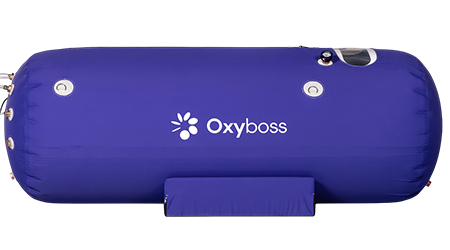
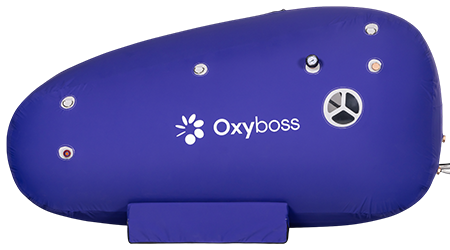
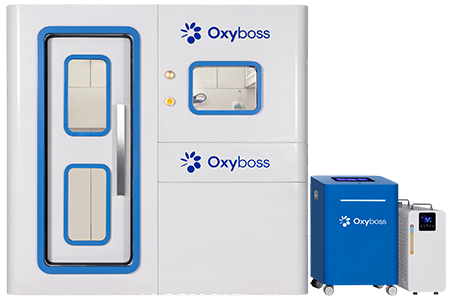
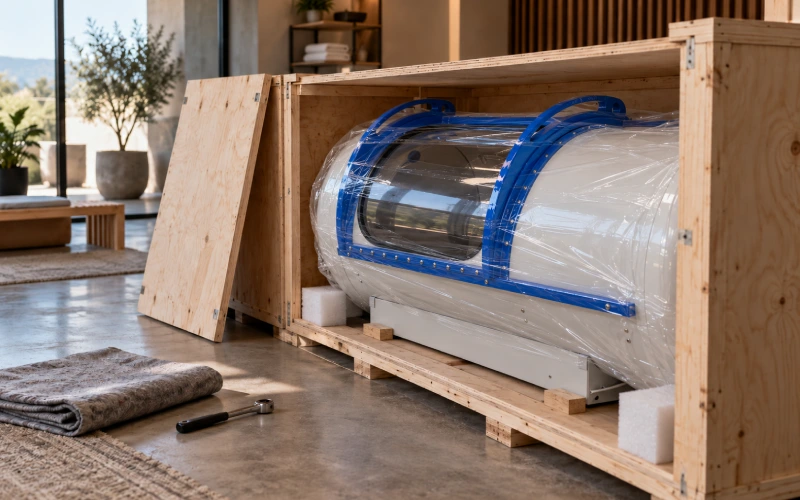
You ordered a hard-shell hyperbaric chamber. The sales rep said “about eight weeks.” Now it’s week twelve, the room isn’t ready, and nobody can tell you when the first session will actually happen.
Sound familiar? The problem isn’t slow shipping. It’s that delivery is one milestone in a much longer project — and most buyers treat it like the finish line.
This guide breaks down every stage between signing a purchase order and running your first session. We build hard-shell chambers for both commercial and personal use, so we’ll be specific about what our process looks like — and where the gaps typically show up, including on our end.
Scope note: This article covers non-medical hyperbaric chambers used in wellness centers, recovery studios, sports facilities, hotels, and homes. We are not a medical device manufacturer. The regulatory framework, timelines, and documentation requirements for FDA-cleared clinical hyperbaric systems are substantially different and are not covered here. Nothing in this article constitutes medical advice.
Why a promised delivery date doesn’t mean much on its own
A vendor tells you “ships in six weeks.” That might be accurate for the manufacturing piece. But between that shipment and your first paying client walking through the door, there’s site prep, electrical work, local permits, installation, testing, operator training, and a final safety walkthrough.
Each of those steps has its own timeline, its own dependencies, and its own potential to stall the whole thing.
The only delivery date worth planning around is the one backed by completed evidence at every stage — not a number on a quote.
Think in gates, not calendar dates
Instead of asking “when will it arrive?”, ask “what has to be true before we move to the next step?”
Here’s the milestone gate framework we use internally and share with every buyer. Each gate has a clear completion requirement and a specific piece of evidence that proves it’s done.
| Gate | What needs to happen | How you know it’s done |
|---|---|---|
| G0 — Configuration locked | Chamber model, pressure rating, accessories, and intended use confirmed. Room selected. | Signed equipment specification sheet and room layout drawing |
| G1 — Compliance confirmed | Applicable pressure vessel documentation verified. Non-medical use declaration reviewed. | Equipment compliance file on record; building code requirements identified |
| G2 — Site released | Room dimensions, access route, floor loading, electrical capacity, ventilation, and exhaust confirmed by a qualified person | Signed site-readiness checklist |
| G3 — Order accepted | Purchase order executed. Commercial terms, scope, lead time, shipping responsibility, warranty, and acceptance criteria documented | Executed PO with vendor acknowledgment. This is when your baseline schedule starts — not before. |
| G4 — Manufacturing complete | Factory build, QC inspections, documentation, and pre-shipment testing finished | Factory acceptance test (FAT) report, inspection records, packing list, certificates |
| G5 — Delivered and received | Equipment arrives undamaged with all components and documentation | Signed delivery receipt, damage inspection log, serial number verification |
| G6 — Installed | Chamber, controls, electrical, exhaust, and monitoring systems connected and powered on | Installation checklist completed and utility sign-off |
| G7 — Tested and accepted | Pressure test, leak test, alarm test, emergency valve operation, and all safety checks pass | Commissioning report, punch list closed, acceptance certificate signed |
| G8 — Ready for use | Operator training complete, safety walkthrough done, local building/fire permits obtained, emergency procedures in place | Training records, permit copies, signed go-live authorization |
One thing that catches people off guard: Gate 5 (delivery) is not Gate 8 (ready for use). There’s a meaningful gap between the two, and the length of that gap depends almost entirely on how much prep work you did before the chamber showed up.
Track three dates for every milestone — not just one
Most buyers track a single date: the one the vendor promised. That’s not enough.
For every milestone above, record three dates:
- Baseline date — the date you and the vendor agreed on when the PO was signed.
- Forecast date — the vendor’s (or contractor’s) current best estimate, updated at each check-in.
- Evidence date — the date you actually received proof that the milestone is complete.
A forecast is not the same as a fact. Until you have the evidence in hand — the FAT report, the signed installation checklist, the permit — treat that milestone as open.
Here’s what that looks like in practice:
| Milestone | Baseline | Current forecast | Evidence received | Variance | Owner |
|---|---|---|---|---|---|
| Factory acceptance test | Week 6 | Week 7 | — | +1 wk | Manufacturer |
| Shipment released | Week 8 | Week 9 | — | +1 wk | Manufacturer / logistics |
| Site ready | Week 4 | Week 4 | Week 4 ✓ | On track | Buyer / contractor |
| Installation complete | Week 10 | Week 11 | — | +1 wk | Installer |
| Training complete | Week 12 | Week 12 | — | On track | Manufacturer |
| Local permits obtained | Week 11 | TBD | — | ⚠️ At risk | Buyer / AHJ |
| Go-live authorization | Week 13 | TBD | — | Blocked | Buyer |
The “Owner” column matters. If a milestone slips and nobody is named as responsible, it doesn’t get recovered — it just drifts.
What actually takes the longest (it’s probably not manufacturing)
Here’s the part most buyers don’t expect: building and permit work usually takes longer than the chamber itself.
The critical path for a hard-shell chamber project generally runs like this:
Lock configuration → Site approval → Place order → Manufacturing → Ship → Install → Test and commission → Local permits and inspections → Operator training → Go-live
Some of these can run in parallel. A few can’t.
What you can do while the chamber is being built:
- Finalize room drawings and confirm dimensions against the equipment spec sheet
- Get your electrical contractor lined up — verify voltage, phase, and dedicated circuit requirements
- Sort out ventilation and exhaust routing
- Start the permit application process with your local building authority (this one alone can take weeks)
- Draft your operating procedures and emergency response plan
- Schedule operator training with the manufacturer
What has to wait:
- Installation can’t start until the room is ready AND the chamber has arrived
- Testing and commissioning can’t start until installation is complete
- You can’t open for business until testing passes, training is done, and permits are in hand
The usual bottleneck? Local permits and inspections. Depending on your jurisdiction, a building or fire authority review can add several weeks to several months. If your site requires changes to ventilation, electrical, or exhaust systems, that review resets.
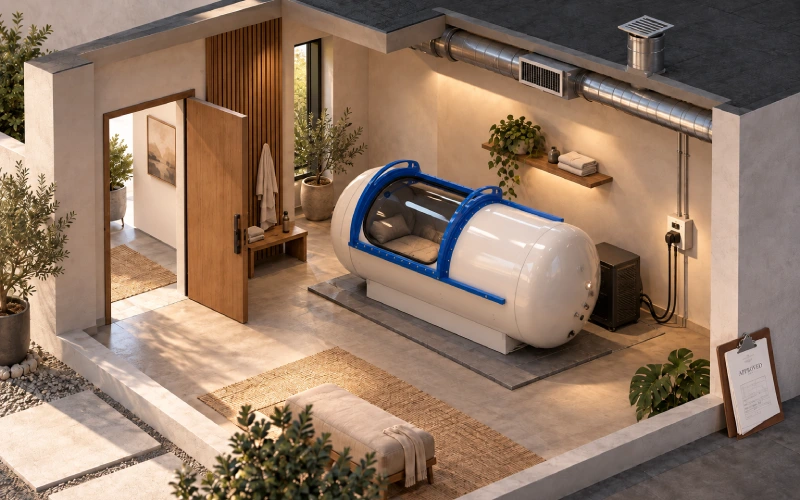
A room that fits the chamber on a floor plan is not the same as a room that’s ready for the chamber. Access routes, doorway clearances, floor load capacity, electrical service, ventilation, exhaust paths, and maintenance clearances all need to be confirmed — ideally before you place the order.
Your site readiness checklist (do this before the chamber ships)
This is where most delays actually start. The chamber is built on time, ships on time, and then sits in a warehouse because the room isn’t ready.
Here’s what to verify before the equipment shows up:
Room dimensions and clearance
- Confirm minimum room size against the manufacturer’s spec sheet (every model is different)
- Measure doorway and hallway widths along the entire delivery path — if the chamber doesn’t fit through the door, you’re looking at wall removal or crane access
- Verify ceiling height. Hard-shell chambers need overhead clearance for the lid or hatch mechanism, and for maintenance access
Floor loading
- Hard-shell chambers are heavy. Get the installed weight (chamber + water if applicable + accessories) from the manufacturer and confirm your floor can handle it
- If you’re on an upper floor or a raised platform, get an engineer’s sign-off
Electrical
- Dedicated circuit(s) sized to the chamber’s electrical load — confirm voltage, phase, and amperage with the manufacturer
- Have an electrician verify and install before delivery, not after
Ventilation and exhaust
- The chamber needs a defined exhaust path for pressure release
- If your space doesn’t have adequate ventilation, that’s a construction project on its own timeline
Access and service zones
- Leave space around the chamber for maintenance, inspections, and emergency access — not just enough to walk past it
- Plan for storage: spare parts, accessories, cleaning supplies
Local code compliance
- Check with your local building department and fire authority before you finalize the room design
- Some jurisdictions require a permit for pressure vessel installation even for non-medical use
- Fire authority reviews are the single most common source of project delays in our experience
Practical tip: Don’t assume a space is ready just because the chamber fits on the floor plan. We’ve seen orders delayed by months because a doorway was two inches too narrow, or because the electrical panel was on the wrong side of the building. Measure everything. Twice.
What to expect during installation and commissioning
Once the chamber is on-site and the room is ready, installation typically takes one to several days for a standard hard-shell unit — depending on the model, site conditions, and whether your electrical and exhaust are already in place.
But installation is not the same as commissioning. After the chamber is physically set up, it goes through a testing and sign-off sequence:
Pressure integrity test — the chamber is pressurized to verify it holds pressure within spec and no leaks are detected.
Safety system checks — every alarm, emergency release valve, interlock, and communication system is tested individually.
Functional test — a full operating cycle is run to confirm the chamber performs as specified under normal conditions.
Punch list review — any open items from installation or testing are logged, assigned, and closed before the system is accepted.
Acceptance sign-off — both the installer and the buyer sign off that all tests have passed and the system is ready for operator training.
Don’t skip the punch list. Small issues found during commissioning — a sensor that reads slightly off, a seal that needs adjustment, a label that’s missing — are easy to fix now and expensive to fix later.
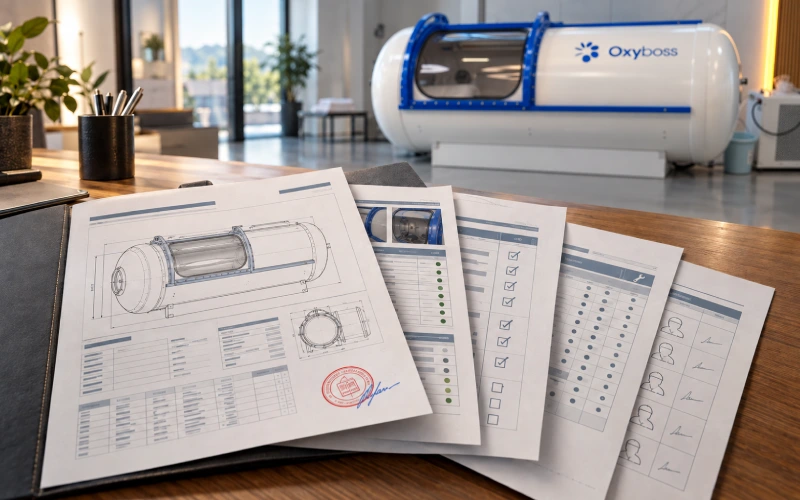
The document package you should have before go-live
Before you start booking sessions, make sure you have these on file. This isn’t optional paperwork — it’s your operational and legal foundation.
- Equipment specification and intended-use documentation
- Pressure vessel design and fabrication records (where applicable)
- Factory acceptance test (FAT) report
- Installation and operating manuals
- Site acceptance / commissioning report with all test results
- Pressure test, leak test, and alarm test records
- Preventive maintenance and inspection schedule
- Operator training records (who was trained, on what, by whom, when)
- Emergency and safety procedures (including what to do during a power outage or pressure anomaly)
- Local building permit and/or fire authority approval (where required)
- Warranty terms and service contact information
One document most buyers forget: the preventive maintenance schedule. Your manufacturer should provide one. If they don’t, ask for it in writing before you sign the PO. Maintenance keeps the chamber running; skipping it voids warranties and creates safety risks.
How to spot delays before they’re announced
Vendors don’t always tell you a milestone is slipping until it’s already late. Here are the early signals:
No photos or production updates by the halfway mark. If your manufacturer hasn’t sent you a single photo of the build in progress by the midpoint of the quoted lead time, ask. A good manufacturer will have production documentation they can share.
Your site contractor keeps changing the electrical or ventilation plan. That usually means the original plan didn’t account for the chamber’s actual requirements. Every redesign adds weeks.
The permit application is “in review” with no timeline. Building and fire authority reviews don’t have SLAs. If you submitted and haven’t heard back in two weeks, follow up. If they ask for changes, treat that as a schedule risk immediately.
Training hasn’t been scheduled and the chamber is almost done. Operator training needs to happen after installation but before go-live. If it’s not on the calendar by the time the chamber ships, it will push your opening date.
Nobody owns the milestone. If you ask “who is responsible for getting the permit?” and the answer is vague, that milestone is already at risk.
When delays happen: label the reason, not just the status
“Delayed” doesn’t help anyone. When a milestone slips, assign it a specific reason so you can act on it:
- Vendor design issue — the configuration isn’t finalized, or a change request came in after the order was placed
- Room or access conflict — the space doesn’t meet requirements, or the delivery path is blocked
- Electrical or utility work incomplete — dedicated circuits, ventilation, or exhaust not ready
- Permit or inspection pending — local authority hasn’t signed off
- Shipping or logistics issue — customs, carrier delay, or damage in transit
- Installation punch list open — items from testing that need to be resolved
- Testing failed — a commissioning test didn’t pass and needs rework
- Training not complete — operators haven’t been trained on the specific model
If a blocked item affects the next gate in the sequence and there’s no owner or recovery plan, escalate it. Waiting doesn’t make it better.
The real timeline: what “delivery” doesn’t include
Here’s the thing most quotes won’t tell you: the time between placing an order and having a working chamber is significantly longer than the manufacturing lead time alone.
For a typical hard-shell chamber project, the full sequence looks something like this:
| Phase | What’s happening | Typical range |
|---|---|---|
| Pre-order (configuration + site assessment) | Locking specs, confirming site readiness, getting quotes | 2–4 weeks |
| Manufacturing | Chamber built, QC’d, FAT completed | Varies by model and customization level |
| Shipping | Crated, transported, received on-site | 1–4 weeks depending on destination |
| Site preparation (if not done in parallel) | Electrical, ventilation, exhaust, permits | 2–8+ weeks |
| Installation | Physical setup, connections, power-on | 1–5 days (standard models, ready site) |
| Commissioning | Pressure test, safety checks, punch list | 1–3 days |
| Training + permits + go-live authorization | Operator training, final inspections, paperwork | 1–4 weeks |
The gap between delivery and go-live is real. If your site prep isn’t done when the chamber arrives, that gap gets wider. If your local authority takes longer than expected on permits, it gets wider still.
The fastest way to compress the total timeline: start site prep and permit applications the day you lock the configuration — don’t wait for the chamber to ship.
Use status colors that mean something
If you’re tracking milestones on a shared schedule (and you should be), use status labels that drive action:
| Status | What it means | What to do |
|---|---|---|
| 🟢 Green | Evidence received. No unresolved predecessor. | Nothing — move on to the next gate |
| 🟡 Amber | Forecast exists, but evidence is missing or a dependency is at risk | Follow up this week. Identify the blocker. |
| 🔴 Red | Predecessor incomplete, approval missing, test failed, or forecast threatens go-live | Escalate now. Name the owner. Define the recovery action. |
| ✅ Complete | Deliverable accepted — not merely shipped or installed | Archive the evidence. Close the gate. |
“Complete” means accepted, not shipped. A chamber that’s been delivered but not tested is not complete. A room that’s been built but not inspected is not complete. Hold the line on this or the whole schedule becomes fiction.
Frequently asked questions
How long does it take to get a hyperbaric chamber delivered and operational?
It depends on the model, your site readiness, and local permit requirements. Manufacturing lead time is one piece of it. The full project — from signing the PO to running your first session — typically takes longer than the lead time alone because of site prep, installation, testing, training, and permits. The single biggest variable is how much prep work you do before the chamber ships.
Can I start site preparation before placing the order?
Yes, and you should. Locking your room layout, starting electrical work, and submitting permit applications early can take weeks off the total project timeline. Just make sure the room design matches the specific chamber model you’re ordering.
What’s the most common cause of delays?
In our experience, it’s site readiness — specifically, electrical work that wasn’t scoped correctly, ventilation or exhaust that needs rerouting, and local building or fire permits that take longer than expected. The chamber itself is rarely the bottleneck.
Do I need a permit to install a hyperbaric chamber?
It depends on your jurisdiction. Many local building authorities require permits for pressure vessel installation, even for non-medical use. Some require fire authority review as well. Check with your local building department early in the process — not after the chamber arrives.
What happens if something fails during commissioning?
It goes on the punch list. The issue is documented, assigned to the responsible party (manufacturer, installer, or contractor), and resolved before the system is formally accepted. Minor items — a sensor calibration, a seal adjustment — are normal. The key is to catch them during commissioning, not after you’ve started operating.
Who is responsible for what during the project?
Generally: the manufacturer handles build, FAT, shipping, installation, commissioning, and training. The buyer handles site prep, electrical, ventilation, permits, and scheduling. Some of these overlap. The best practice is to define responsibilities in writing at the PO stage, not after a problem comes up.
This article reflects our experience as a hard-shell hyperbaric chamber manufacturer serving both commercial and personal buyers. Timelines and requirements vary by model, location, and project scope. For project-specific guidance, [contact our team] for a detailed timeline estimate based on your configuration and site conditions.
Sources referenced in this article:
- U.S. FDA Product Classification Database — Chamber, Hyperbaric (Product Code CBF): accessdata.fda.gov
- International Health Facility Guidelines — Hyperbaric Unit, Part B: healthfacilityguidelines.com
- International Hyperbaric Association — Resources for Clinics: ihausa.org