Disclaimer: This article is for general informational and educational purposes only. The products discussed on this site are non-medical, mild pressure chambers (typically operating at 1.3 – 2.0 ATA) and are not intended to diagnose, treat, cure, or prevent any disease. Nothing in this article constitutes medical advice. If you have any concerns about ear health, sinus conditions, or your ability to tolerate pressure changes, please consult a qualified healthcare professional before using any pressure chamber.
Short answer: yes, ear discomfort is possible — but at the mild pressures used in home chambers (around 1.3 – 2.0 ATA), many users find it mild and manageable once they know a few basic techniques.
If you’ve ever felt that plugged-up sensation during an airplane descent, you already know what ear pressure imbalance feels like. A home hyperbaric chamber can create a similar sensation — but at much milder pressures, and with one practical advantage: in many home chamber setups, the pace can be slowed to your comfort level.
This guide explains why pressure affects your ears, what to expect at the mild levels home chambers operate at, and how to keep every session comfortable.
Why Does Pressure Affect Your Ears at All?
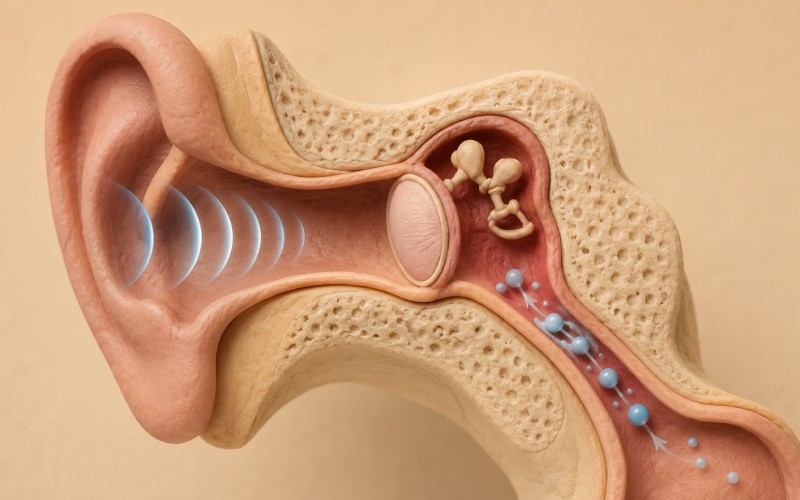
Your eardrum has air on both sides of it. When the air pressure around you increases — whether in a chamber, on a plane, or driving down a mountain — the outside air pushes inward against the eardrum. The air pocket behind the eardrum, inside the middle ear, needs to catch up.
The equalizer is a narrow passage called the Eustachian tube — roughly 36 mm long, connecting the back of your throat to the middle ear 1. Most of the time this tube sits closed. When you swallow, yawn, or chew, the muscles around it contract briefly and pop it open, letting a small puff of air through to balance the pressure 1.
If the tube doesn’t open when it should, that’s when you start to feel fullness, stuffiness, or mild discomfort 1.
An Important Distinction: Mild Chambers vs. High-Pressure Facilities
Not all hyperbaric environments are the same, and the ear experience differs significantly depending on the pressure level involved.
| Home/Mild Pressure Chambers | Facility-Based High-Pressure Units | |
| Typical Pressure | 1.3 – 2.0 ATA | 2.0 – 3.0 ATA |
| Pressure Increase Over Ambient | ~4.4 psi above normal | ~14.7 – 29.4 psi above normal |
| Comparable Everyday Experience | Roughly similar to descending to ~10 feet of water | Roughly similar to descending to 33–66 feet of water |
| Ear Equalization Demand | Low to moderate | Moderate to high |
| User Control Over Pressurization Rate | Often user-managed or adjustable | Operated by a trained technician |
Most published studies on ear barotrauma during hyperbaric oxygen exposure were conducted in facility-based settings at 2.0 ATA and above 2. The pressure differential involved at those levels is several times greater than what a 2.0 ATA home chamber produces. So when you see statistics about ear discomfort rates, it’s worth understanding the context — those numbers were generated under more demanding conditions than a typical mild home unit creates 2.
That said, even a small pressure change can cause ear discomfort if you don’t equalize. So the techniques still matter 1.
What Ear Discomfort Feels Like in a Mild Chamber
At 2.0 ATA, many users describe the sensation as similar to the early phase of airplane ear — a feeling of fullness or slight muffling. Here’s the typical progression:
| Stage | What You Might Notice | What to Do |
| Comfortable | Nothing unusual. Sounds normal. | Keep equalizing periodically as a habit. |
| Mild Fullness | Ears feel slightly “plugged” or muted. | Swallow, yawn, or do a gentle Valsalva. You’ll often feel a soft pop and quick relief. |
| Noticeable Pressure | A dull, pressing sensation. Hard to ignore. | Pause or slow down the pressurization. Equalize actively. Do not continue pressurizing until the feeling clears. |
| Discomfort | Sharp or persistent enough to be genuinely unpleasant. | Stop pressurization. Let some pressure out until your ears feel normal. If it doesn’t resolve, end the session and consult a healthcare professional. |
The critical point: don’t push past mild fullness. In a home chamber, there is usually no reason to keep increasing pressure when your ears are asking for more time. If it doesn’t feel right, slow down or stop. That’s the entire strategy 3.
5 Equalization Techniques That Work
None of these are complicated. Most of them you’ve done before without thinking about it. The key is to start them early — before you feel anything, not after 1.
1. Swallowing
Sipping water works well. The swallowing motion activates the muscles around the Eustachian tube and briefly pulls it open 1. Keep a water bottle nearby.
2. Yawning
A big, exaggerated yawn — even a fake one — stretches the relevant muscles. It doesn’t need to be a real yawn. Open your jaw wide and mimic the motion. Repeat as needed 1.
3. Chewing Gum
Repetitive jaw motion keeps those muscles active. Simple, passive, effective. A lot of first-time users find this is the easiest method because it requires zero thought.
4. The Valsalva Maneuver
More technical-sounding than it actually is:
- Close your mouth
- Pinch your nostrils shut
- Gently try to blow air out through your closed nose
You should feel a soft “pop” in one or both ears. Gently is the key word here. A light, steady push — not a hard blow 4.
5. The Toynbee Maneuver
The Valsalva’s quieter cousin:
- Pinch your nose shut
- Swallow at the same time
Some people find this works better for them. It may take a few tries to get the timing right 4.
The golden rule: Start equalizing the moment pressurization begins — before you feel anything. Once you’re already uncomfortable, the pressure difference may be harder to overcome, making equalization more difficult 1 4. Stay ahead of it.

Why Some People Find It Harder
Not everyone’s Eustachian tubes are the same. Some factors that can affect how easily you equalize:
Congestion and allergies. Swollen tissue around the Eustachian tube openings can reduce their ability to open 1. Healthcare professionals generally advise that people experiencing active congestion — from colds, seasonal allergies, or sinus issues — consult with a professional before using any pressure-based equipment.
Individual anatomy. Some people simply have narrower or more angled tubes. Children tend to have shorter, more horizontal Eustachian tubes that may not ventilate as efficiently 1.
One ear more stubborn than the other. Very common. One tube may just be less cooperative. Try tilting your head toward the difficult side while equalizing — sometimes the change in angle helps 4.
Experience level. People who regularly encounter pressure changes may become more comfortable with equalization techniques over time. One study of flight attendants found measurably different Eustachian tube function compared with people without regular pressure exposure 5. That doesn’t guarantee the same pattern for every chamber user, but practice with equalization techniques often helps.
What If You Can’t Equalize Mid-Session?
It happens, especially during your first few sessions. Here’s a straightforward approach:
- Slow or pause pressurization. If your chamber gives you direct control over the pace, use it 4.
- Try all five techniques. Sometimes one works when others don’t.
- If fullness doesn’t clear, release some pressure. Bring the chamber back to a level where your ears feel normal, then try building up again more slowly 4.
- Accept a lower pressure. Not every session has to reach the same level. Your ears might cooperate fully tomorrow and push back today. That’s normal.
- End the session if needed. There’s no benefit to sitting in a chamber feeling uncomfortable. Depressurize gradually and try again another day.
Tips for a Comfortable Experience
- Stay hydrated before your session. Dry mucous membranes may feel less comfortable during pressure changes.
- Practice equalizing beforehand. Try the Valsalva and Toynbee maneuvers before you ever get inside. Get familiar with the sensation.
- Use a slow pressurization rate. A gradual pressure increase gives your ears more time to adjust between changes. If your chamber offers an adjustable fill rate, start with the slowest comfortable setting and increase only as your ears allow 4.
- Talk to a healthcare professional first if you have a history of ear issues, sinus problems, recent infections in that area, or difficulty equalizing on planes 1.
Do’s and Don’ts — Quick Reference
| ✅ Do | ❌ Don’t |
| Start equalizing early and often | Wait until you feel discomfort to act |
| Keep water nearby to sip | Force pressurization through ear resistance |
| Use the slowest comfortable pressurization rate | Rush the pressure up to “get it over with” |
| Practice techniques before your first session | Blow too hard during the Valsalva |
| Listen to your body and adjust | Assume every session will feel the same |
| Talk to a healthcare professional if you have concerns | Use the chamber during heavy congestion without professional guidance |
FAQ
Is ear pressure in a home chamber the same as on an airplane?
The mechanism is similar — pressure imbalance across the eardrum. Many people describe the sensation as familiar, but a mild home chamber can feel more manageable because pressurization is gradual and, in many home setups, can be slowed or paused to your comfort level 1.
Can a mild pressure chamber permanently damage hearing?
Most users of mild home chambers experience temporary pressure-related sensations rather than injury. That said, sharp pain, bleeding, dizziness, or hearing changes are not normal. If any of those occur, stop immediately and see a healthcare professional 2.
I struggle to equalize on flights. Should I avoid a home chamber?
Not necessarily — but take it slowly and speak with a healthcare professional first. Many people who struggle on flights find that a chamber’s milder pressure and slower pace make the experience easier to manage. Start with the lowest pressure setting and the slowest fill rate.
How many sessions before my ears adjust?
There’s no universal number. Many users find equalization feels more familiar with practice, but the learning curve varies from person to person. One study in flight attendants suggests that repeated exposure to pressure changes may be associated with different Eustachian tube function 5.
Do ear plugs help?
The key issue is not ear-canal occlusion but middle-ear equalization 1. Standard ear plugs are not a substitute for that process. During chamber use, follow the chamber manufacturer’s instructions and avoid putting anything in the ear canal unless a qualified professional has advised it.
What if only one ear gives me trouble?
Common. One Eustachian tube is often less cooperative than the other 1. Try tilting your head toward the affected side while doing the Valsalva or Toynbee maneuver. If one ear is consistently difficult, use an even slower pressurization rate and consider consulting a healthcare professional.
Are children more susceptible to ear discomfort?
Children tend to have shorter, more horizontal Eustachian tubes, which can make equalization harder 1. They may also have more difficulty performing equalization techniques consistently. Professional guidance is recommended before children use any pressure equipment, and adult supervision during use is essential.
The Bottom Line
A home hyperbaric chamber can cause ear discomfort — but at 2.0 ATA, the pressure involved is modest, the sensation is familiar to many people, and the tools to manage it are simple techniques you can learn in minutes.
The single best piece of advice: equalize early and often, and go at your own pace. There’s no reason to push through discomfort. If today’s session isn’t cooperating, slow down, back off, and give your ears the time they need 1.
References
- Casale J, Shumway KR, Hatcher JD. Physiology, Eustachian Tube Function. StatPearls. 2023. https://www.ncbi.nlm.nih.gov/books/NBK532284/
- Nasole E, Zanon V, Bosco G, et al. Middle ear barotrauma during hyperbaric oxygen therapy: a review of occurrences in 5,962 patients. Undersea & Hyperbaric Medicine. 2019. https://pubmed.ncbi.nlm.nih.gov/31051054/
- Lima MAR, Farage L, Cury MCL, Bahmad F Jr. Update on middle ear barotrauma after hyperbaric oxygen therapy—insights on pathophysiology. International Archives of Otorhinolaryngology. 2014. https://pmc.ncbi.nlm.nih.gov/articles/PMC4297009/
- Sheffield R, Posey K. What Chamber Operators Should Know About Ear Barotrauma (and How to Prevent It). International ATMO Education. 2018. https://learn.hyperbaricmedicine.com/wp-content/uploads/2018/07/CE-ear-barotrauma-071818-publish.pdf
- Emre IE, Dogan C. Eustachian Tube Function in Flight Attendants. Indian Journal of Otolaryngology and Head & Neck Surgery. 2022. https://pubmed.ncbi.nlm.nih.gov/36213469/