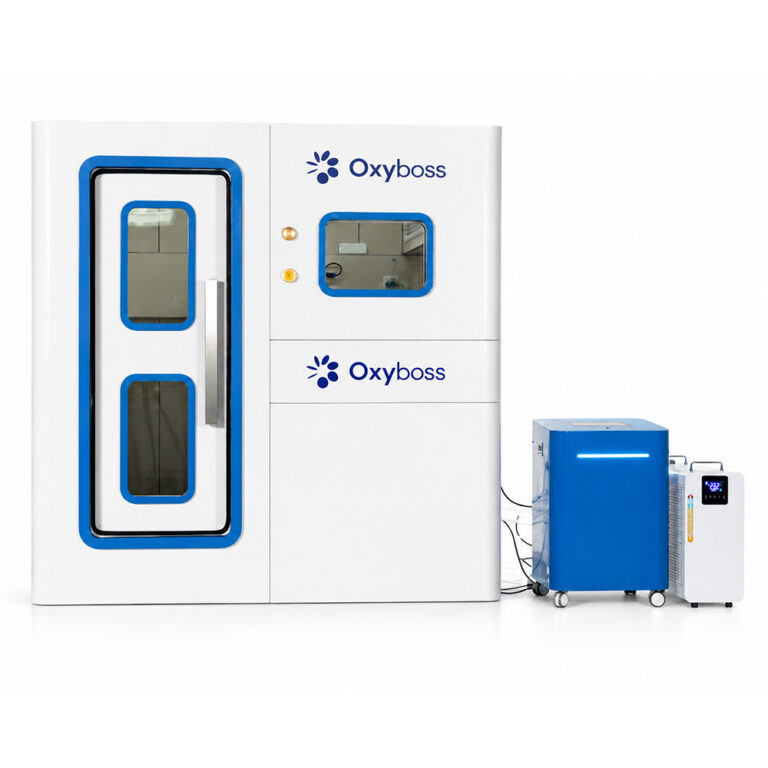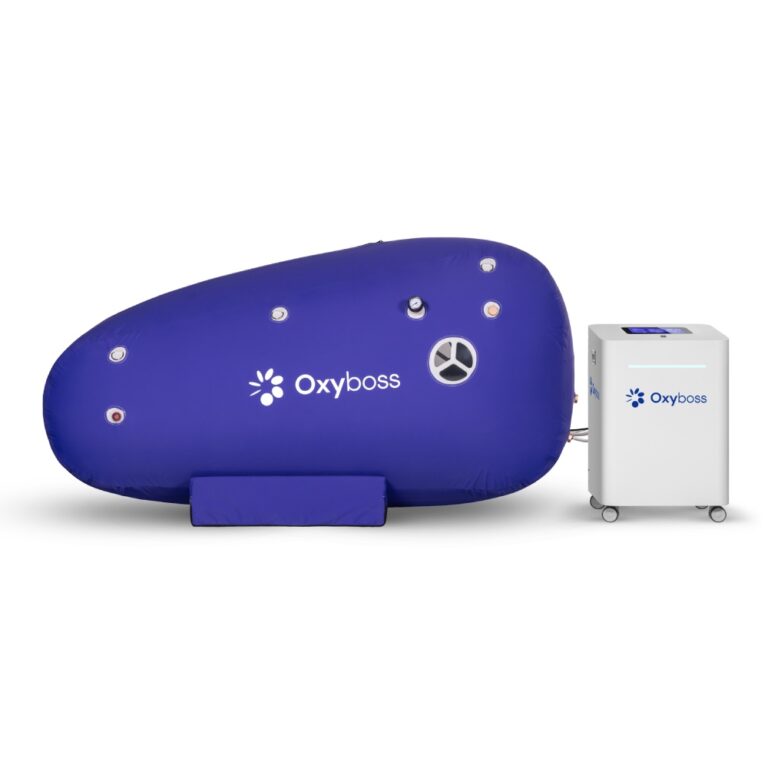
You’re weighing options. Maybe a hyperbaric chamber feels too big, too expensive, or too unfamiliar — and you want to know if something simpler can fill the same role. That’s a fair question. But it has a tricky answer.
The short version: most products marketed as “alternatives” to a hyperbaric chamber operate through entirely different physical mechanisms. They may belong in the same wellness routine, but they are not interchangeable. Before comparing prices or reading reviews, you need to compare what each tool physically does — because that determines whether switching from one to another is a trade-off, or a category change.
Disclaimer: This article discusses physical mechanisms and product categories for general educational purposes only. Nothing here is intended as health advice, a safety guarantee, or a recommendation for any specific wellness outcome. If you have questions about whether any product is appropriate for your situation, consult a qualified professional.
What Makes a Hyperbaric Chamber Different — At the Physics Level
A hyperbaric chamber raises the atmospheric pressure around you. Normal sea-level pressure is 1.0 ATA (atmospheres absolute). Home-use chambers typically operate somewhere above that.
The relevant physics principle is Henry’s Law: the amount of a gas that dissolves in a liquid is proportional to the pressure of that gas above the liquid [1]. Inside a pressurized chamber, the increased atmospheric pressure changes the physical conditions under which you breathe — more oxygen can dissolve into liquid (including blood plasma) than would be possible at normal atmospheric pressure.
That’s the mechanism. Pressure changes the gas-dissolution environment. That’s what separates a chamber from other oxygen-adjacent products.
What this means for your body in practice varies by individual and depends on many factors that go beyond the scope of a product comparison. We’re staying at the physics level here.
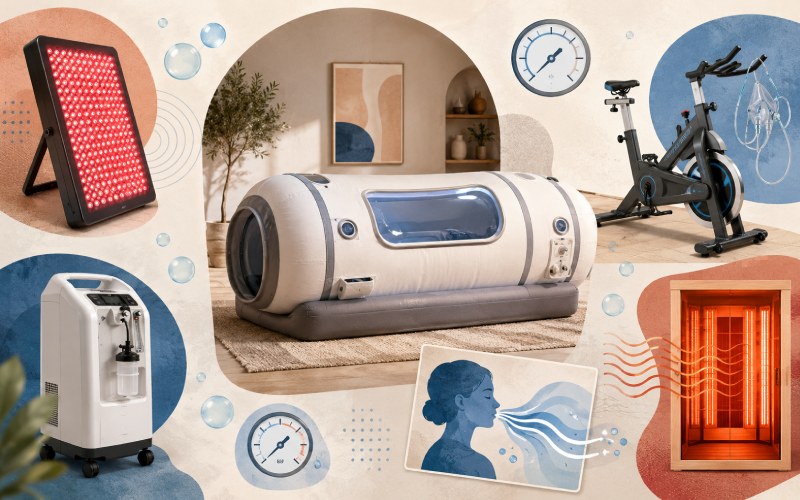
The “Alternatives” — And How They Actually Differ
Calling something an “alternative” implies it does the same job through a different path. Most of these products don’t — they do different jobs.
Exercise With Oxygen (EWOT)
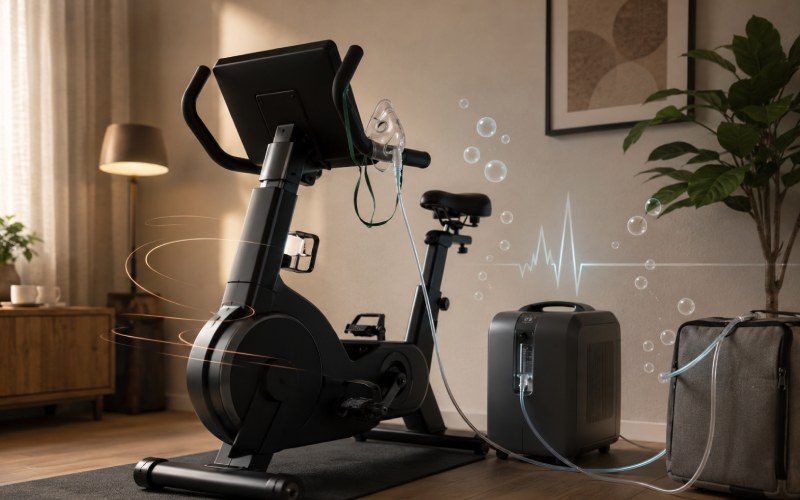
EWOT pairs cardiovascular exercise with a high-flow oxygen mask. No pressurized environment. Your body takes in more oxygen because your breathing rate and heart rate are elevated during exercise.
The mechanism is circulation-driven, not pressure-driven. You’re moving more air through your lungs faster, while that air happens to be oxygen-enriched. The pressurized gas-dissolution dynamic described by Henry’s Law is not in play because there’s no change in atmospheric pressure.
Sessions are shorter — often 15 to 20 minutes. Equipment is generally less expensive than a chamber. But the physical mechanism is a different category, not a budget version of the same one.
Red Light Therapy
Red light panels emit wavelengths in the visible red and near-infrared spectrum. These wavelengths interact with mitochondria — the energy-producing structures in your cells — through a process called photobiomodulation [2].
This has nothing to do with oxygen delivery or atmospheric pressure. It’s light energy interacting with cellular components. Comparing it to a hyperbaric chamber is a category error: they share shelf space in “wellness products” but operate through unrelated physics.
Infrared Sauna
Infrared saunas use heat to raise your core body temperature. The mechanism is thermal stress — your body responds to elevated temperature by increasing circulation and activating heat-responsive biological pathways [3].
No pressure. No oxygen enrichment. The only overlap with a hyperbaric chamber is that both involve sitting in an enclosed space. The physical mechanisms share nothing.
Standalone Oxygen Concentrators
A portable oxygen concentrator filters ambient air and outputs enriched oxygen (roughly 90–95% purity) through a mask or nasal cannula. No pressurized environment.
Without increased atmospheric pressure, the Henry’s Law dynamic doesn’t apply. You’re breathing higher-concentration oxygen at normal pressure. This changes the oxygen fraction of inhaled air but does not change the physical pressure conditions that drive plasma dissolution.
Breathing Techniques
Methods such as structured hyperventilation or controlled breath-holds aim to change how your body processes the oxygen already available — shifting CO₂ levels, altering breathing patterns, or training respiratory efficiency.
These practices are about utilization and regulation, not about changing the physical environment in which oxygen is delivered. They require no equipment. They are also not doing anything that overlaps with what a pressurized chamber does.
Side-by-Side: What’s Actually Different
| Factor | Hyperbaric Chamber | EWOT | Red Light Therapy | Infrared Sauna | Oxygen Concentrator |
| Core mechanism | Increased atmospheric pressure (Henry’s Law) | Elevated circulation + enriched O₂ | Photobiomodulation (light + mitochondria) | Thermal stress response | Enriched O₂ at ambient pressure |
| Involves pressure change? | Yes | No | No | No | No |
| Involves oxygen enrichment? | Usually yes (paired with concentrator) | Yes | No | No | Yes |
| Involves physical exertion? | No — passive | Yes — requires cardio exercise | No — passive | No — passive | No — passive |
| Typical session length | Varies by protocol, often 60–90 min | Often 15–20 min | Often 10–20 min | Often 20–40 min | Variable |
| Space requirement | Moderate to large | Small to moderate | Minimal | Moderate | Minimal |
| Mechanism overlap with a chamber | — | Low (different delivery physics) | None | None | Partial (oxygen enrichment only, no pressure) |
The point of this table is that these products sit in different mechanistic categories. Deciding between them isn’t like choosing between two brands of the same thing — it’s like choosing between a bicycle, a kayak, and a pair of hiking boots. All valid. Not interchangeable.
So When Is Something a Real “Alternative”?
Honestly? If your primary interest is the pressure-driven oxygen dissolution mechanism, there isn’t a consumer alternative that replicates it without a pressurized vessel. That’s not a sales pitch — it’s a constraint of physics. Henry’s Law requires pressure. No pressure, no enhanced gas dissolution.
If your primary interest is something else — cardiovascular conditioning, mitochondrial support through light, heat-based stress response, or simply breathing higher-concentration oxygen — then these other products aren’t “alternatives to a chamber.” They’re the right tool for a different job, and comparing them to a chamber was the wrong frame to begin with.
The most useful question isn’t “what’s an alternative to a hyperbaric chamber?” It’s: “What mechanism am I actually looking for, and which product delivers it?”

If You’re Considering Stacking Multiple Tools
Many people eventually combine several of these products in a single routine. And that can make sense precisely because the mechanisms don’t overlap — you’re not doubling up on the same thing; you’re covering different pathways.
There’s no single “correct” combination. It depends on what you’re trying to do, how much space and budget you have, and how much time you want to spend. The main insight is just: don’t think of these as competing alternatives. They’re more like different instruments in the same toolkit.
Frequently Asked Questions
Is an oxygen concentrator basically a cheaper hyperbaric chamber? No. An oxygen concentrator increases the percentage of oxygen in the air you breathe, but it doesn’t change the atmospheric pressure. The pressure change is what creates the enhanced gas-dissolution conditions described by Henry’s Law. These are two different physical variables.
Does EWOT provide the same physical mechanism as a hyperbaric chamber? No. EWOT uses elevated heart rate and breathing rate during exercise to move more oxygen through your system. A hyperbaric chamber uses increased atmospheric pressure. The delivery mechanism is fundamentally different.
Can I combine a chamber with other products? Many people do. Because the mechanisms are different, there’s no inherent redundancy. Whether any specific combination makes sense for you depends on your goals, schedule, and budget.
What should I look for in a chamber if I decide to go that route? Focus on: verified pressure ratings and safety testing, certifications relevant to your region (such as CE or equivalent), redundant pressure-relief valves, material safety documentation (especially fire resistance, since oxygen-enriched environments carry increased fire risk [4]), and practical factors like noise, interior dimensions, and ventilation. Safety certifications and pressure-vessel standards — such as those published by ASME for vessels designed for human occupancy[5] — are a reasonable starting baseline for evaluating build quality.
References
- Avishay, D. M., & Tenny, K. M. (2023). Henry’s Law. In StatPearls. StatPearls Publishing. https://www.ncbi.nlm.nih.gov/books/NBK544301/
- Hamblin, M. R. (2017). Mechanisms and applications of the anti-inflammatory effects of photobiomodulation. AIMS Biophysics, 4(3), 337–361. https://pmc.ncbi.nlm.nih.gov/articles/PMC5523874/
- Laukkanen, J. A., Laukkanen, T., & Kunutsor, S. K. (2018). Cardiovascular and other health benefits of sauna bathing: A review of the evidence. Mayo Clinic Proceedings, 93(8), 1111–1121. https://pubmed.ncbi.nlm.nih.gov/30077204/
- U.S. Food and Drug Administration. (2025). Follow instructions for safe use of hyperbaric oxygen therapy devices — Letter to health care providers. https://www.fda.gov/medical-devices/letters-health-care-providers/follow-instructions-safe-use-hyperbaric-oxygen-therapy-devices-letter-health-care-providers
- American Society of Mechanical Engineers. (2023). ASME PVHO-1-2023: Safety Standard for Pressure Vessels for Human Occupancy. https://www.asme.org/codes-standards/find-codes-standards/pvho-1-safety-standard-pressure-vessels-human-occupancy