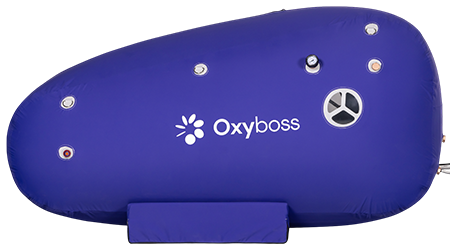
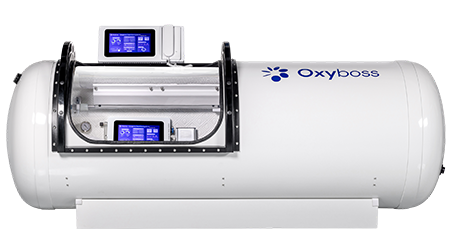
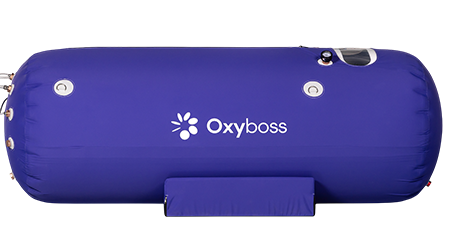

Most people who step into a hyperbaric chamber for the first time have the same quiet worry: I’m about to be sealed inside a pressurized space — is the air in there actually safe to breathe? The short answer is yes, when the system is set up correctly — and “set up correctly” comes down to three things you rarely see marketed: where the gas comes from, how the air moves, and how clean that air is kept.
This article is about those three things. Not the benefits, not the marketing — just the plumbing and the physics that decide whether the air around you is trustworthy.
First, what’s actually inside the chamber?
There’s a common mix-up worth clearing up before anything else. People imagine a hyperbaric chamber as a tank full of pure oxygen. In most real-world setups — especially in the mild hyperbaric range (roughly 1.3–1.5 ATA) — that’s not what’s happening.
What usually happens is: the chamber is pressurized with compressed ambient air, and the user breathes concentrated oxygen through a mask or hood delivered from an oxygen concentrator. So there are effectively two gas streams:
- The air filling the chamber — this comes from a compressor pulling in room air.
- The oxygen you inhale — this comes from a concentrator that pulls oxygen out of that same room air.
Almost every real safety question is about the first stream. And that leads straight to the single most important sentence in this article.
The one thing that matters most: where the intake air comes from
A chamber’s air is only as clean as whatever the compressor is breathing in. That’s it. That’s the whole game.
A compressor doesn’t create air — it takes the air in the room and squeezes it into the chamber. So if the intake is sitting somewhere it shouldn’t be, whatever’s in that spot gets concentrated and pushed inside with you. The classic mistakes are:
- Placing the compressor near a running engine (a car in an attached garage, a generator, a delivery truck idling outside a nearby window).
- Putting the intake in a poorly ventilated utility room with fuel-burning equipment (a gas furnace, water heater, or boiler).
- Running it in a freshly painted, off-gassing, or chemically treated room.
Notice the pattern: none of these are problems with the chamber itself. They’re problems with placement. This is why the boring instruction in every manual — “operate in a clean, well-ventilated area, away from exhaust and combustion sources” — is genuinely the most safety-critical line in the whole document. It’s not legal boilerplate. It’s the actual mechanism.
Practical rule of thumb: put the compressor intake where you’d be comfortable sitting and breathing for an hour. If the air is fine for you standing next to it, it’s fine going into the chamber.
Oxygen concentration and why “more is not automatically better”
Higher oxygen in an enclosed space raises flammability, not toxicity in the everyday sense. Materials that smolder slowly in normal air can ignite more easily and burn faster in an oxygen-enriched environment. This is the real reason hyperbaric settings are strict about what goes inside.
That’s why responsible operation means:
- No open flames, sparks, or heat sources — obvious, but non-negotiable.
- No easily ignitable materials — certain fabrics, oils, lotions, aerosols, and some electronics.
- Keeping the chamber-fill air as normal ambient air, with concentrated oxygen delivered directly to the user rather than flooding the whole enclosure.
The mild-hyperbaric approach — pressurize with air, breathe oxygen through a mask — is partly a design choice around exactly this. It keeps the enclosure’s overall oxygen level much closer to normal than a chamber flooded with pure oxygen would be.
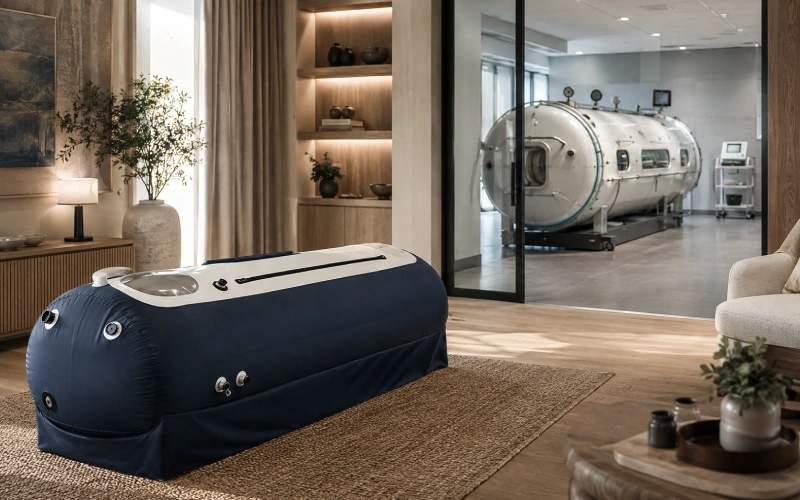
Ventilation and the gas everyone forgets: CO₂
People fixate on oxygen and forget the gas you’re constantly producing: carbon dioxide. In any sealed space with a person breathing in it, CO₂ accumulates. If it isn’t managed, the first symptoms are subtle — a headache, drowsiness, feeling stuffy — long before anything dramatic.
This is handled by continuous air exchange (flushing): the system keeps pushing fresh air through and venting used air out, so CO₂ never builds up. It’s not a one-time fill; it’s an ongoing turnover. When a chamber feels stuffy, that’s almost always a ventilation/flush issue, not an oxygen issue — and it’s the clearest signal that airflow needs checking before the next session.
Two things worth confirming about any system:
- It maintains a steady flow-through, not a static seal.
- The exhaust vents somewhere useful — not right back into the intake, and not into a closed room with no air exchange of its own.
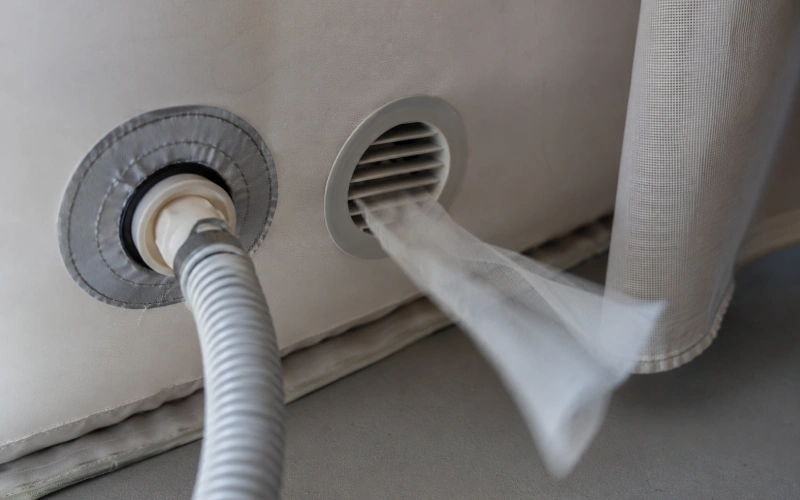
What “clean gas” actually means
“Gas quality” sounds vague until you break it into the things that can actually be wrong with it:
| Concern | Where it comes from | How it’s controlled |
|---|---|---|
| Particulates / dust | Room air, worn parts | Intake and inline filtration |
| Oil / hydrocarbons | Oil-lubricated compressors | Oil-free compressors or proper filtration |
| Moisture | Humid room air | Drying / filtration; prevents mold and buildup |
| Contaminant gases (exhaust, fumes) | Bad intake placement | Correct intake location (see above) |
The through-line: filtration handles particles, oil, and moisture, but filtration does not fix a bad intake location. A filter cleans up dust and oil mist; it does not reliably scrub out dissolved contaminant gases. That’s why placement — not the filter — is the primary defense.
Mild vs. clinical: same physics, different envelope
It’s worth being clear that safety parameters scale with intensity. A clinical hyperbaric setup running at 2.0–3.0 ATA with high or pure oxygen operates in a much more demanding regime: higher fire-risk management, stricter fill protocols, medical supervision, and tightly controlled gas handling.
A mild hyperbaric environment (~1.3–1.5 ATA, air-filled with oxygen delivered to the user) sits in a gentler part of the same physics. The gas laws don’t change — pressure still increases how much oxygen dissolves in plasma — but the lower pressure and lower enclosure-oxygen level mean the safety envelope is wider and the operational demands are lower. That’s a feature of the category, not a shortcut around it. The basics in this article still apply; they’re just easier to meet.
A simple pre-session checklist
Before any session, three questions cover most of the real risk:
- Intake: Is the compressor pulling from clean air, away from any exhaust, fumes, or combustion source?
- Airflow: Is there continuous ventilation, and does the space itself feel fresh — not stuffy?
- Contents: Is everything going inside free of open flames, sparks, aerosols, oils, and easily ignitable materials?
If all three are yes, the gas environment you’re about to sit in is doing its job.
The honest part
No article replaces the manufacturer’s manual, proper installation, and — where relevant — professional guidance. Systems differ, and the specifics of your compressor, concentrator, filtration, and room matter more than any general rule. The goal here isn’t to make you your own safety inspector; it’s to help you understand what the safety measures are actually protecting against, so the instructions stop feeling like arbitrary fine print and start making sense.
FAQ
Can a hyperbaric chamber cause carbon monoxide problems on its own? No — a properly set-up chamber has nothing inside it that produces carbon monoxide. CO comes from incomplete combustion of fuel, and there’s no combustion happening in a chamber. The only realistic way CO could enter is if the compressor’s intake were placed near an external source of exhaust or fumes and drew it in. This is entirely preventable, and it’s exactly why intake placement — away from engines, generators, and fuel-burning equipment — is the top safety rule. In other words, the chamber isn’t the source; a bad intake location would be.
Why does the air sometimes feel stuffy inside? That’s almost always carbon dioxide, not a lack of oxygen. It means the continuous air exchange isn’t turning over fast enough. Checking ventilation and flow-through usually resolves it.
Does a filter make the air safe no matter where the compressor sits? No. Filters handle dust, oil mist, and moisture well, but they don’t reliably remove dissolved contaminant gases. Correct intake placement is the real protection; the filter is a second layer, not a substitute.
Is oxygen-enriched air dangerous to breathe? Not in the toxic sense at mild-hyperbaric levels. The main concern with higher oxygen is increased flammability, which is why open flames and easily ignitable materials are kept out — the caution is about fire risk, not breathing risk.
How is mild hyperbaric different from a clinical chamber in terms of safety? Same underlying physics, gentler settings. Mild systems (~1.3–1.5 ATA, air-filled) run at lower pressure and lower enclosure-oxygen levels than clinical systems (2.0–3.0 ATA), which widens the safety margin and lowers the operational demands — though the same basics of clean intake, ventilation, and gas quality still apply.