
Most people never think about how their brain gets fed. It just works. Until it slows down a little — a name that won’t come, a train of thought that derails — and suddenly everyone’s paying attention.
So let’s start there. Not with the machine. With the brain, and why it drifts.
What Dementia Actually Is
Dementia isn’t one disease. It’s an umbrella term for a gradual loss of memory, reasoning, and everyday function. Alzheimer’s is the largest slice under that umbrella. The scale is real: the global count of people living with dementia is projected to roughly double every twenty years, from 46.8 million in 2015 toward 131.5 million by 2050 [1].
Here’s the part that surprises people. The underlying brain changes don’t switch on the day someone forgets where they parked. They build quietly, for years. Some imaging work suggests shifts in brain energy metabolism can show up long before obvious symptoms [2]. That long, silent runway is exactly why the “long before anything goes wrong” conversation matters — and it’s a conversation about general wellness, not about managing any condition.
Why Brain Function Slides With Age
The brain is a spectacularly hungry organ. Small, but hungry. Though it’s only about 2% of body mass, it consumes over 20% of the body’s oxygen, and a lot of age-related decline traces back to the oxygen-processing machinery getting less efficient [3].
When that supply chain gets shaky, cells don’t get what they need to fire cleanly. And the shakiness usually comes from a handful of overlapping problems that feed each other.
Five Cellular Reasons the Aging Brain Slows Down
Researchers keep circling the same interconnected culprits. They rarely act alone.
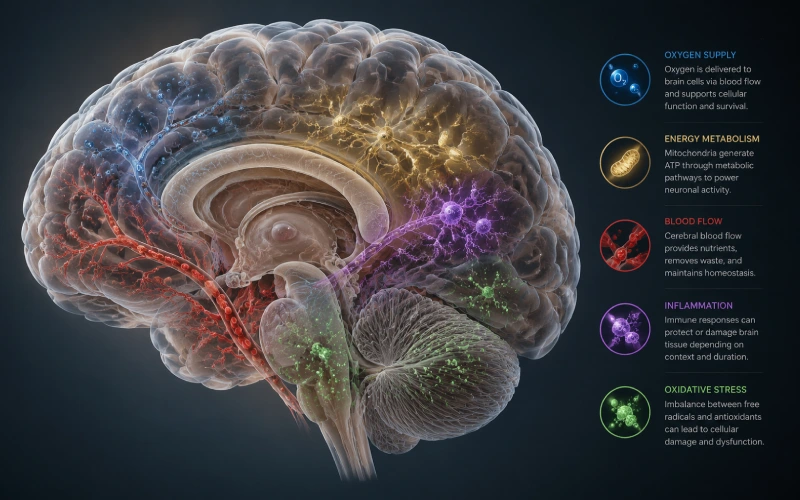
1. Oxygen delivery drops. Reduced cerebral blood flow can push brain tissue toward subtle oxygen shortfall, lowering oxygen metabolism and nudging up brain lactate [4].
2. Energy production stumbles. The brain runs on glucose converted into usable energy. Older biochemical estimates of cerebral energy formation in Alzheimer-type decline found reductions from around 7% in the earliest stages to over 50% in advanced stages [5]. A huge gap for an organ that never rests.
3. Blood flow declines. Regional blood flow and oxygen use fall in the frontal, parietal, and temporal cortex in Alzheimer-type decline, and the reductions track with severity [6]. Less flow, less delivery, less function — a loop.
4. Inflammation climbs. Short bursts of immune activity are useful. The slow, never-quite-off version is not.
5. Oxidative stress builds. A large body of evidence points to reactive oxygen species driving damage to the cell’s energy factories, arising partly from chronic low blood flow, and sitting near the root of the whole process [7].
Put simply: aging cells make more oxidants, oxidants wear down the energy factories, tired factories can’t defend themselves, and inflammation tags along.
Two Very Different Chambers — Read This Before Anything Else
This is the section the internet usually skips, and skipping it is how people end up believing things that aren’t true. So, before I go one sentence further into oxygen and pressure, the single most important distinction:
Clinical hyperbaric environments and mild home wellness chambers are not the same thing, and their science does not transfer one-to-one.
| Clinical hyperbaric environment | Mild home wellness chamber | |
|---|---|---|
| Typical pressure | ~2.0 ATA and above | ~1.3 ATA or lower |
| Air breathed | High-concentration oxygen | Ambient air (~21%) or lightly enriched |
| Setting | Supervised facility | Home wellness routine |
| Purpose framing | Managed under professional oversight | General wellness only |
| Dissolved-oxygen effect | Large increase in plasma oxygen | Much smaller, gentler shift |
Why this matters scientifically: under high pressure with concentrated oxygen, a large amount of oxygen dissolves directly into blood plasma, well beyond what red cells carry [8]. That steep rise is what the most striking research effects were built on. At 1.3 ATA breathing ordinary air, the increase in dissolved oxygen is far more modest. So the honest framing is this — the dramatic findings from high-pressure clinical studies cannot be assumed to reproduce in a mild home setting. What a mild chamber offers is better understood as a gentle, repeated pressure-and-oxygen nudge — a mild hormetic stimulus — aimed at everyday wellness, recovery, and comfort, not as a scaled-down copy of clinical results.
I’d rather lose you here with honesty than keep you with a promise the physics won’t back.
What the Higher-Pressure Research Has Shown (and Where It Applies)
With that boundary drawn, the clinical-environment research is genuinely interesting — as background on how oxygen and pressure interact with brain biology, at those pressures.
Raising blood and plasma oxygen sharply, then returning to baseline, appears to act as a signal that activates oxygen- and pressure-sensitive genes [8]. The body reads the swing as a cue to adapt.
Some of the mechanism work is worth knowing:
- Energy factories. In a 2023 controlled animal study on traumatic brain injury (published in Antioxidants), the high-pressure oxygen environment helped preserve mitochondrial respiration, including oxidative phosphorylation and electron transfer [9]. An earlier 2003 rodent study on motor-neuron decline reported the respiration rate for mitochondrial complex IV in the motor cortex improving by roughly 40% [10].
- Adaptability (neuroplasticity). A 2024 review in Frontiers in Neurology summarized effects at the cerebral level: enhanced blood flow and metabolism, new blood-vessel growth, synaptic plasticity, and stronger neuronal connectivity [3].
- Blood flow and cognition in older adults. A 2020 randomized controlled trial by Hadanny and colleagues, published in Aging, reported that a high-pressure oxygen protocol in healthy older adults was associated with cognitive gains tied to changes in regional cerebral blood flow, with the largest improvements in attention and information processing speed [11].
These are real signals. They are also, to be clear, results from high-pressure, high-oxygen protocols under supervision. Read them as “how the biology can respond in that environment,” not as “what your home chamber will do.”
So What Might a Mild Home Chamber Reasonably Support?
Here’s where I’ll stay inside the lines the evidence actually draws.
A mild chamber’s appeal isn’t reversing anything — it’s the gentle, repeatable exposure that people fold into a wellness routine. Users most commonly describe it in terms of recovery and energy: support for muscle and tissue repair after activity, and a general sense of more energy and less fatigue [12]. Framed correctly, a mild chamber is a low-intensity pressure-and-oxygen environment that supports comfort, recovery, and everyday cognitive wellness — think steadier focus and less of that end-of-day mental fog — rather than a tool aimed at any diagnosis.
That’s a narrower promise. It’s also a truer one.
The Limits Worth Sitting With
I’d rather be a little boring here than a little wrong.
Even in the higher-pressure research, human studies tend to be small, and the details that matter most aren’t settled. Reviewers repeatedly note that the ideal pressure, session length, and frequency still need to be worked out [3]. A 2024 pilot report was blunt about its own small sample size limiting how far results generalize [13]. And some early enthusiasm rested on thin ground — one review flagged a promising recovery finding that came from a single trial lacking a sham control [14].
Now layer on the pressure gap between clinical and mild settings, and the honest summary is: promising direction, thin proof in places, and a real translation problem between the lab and the living room. Anyone claiming certainty about a home chamber and the aging brain is getting ahead of what’s known. Raise an eyebrow at big promises.
Bringing It Home
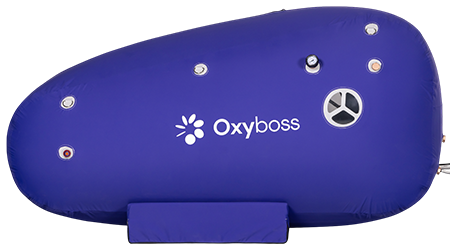
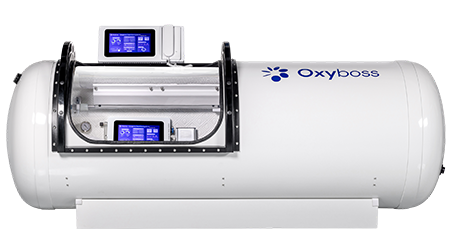
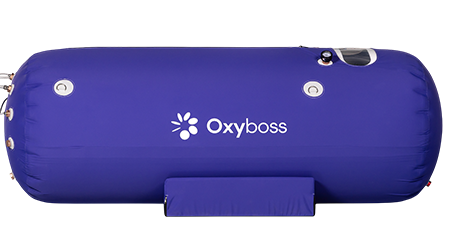
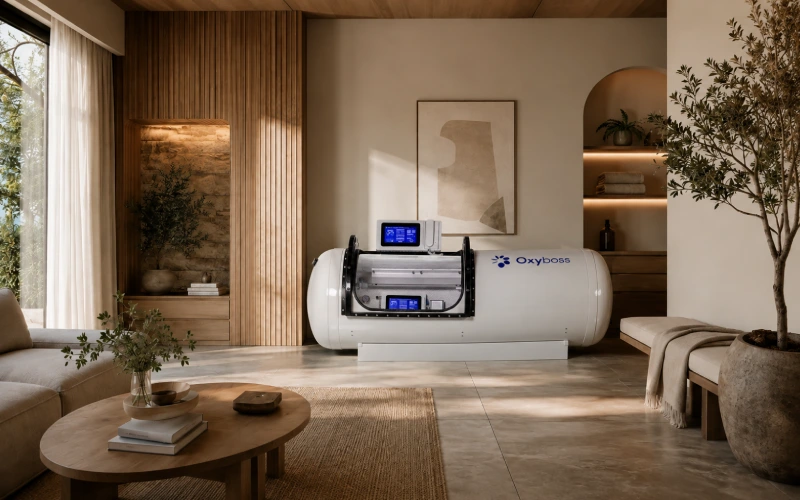
The home version of a hyperbaric chamber is built for convenience, not clinical settings. Mild systems are generally designed as low-risk, non-invasive wellness devices, typically running at 1.3 ATA or below [12, 15].
They fit real life. Modern home chambers tend to be quiet, low-maintenance, and energy-efficient, which makes them workable in a bedroom, home office, or dedicated wellness corner [16]. People like the privacy and the not-driving-across-town part.
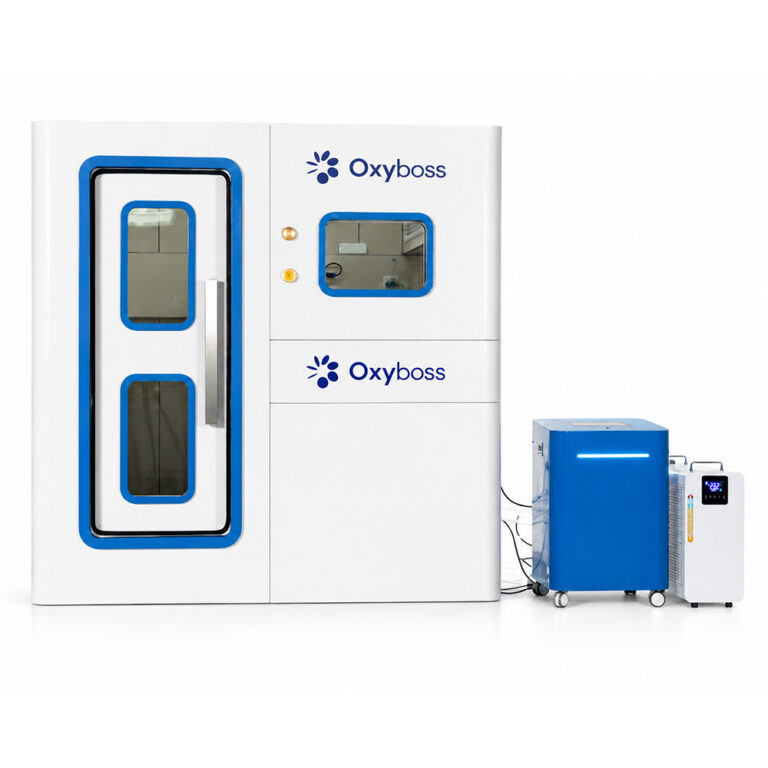
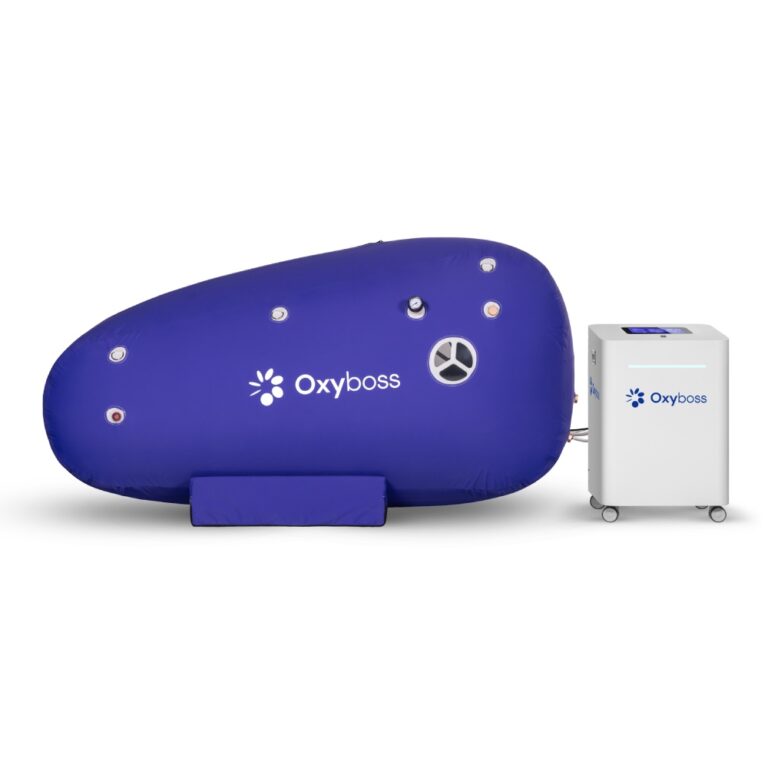
Two builds you’ll run into: soft-shell chambers use flexible materials and lighter pressure for comfort-focused routines, while hard-shell chambers offer a rigid structure and steadier airflow [17]. Neither is “better.” Different fit, different budget, different space.
Safety — Read This Part Twice
Mild chambers have a good track record when people follow the rules. That last clause does heavy lifting.
Most users report only mild sensations, with ear pressure being the most common as the pressure shifts; some feel a bit of sinus discomfort or brief closed-in unease at first, and these usually ease with familiarity [18]. The larger concerns are genuinely uncommon at mild pressures — oxygen-related side effects are described as very rare in home chambers running around 1.3–1.5 ATA, though they can appear with higher pressure or overly long sessions, which is why manufacturer duration guidance matters [17].
Basics worth taping to the wall: pressurize slowly, equalize gently (swallow or yawn), skip sessions when congested, keep flammable items out, and stay within recommended pressure and time [18, 19]. And the sensible first move before any new routine — talk with a qualified professional. These devices are designed for general wellness, and no medical claims are being made [12].
Frequently Asked Questions
Is a mild home chamber the same as a clinical one? No — and this is the whole point. Home chambers run at mild pressures near 1.3 ATA using filtered ambient air, while clinical environments reach 2.0 ATA or higher under supervision [12, 15]. Different pressure, different air, different purpose.
Can a home chamber reverse or stop cognitive decline? That’s not a claim the evidence supports, and it’s not what these devices are for. Even the higher-pressure research is promising-but-incomplete, and its results shouldn’t be assumed to carry over to mild home use [3].
Do the clinical study results apply to my home chamber? Not directly. The striking findings came from high pressure plus concentrated oxygen [8, 11]. A mild chamber is better understood as a gentle wellness stimulus, not a scaled-down version of those protocols.
What do home users actually report? Most commonly, recovery and energy — support for tissue repair after activity and a sense of reduced fatigue [12]. Individual experience varies.
How do I judge a chamber’s quality? Look for safety certifications from recognized bodies, confirm it meets the relevant home-use safety standards, and check the warranty and support [16, 17].
Where That Leaves You
The logic is clean, even where the proof is still catching up. The aging brain struggles with oxygen, energy, flow, and inflammation. Oxygen and pressure act directly on those levers — clearly at clinical intensities, and far more gently in a mild home setting. The early human data on attention and processing speed is real. The translation to a 1.3 ATA living-room chamber is not settled, and pretending otherwise would be dishonest.
If a mild hyperbaric routine sounds like something you’d fold into your wellness habits — for recovery, energy, and everyday mental freshness — the smart path is simple. Talk to a qualified professional first, choose a properly certified chamber, and follow the guidance to the letter. Curious enough to look closer? Explore the mild chamber options built for home wellness and start the conversation about whether one fits your space.
References
- World Alzheimer Report 2015 — Global prevalence and projections — https://www.alzint.org/resource/world-alzheimer-report-2015/
- Brain changes, blood flow, and metabolism in predicting decline — https://www.medicalnewstoday.com/articles/brain-changes-blood-flow-metabolism-help-predict-alzheimers-stages-dementia
- Hyperbaric oxygen as a neuromodulatory technique: a review of recent evidence, Frontiers in Neurology (2024) — https://www.frontiersin.org/journals/neurology/articles/10.3389/fneur.2024.1450134/full
- Cerebral oxygen consumption and lactate levels in Alzheimer’s disease and Lewy body dementia, GeroScience (2025) — https://link.springer.com/article/10.1007/s11357-025-01658-x
- Oxidative energy metabolism in the Alzheimer brain — https://link.springer.com/article/10.1007/BF03159971
- Cerebral blood flow and oxygen metabolism in senile dementia of Alzheimer type — https://link.springer.com/article/10.1007/s002340050553
- Oxidative stress, mitochondrial failure, and vascular hypoperfusion in Alzheimer disease — https://www.ncbi.nlm.nih.gov/pmc/articles/PMC3991025/
- Oxygen metabolism abnormality and Alzheimer’s disease: an update — https://www.sciencedirect.com/science/article/pii/S2213231723003567
- Hyperbaric oxygen and mitochondrial modulation after traumatic brain injury, Antioxidants (2023) — https://www.ncbi.nlm.nih.gov/pmc/articles/PMC10740762/
- Hyperbaric oxygen and mitochondrial function in Wobbler mice (2003) — https://pubmed.ncbi.nlm.nih.gov/12849745/
- Hadanny et al., Cognitive enhancement of healthy older adults using hyperbaric oxygen: a randomized controlled trial, Aging (2020) — https://www.ncbi.nlm.nih.gov/pmc/articles/PMC7377835/
- Mild hyperbaric chambers: a practical guide to at-home use — https://www.zenergyrecovery.com/blogs/recovery-zone/mild-hyperbaric-chambers-a-practical-guide-to-at-home-oxygen-therapy
- Hyperbaric oxygen pilot study report, Indiana Department of Health (2024) — https://www.in.gov/health/files/HBOT_Report_2024-IDOH-11.1.24.pdf
- Hyperbaric oxygen post established stroke — randomized trial review — https://www.ncbi.nlm.nih.gov/pmc/articles/PMC11283856/
- Legality and use of a hyperbaric chamber at home — https://www.oxygenhealthsystems.com/is-it-legal-to-use-a-hyperbaric-oxygen-chamber-in-my-home/
- A guide to hyperbaric chambers for home use — https://atlantahyperbariccenter.com/blog/hyperbaric-chambers-for-home-use/
- Hyperbaric chamber safety: risks and precautions — https://peakprimalwellness.com/blogs/wellness/are-hyperbaric-chambers-safe
- How to use a hyperbaric chamber safely at home — https://peakprimalwellness.com/blogs/wellness/how-to-use-a-hyperbaric-chamber-safely-at-home
- Hyperbaric oxygen at home: setup, safety, and session planning — https://www.hyperbaricpro.com/hyperbaric-oxygen-therapy-at-home-setup-safety-session-planning/