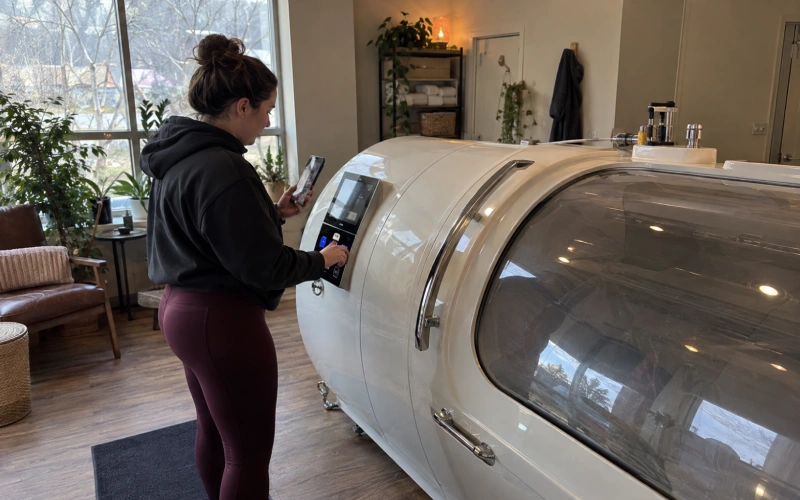
If two guests in the same week mention the same symptom at the same chamber, that is not a coincidence. It is a signal. Here is how to read it, log it, and act on it without losing a day of bookings or, worse, missing the one that mattered.
The short version. Treat a single report as data. Treat a second matching report inside seven days at the same chamber as a trend. Treat a third, or any of the red-light signals below, as a stop-pressing-and-call-the-manufacturer event. Document every report the moment it comes in, even if you decide to keep running. The log is the most valuable asset you have when you have to explain what happened later.e distinction matters because the response is different.
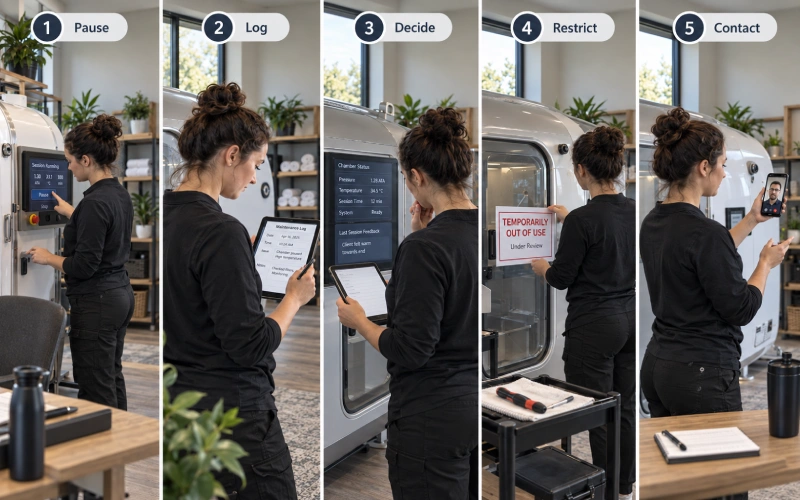
1. The five-step response, in order
Below is the sequence we recommend, in the order we recommend it. Skip a step and the next one falls over.
Step 1 — Pause, do not power down
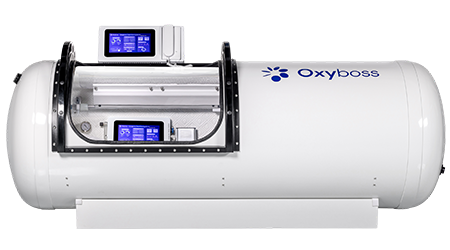
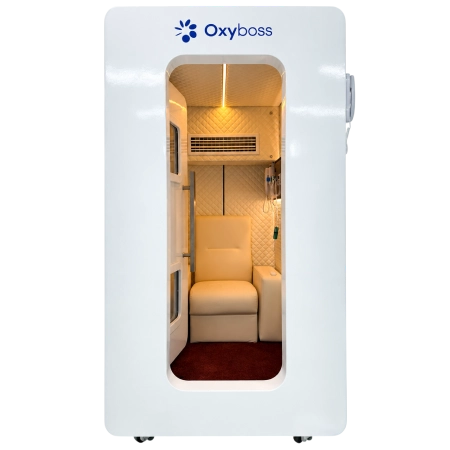
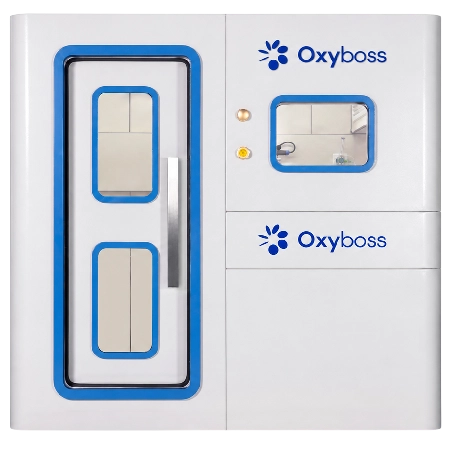
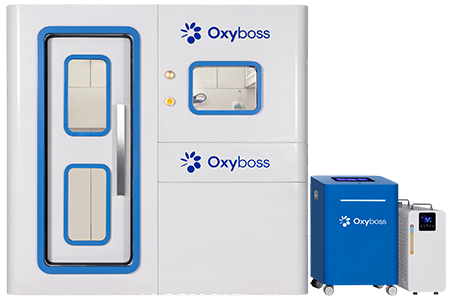
Keep the chamber pressurised if a guest is still inside. Do not cut power mid-session unless one of the red-light signals in section 3 is active. The Oxyboss hard chamber has both an automatic relief valve and a manual mechanical relief valve on the inside and outside of the cabin, so a controlled depressurisation is always available even with full power loss.
Step 2 — Log the report while it is fresh
Use the form in section 4. The single most common mistake operators make is waiting until end of shift to write it down. By then the timestamp is fuzzy, the symptom words are paraphrased, and the chamber serial number is missing.
Step 3 — Decide: chamber issue, guest issue, or both
Section 5 walks through the diagnostic. If you cannot reach a clear conclusion after 20 minutes, treat it as a chamber issue until evidence says otherwise. False positives cost you a half day. False negatives can cost you a lot more.
Step 4 — Either continue under restrictions or hold the chamber
For low-grade symptoms (mild ear discomfort that resolves with clearing, brief light-headedness on the way up), continuing at a lower starting pressure around 1.2 ATA, with ear-clearing coaching, is reasonable. For anything in section 3, the chamber holds.
Step 5 — Tell us
Send the log from step 2 to our support desk. We are the manufacturer, and we want the data even when you are not sure it is our fault. If you cannot reach us within 48 hours, write to MedWatch instead. Section 7 covers that decision.
2. Stop-on-first-sign signals Do not wait
These are the signals where one report is enough. Three in a row is not required. If you see any of these, the chamber is held until the manufacturer clears it in writing.
- Cabin oxygen concentration at or above 23.5 to 25 percent. Normal cabin air is about 21 percent. A reading above 23.5 percent means oxygen is leaking from the mask circuit into the cabin, and oxygen-enriched cabin air is a real fire risk. The Oxyboss cabin has a continuous oxygen sensor with the cabin and exterior displays, and the audible alarm threshold is set at 24 percent, at which point the system stops oxygen delivery and continues cabin air exchange. If you see the alarm, take it seriously.
- Any smoke, burnt smell, or electrical oddity. A burnt-plastic smell, visible smoke, repeated breaker trips, or any sparking inside or outside the cabin. Stop the session, evacuate the guest through the mechanical relief valve, cut main power, and call us.
- Cracking, whitening, or crazing of the acrylic window. Acrylic is tough but it is not indestructible. Any visible crack, white stress mark, or star pattern is a hold signal. Do not run the chamber again until the window has been replaced.
- Metallic grinding, knocking, or violent vibration from the compressor. The 3-in-1 integrated oxygen source unit runs quietly under normal load (under 60 dB(A) at one metre). Any sharp metallic sound is not normal.
- Pressure runaway. The chamber climbing past its set point, the mechanical safety valve popping open on its own, or the display and the analog gauge disagreeing by more than 0.1 ATA.
- Door will not open after a controlled depressurisation. The door should open by hand from either side once the cabin reads zero ATA. If it does not, there is a mechanical fault, not a guest issue.
Why these are different. Symptoms like ear pain, mild sinus pressure, or light-headedness are guest-physiology issues that a chamber can sometimes amplify but rarely cause on its own. The signals above are physical faults in the chamber, its oxygen delivery, or its structure. A second guest cannot cause a cracked window. They can both, however, report the smell it produces.
3. What to log for every report, without exception
The log is your strongest asset the moment a guest, an insurer, or a regulator wants to know what happened. Keep one record per report. Keep the fields below, in this order, every time.
- Date, local time, and shift handover name.
- Chamber model and serial number (laser-etched on the data plate on the cabin exterior).
- Guest identifier (initials or booking ID — do not log full names in a shared file).
- Symptom in the guest’s own words, in quotes.
- Phase of session when it started: compression / plateau / decompression.
- Set pressure and actual cabin pressure at the time, both numbers.
- Cabin oxygen concentration reading at the time.
- Mask on or off, and whether the mask circuit was visibly leaking.
- Whether the guest had any relevant risk factor that day (cold, congestion, alcohol in the prior 12 hours, recent diving, first session ever).
- What you did: continued, paused, depressurised, held.
- Whether you told us. If yes, ticket number. If no, why not.
The same fields, used the same way, make three reports at the same chamber into a trend instead of three anecdotes.
4. How to decide whether it is a chamber issue or a guest issue
Run the four checks below before you call it. Each one takes under two minutes.
4.1 Reproduce the symptom on yourself, in an empty cabin
Run a full compression and decompression cycle in the empty chamber at the same set pressure. Listen for the same noise, watch the same display, breathe the same cabin air. If the empty-chamber test reproduces the symptom, it is the chamber.
4.2 Cross-check the sensors against each other
The cabin oxygen concentration on the external display should match the internal display within a small margin. The set pressure should match the actual pressure reading. If two displays disagree, the sensor with the outlier is suspect until proven otherwise.
4.3 Look at the last three sessions’ logs, not just today’s
A symptom that appeared today and was not there last week is more interesting than one that has been there for a month. The trend across the log is what tells you whether the chamber is drifting.
4.4 Ask the guest the right question
“On a scale of one to ten, how would you describe it?” is too soft. Ask: “When exactly did it start? What were you doing? Did it stop on its own? Is it still there now?” A symptom that ends when the session ends and does not return is almost always a session-time reaction. A symptom that persists after the session ends needs a different path.
5. Why a series of reports makes a chamber more likely, not less
This is counterintuitive and worth saying plainly. When one guest reports a symptom, you cannot tell whether it is the chamber or the guest. When three different guests report the same symptom at the same chamber within a week, the chamber is the common factor. Guest biology varies wildly; chamber hardware does not.
The classic chain looks like this. One guest reports a faint smell. You notice nothing. Two days later, a second guest reports the same faint smell, on a different day, with no other common factor. At this point you should already have an empty-chamber test scheduled. The third report, even a mild one, is the trigger for a hold.
What you should absolutely not do is interpret “but the last guest was fine” as evidence the chamber is fine. The last guest was there on a different day, after a different run cycle, and breathed a different cabin air mixture than the one currently in the chamber. The cabin is not the same object between sessions.
6. Reporting to us versus reporting to the regulator
These are two different actions and they are not interchangeable.
6.1 Reporting to the manufacturer (us)
Send the section 4 log to our support address. We are the manufacturer of record for the Oxyboss chamber line and we keep our own intake records. For commercial operators, our standard turnaround on a written fault report is 48 hours for problem confirmation, and 3 to 5 business days to dispatch a replacement module if one is needed. Replacement modules are stocked locally for the most common parts.
This is the action you take for any chamber-side signal, not just the red-light ones.
6.2 Reporting to the regulator
In the United States, the FDA runs the MedWatch voluntary reporting program for device-related events. The portal is at fda.gov/safety/medwatch. The MedWatch portal accepts reports from users, operators, and manufacturers. In the European Union, the equivalent route for non-medical wellness devices goes through the national product-safety authority of the country you are operating in; the European Commission’s Safety Gate portal is the public-facing window.
Important framing: Oxyboss chambers are sold as personal wellness devices, not as medical devices. That distinction means neither you nor we are under a strict legal duty to file a MedWatch report on a wellness device the way a hospital would be for an FDA-cleared device. You can still file one, and we will not push back. But the more common path, and the one that gets the chamber fixed fastest, is the manufacturer first.
7. What we will ask you when you call
So that you can have the answers ready, here is the script we run. The faster you answer these, the faster we can dispatch a module.
- Chamber model and serial number.
- When did the symptom first appear in your log, and on which session?
- What does the cabin oxygen sensor read right now, at rest, with no one inside?
- What does the cabin pressure gauge read right now, with the door closed and the system idle?
- Any unusual smell, noise, or display behaviour in the last seven days, even if you did not log it formally?
- Has the chamber been moved, installed in a new room, or had any filter, seal, or door-gasket work in the last 30 days?
- Photos or a short video of the symptom if it is visible (a flickering display, a stain near the door, a cracked window).
If you can answer the first four before you call, the call takes about ten minutes. If you cannot, we can usually still help, but expect a second call after you check the cabin.
8. What an Oxyboss chamber will and will not do
Setting expectations cleanly is part of the response. The Oxyboss hard-chamber line is sold and operated as a personal wellness device. It is not a medical device, it is not FDA cleared, and it is not intended to diagnose, treat, or substitute for medical care.
Specifically, the chamber line:
- Pressurises the cabin with compressed air, not with oxygen. The cabin interior stays close to normal atmospheric oxygen concentration. The high-concentration oxygen (90% ± 3%) is delivered only through the mask or nasal cannula to the guest.
- Carries continuous cabin-oxygen monitoring with a display inside and outside the cabin, and an audible alarm at 24% cabin oxygen with automatic oxygen shutoff and continued air exchange.
- Has both automatic and manual mechanical relief valves, accessible from inside and outside the cabin, that work even with full power loss.
- Aligns with the ASME PVHO-1 standard family for pressure-vessel design. This is an engineering design alignment, not a medical-device certification.
- Carries CE marking under the European Pressure Equipment Directive (PED) for the hard-chamber line, and ISO 9001 for the quality system. ISO 13485 and FDA 510(k) clearance are not part of the product offering.
- Has a published operating pressure range up to 2.0 ATA. Pressure level does not, by itself, define whether a chamber is a medical device or a wellness device. That classification is set by the intended use and the regulatory pathway, not by the pressure number.
What it does not do, and what we do not claim it does, is also worth stating:
- It does not diagnose any condition.
- It does not treat, cure, or relieve any disease.
- It does not replace any medical device or any course of medical care.
- It does not carry an FDA 510(k) clearance.
- It is not a substitute for consulting a licensed clinician about any symptom that persists after the session.
Important. Oxyboss chambers are sold as personal wellness devices. They are not medical devices. They do not diagnose, treat, cure, or relieve any disease, and they are not a substitute for medical care. If a symptom persists after a session, stop using the chamber and consult a licensed clinician. In the United States, you can also file a voluntary report with the FDA MedWatch program. In the European Union, contact the product-safety authority of the country you operate in.
This page is intended for commercial operators of the chambers under audit. It is not medical advice, it is not a substitute for the user manual, and it does not replace the user manual’s safety instructions.

9. Frequently asked questions
One guest reported mild ear discomfort. Should I still run the next booking?
Yes, with caveats. Log the report, screen the next guest for the same risk factor (for example, recent cold or congestion), set a lower starting pressure around 1.2 ATA, walk them through ear-clearing before compression, and stop the session if they show the same sign. A single isolated report is not a stop signal. Three in a row at the same chamber almost always is.
How fast do I need to escalate from one report to a shutdown?
Some signals demand immediate shutdown on the first report: cabin oxygen concentration at or above 23.5 to 25 percent, any smoke or burnt smell, any cracking or whitening of the acrylic window, and any metallic grinding or violent vibration from the compressor. These are stop-press signals, not wait-and-see signals. Everything else can be logged and watched across the next three sessions.
Is reporting the issue to the manufacturer the same as reporting to the FDA?
No. Reporting to us (the manufacturer) and reporting to the FDA’s MedWatch program are two different actions. As the manufacturer, we have our own intake and follow-up process. The FDA’s MedWatch portal is a separate channel run by the agency. For an Oxyboss chamber sold as a personal wellness device, neither you nor we are required to file a MedWatch report, but you can still do so, and we will not stand in the way.
Do I need to tell the guest this is not a medical device?
Yes. The Oxyboss chamber line is sold as a personal wellness device. It is not a medical device, it does not diagnose, it does not treat, and it is not a substitute for medical care. That sentence belongs on your intake form and on the wall near the chamber, not just on our product page.
What if I cannot tell whether it is the chamber or the guest?
Treat it as a chamber issue until evidence says otherwise, but keep the chamber running under restrictions: lower starting pressure, mask-fitness check at intake, mandatory ear-clearing walkthrough, and a tighter log on the next three sessions. If the symptom does not recur, reopen the question. If it does, hold the chamber.
How long should I keep the logs?
At minimum, the lifetime of the chamber at your site. Most jurisdictions require several years of records for any device used commercially; check the rule in the country you operate in. Storage can be a shared spreadsheet, a paper binder, or both. The format matters less than the consistency.
Does reporting a problem to you void my warranty?
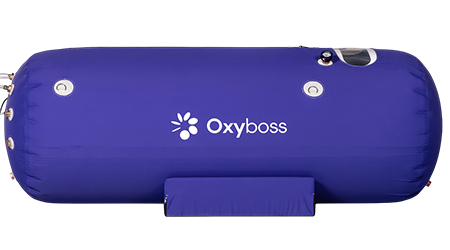
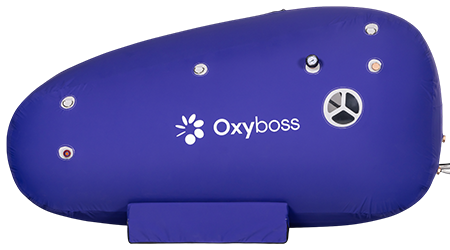
No. Reporting a fault is the opposite of voiding the warranty; it is the precondition for the warranty to work. Concealing a fault to keep the chamber on the schedule is the action that tends to void warranties. The standard hard-chamber warranty is three years, the soft-chamber warranty is one year, and consumables (mask, mattress, pillow, seal) are replaceable parts outside the warranty.