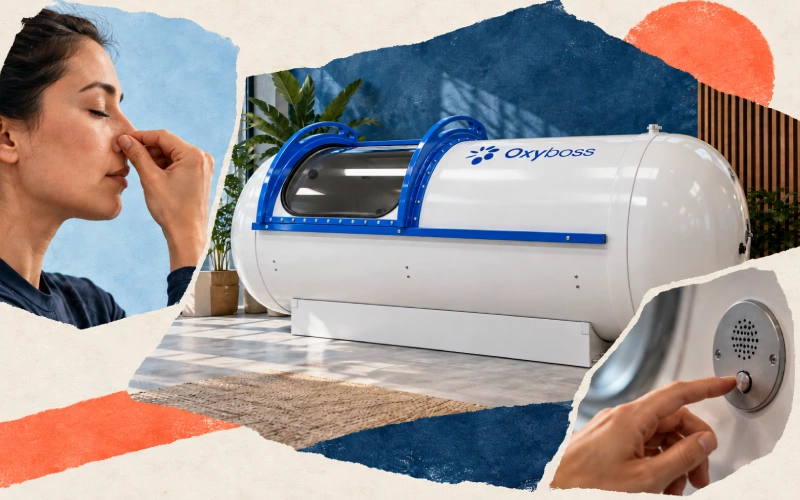
Someone who walks out of session one was an intake you paid for and a sale you didn’t close. They came back once, sat in a tube that made their ears hurt, heard noise they couldn’t explain, and decided the whole thing wasn’t for them — and that decision tends to survive every later attempt.
Almost all of it is preventable, and nearly every fix happens before the door seals.
Three Triggers, Three Different Fixes
Chamber anxiety isn’t a single thing, and that’s why generic relaxation advice underperforms. It breaks into three mechanics, each with its own cause and its own fix:
| Trigger | What they feel | Root cause | What fixes it |
|---|---|---|---|
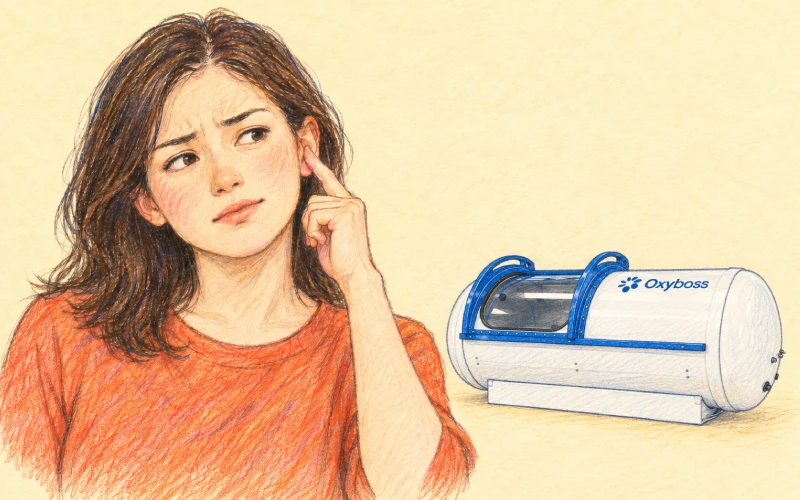
| Ear pressure | Sharp ache 10–20 min in, feels like something is wrong | Eustachian tubes not equalizing as pressure climbs | 2 psi/min compression rate, plus equalization coaching before the door closes |
| Confinement | Shoulders against walls, no line of sight to an exit, window fogging | Tube bore geometry, pressurization noise, no visual anchor | 28-inch bore minimum, window facing a doorway, unpressurized walkthrough first |
| Loss of control | Sealed in, can’t stop it themselves, operator out of view | No stated way to end the session | Two-way intercom, or a posted knock signal with a trained operator watching |
Handle all three in session one. Miss one and the brain files the whole environment as threat, and every later session inherits that association even after the physical problem is solved.
Ear Pressure: Why 1 psi/min Is Slower Than You Think
Compression rate has a floor, and it’s lower than most operators assume. Research found 1 psi/min compression actually increased barotrauma risk while 2 psi/min was optimal. Rates above 4 psi/min also caused more problems.[1] The mechanism is mechanical: a slow climb holds sustained negative pressure across the Eustachian tube lining longer, which gives the tissue time to swell.
If your controller allows rate adjustment, 2 psi/min is the tested setting. This is a controller setting, not a hardware limit — worth checking before you spec replacement units.
The Numbers Only Make Sense Once You Check the Denominator
Ear problems get quoted everywhere at wildly different rates, and none of it is disagreement. It’s different denominators:
| How it’s measured | Reported rate | What that denominator actually means |
|---|---|---|
| Broadest clinical definition | ~2% | Symptom-level ear discomfort during treatment |
| Large treatment series, graded scale | ~43% | Any middle ear barotrauma finding on TEED grading, including mild redness |
| Grading split within that 43% | 84% were grade 1–2 | Mild: drum injection, retraction, or slight hemorrhage — no rupture |
| Monoplace chambers, adverse events | ~0.4% overall | All adverse effects combined, not ear-specific |
| Ear pain’s share of those events | ~50% | Roughly half of that 0.4% |
| Sinus barotrauma | ~1 per 10,000 treatments | Rare, usually alongside an active upper respiratory infection |
A study grading every eardrum on a severity scale finds far more than a study counting “did they complain.”[1][2] When someone quotes you the 2% figure as reassurance, they’re quoting the narrowest denominator — and the 43% figure, which sounds alarming, is 84% grade 1–2 mild findings that resolve on their own.
The operationally useful read: most people can equalize once they know how. Your job in session one is teaching, not persuading.
Coaching Beats Reassuring
Techniques worth walking through before pressurization:
- Swallow repeatedly during the climb — simplest thing that works
- Toynbee — pinch nose, swallow
- Frenzel — pinch nose, make a “k” sound, push the tongue up
- Valsalva — pinch nose, gentle exhale, but not on ascent
Active coaching measurably reduces barotrauma rates.[1] In a setup with no inside tender, that means voice intercom or a laminated card on the wall where they can see it.
For clients with chronic sinus issues, a nasal decongestant spray 30 minutes pre-session opens the tubes enough for equalization to work.[2] When coaching and medication don’t resolve it, myringotomy or tympanostomy tubes are the clinical backup for extended courses — a referral conversation, not something you solve in the facility.
Confinement: Geometry Decides Before Anyone Sits Down
Configuration is the one anxiety factor fully settled before the first client arrives, and the tradeoffs are concrete:
| Configuration | Confinement load | Communication | Pressure ceiling | Staffing | Fits |
|---|---|---|---|---|---|
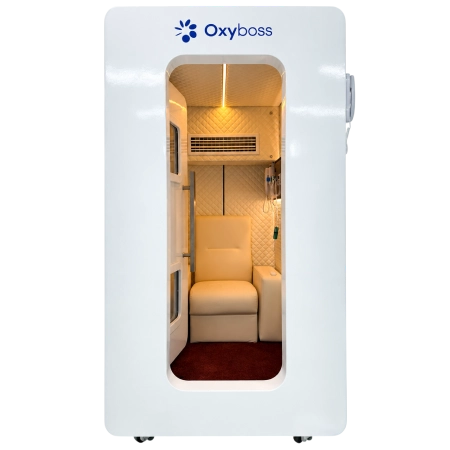
| Multiplace walk-in room | Lowest — it’s a room | In-person tender throughout | Medical-grade | Trained tender inside | Clinics, high throughput, anxious clientele |
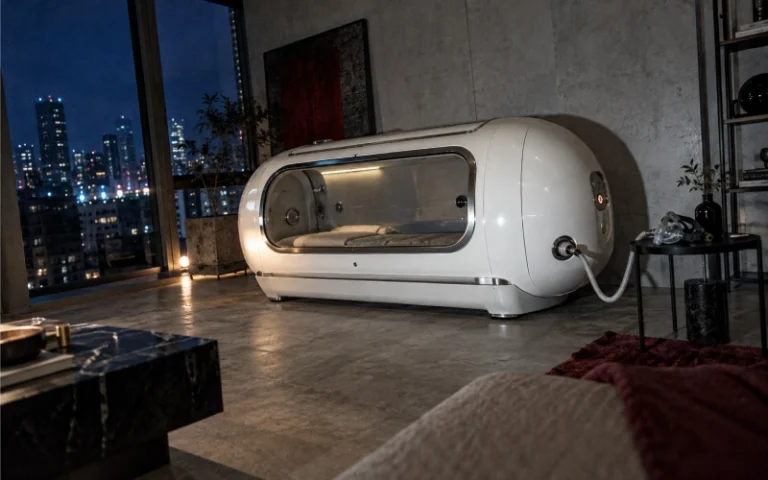
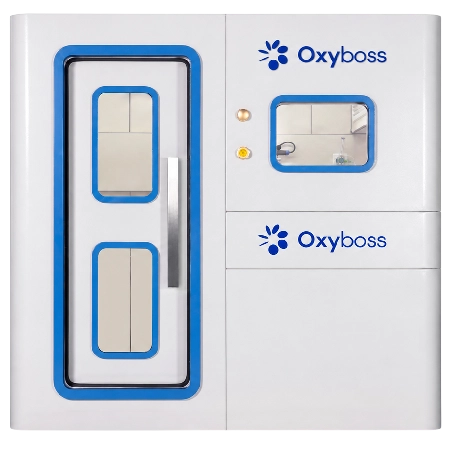
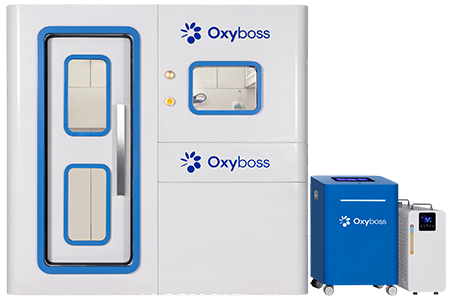
| Monoplace, large bore (28 in) | Moderate — shoulder room | Window + intercom | Medical-grade | Operator at controls | Private rooms, home setups |
| Monoplace, standard bore (24 in) | Highest — contact both sides | Window + intercom | Medical-grade | Operator at controls | Budget single-station installs |
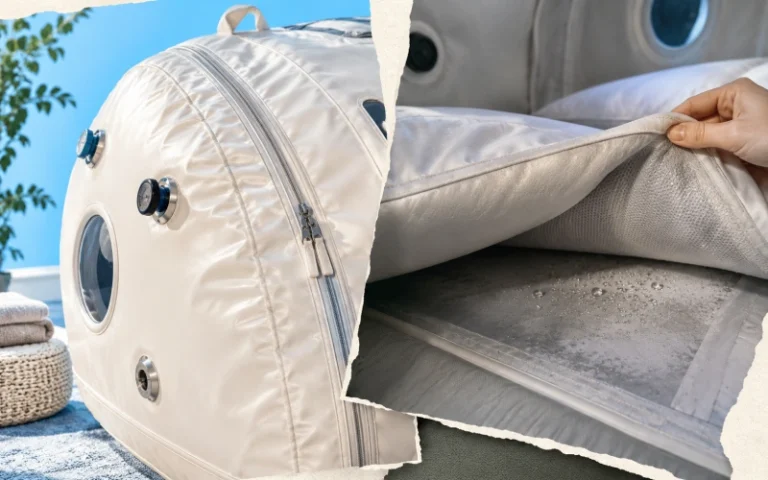
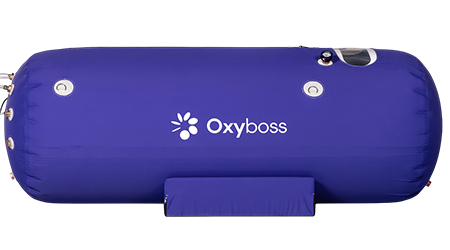
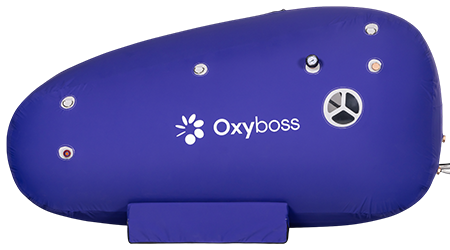
| Soft-sided fabric | Low perceived threat | Closest, smallest space | Typically 1.3 ATA | Operator at controls | Home wellness, non-medical use |
Confinement issues show up almost exclusively in monoplace data, which tracks with the geometry: a tube concentrates every cue into one enclosed experience, a room doesn’t.[1] It appears in about 2% of the general patient population and roughly 8 events per 10,000 monoplace treatments.[1] A low average hides a sharp distribution — plenty of people don’t notice it, and a meaningful minority can’t finish a session without support.
Three geometry decisions that cost little and move the needle:
- 28-inch inner bore handles more body types than 24 inches without triggering a new pressure-vessel certification. That four-inch difference is what avoids the shoulders-touching-both-sides read of entrapment.
- Window sightline onto a doorway, not a blank wall. A subconscious exit cue is free and frequently missed at install.
- Comfort fit-out on multiplace — ventilation, seats instead of a bench, anything that reduces the clinical-instinct read of the space. Environmental detail moves more first sessions than most buyers expect.
Multiplace eliminates the confinement variable entirely and costs more, because you need a trained tender inside. If clients pay out of pocket and can walk out mid-session, that’s the tradeoff worth paying.
On soft-sided fabric: less intimidating up front, but pressure-vessel certification is harder to verify and UHMS has published both a position statement and a consumer warning on low-pressure bag chambers.[3][4] If you sell them for wellness use, ask the supplier for ASME PVHO-1 documentation and third-party test reports before you commit to a unit count.
Loss of Control: Make the Stop Signal Real
A two-way intercom is standard in clinical setups and sometimes skipped in commercial chambers to save cost. That’s the wrong trade — knowing “I can say I need to stop and someone will hear me” does more for anticipatory anxiety than any intake form question.
Without an intercom, standardize this instead:
- Knock signal, posted on both sides — one knock for okay, two for slow down, three for stop now
- Visual check-in every 10 minutes through the window, with the operator acknowledging
- Operator position where they can be seen from inside for the first 10 minutes
One case report describes a person who panicked in minute one of their first session, then completed every later session without difficulty once the team explained they could knock to stop at any point.[5] The intervention was legibility, not pharmacology.
Sensory layering helps some people and is cheap: chamber-safe headphones, an eye mask when reflections distract, a cotton blanket or pillow for tactile grounding. Cotton specifically — synthetics carry static risk in an oxygen-rich environment.
The Adaptation Curve: Set It Before Session One
Clinical observation of first-time chamber clients found initial fear diminished after the first session, with several participants reporting they ended up more relaxed inside the chamber than outside it.[6] First-person accounts from clients scheduled for hyperbaric sessions follow the same shape: the hard part is the first one or two, and by the third or fourth it reads as routine.
That shape decides whether session two happens. Someone who assumes session one is representative bails after two and concludes the chamber doesn’t work for them. The conclusion outlives the reason, which is why it has to be addressed during intake rather than during the debrief.
Practical planning window: sessions 1–2 are the hard part, sessions 3–4 are where the drop shows, sessions 5–6 are maintenance. Treat that as a scheduling assumption, not a clinical prediction — it describes the shape most people describe, and individual response varies.
Anchor the framing to something they’ve already been comfortable in — a hammach, an airplane seat, the back of a road trip car. One anchor that backfires: elevators. Movement plus enclosure is its own trigger.
Where people have used the walkthrough itself as the anchor, the pattern repeats. A user scheduled for hyperbaric sessions wrote, “Tomorrow they’re giving me orientation so I can sit in the tube” — the orientation session was framed as a milestone, not a hurdle. Cost is 15 minutes: climb in with the door open, look around, close it for two minutes, open it yourself. The brain files the chamber as explored space rather than unknown threat.
The First-Session Workflow
Pre-session, 15 minutes:
- Screen intake — claustrophobia, panic history, prior MRI or enclosed procedures, current medications, recent ear or chest surgery, active respiratory infection
- Walk to the chamber, door open, let them look inside
- Have them demonstrate one equalization technique outside the chamber
- Show the intercom or the knock signal and say it out loud
- Name the sounds they’ll hear during compression
- Ask for a 0–10 anxiety score and write it down
Session, 60–90 minutes:
- Compress at 2 psi/min, watching for equalization trouble in the first 15 minutes
- Visual check-in every 10 minutes
- Decompress controlled, don’t rush the ascent
Post-session, 2 minutes:
- “Any ear discomfort? Rate your anxiety now, 0–10.”
- “First couple are adjustment — by three or four it usually gets easier.”
- Log both numbers next to the intake score
That last check is the one operators skip. If the post-session score is higher than the intake score, something is mechanically wrong — unmanaged ear pain, wrong compression rate, or a claustrophobia profile that needs a referral rather than a repeat. You find that in the two-minute debrief or you find it as a no-show.
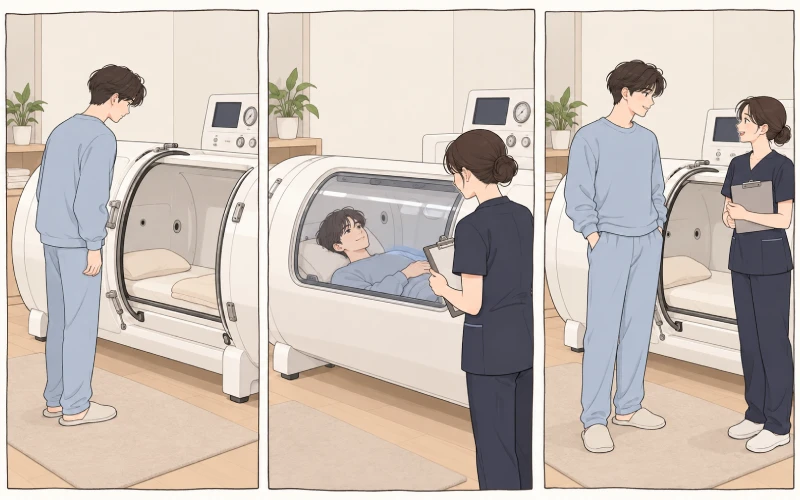
The pre-session safety walk isn’t paperwork either. Show the checklist and explain the reasoning — cotton only, no unapproved electronics, proper grounding — and ambient worry converts into procedural confidence. The FDA’s August 2025 letter on chamber fires resulting in injury and death makes clear why these steps exist, and the governing codes are NFPA 99 and ASME PVHO-1.[7]
When Someone Shouldn’t Be In the Chamber
Screening isn’t about comfort — it’s about not putting someone in a position where panic has a legitimate reason to fire.
Absolute: untreated pneumothorax (trapped gas expands under pressure), severe COPD with blebs or bullae, bleomycin within 6 months, doxorubicin within 24 hours.
Defer until resolved: active respiratory or sinus infection (swollen mucosa traps gas and blocks equalization), recent chest or ear surgery pending surgeon clearance, uncontrolled fever, poorly controlled diabetes (check pre-session glucose, set a floor around 100 mg/dL), severe heart failure below roughly 35% ejection fraction.
Case by case: pregnancy, seizure disorder (hyperoxia can lower the threshold, rarely at 1.3–1.5 ATA), and baseline anxiety or panic disorder.[2][8]
That last row gets skipped most often. Anxiety is not a contraindication to a non-medical chamber. What changes is your protocol — more orientation time, continuous voice contact, a lower threshold for pausing.
For the small group where orientation and coaching aren’t enough, structured exposure with a psychologist is the documented path: enter and exit repeatedly in escalating steps until the panic response fades. Knowing that protocol exists lets you refer out rather than write someone off, which is the difference between a referral and a complaint.
In intake forms, name the expected effects — ear fullness, sinus pressure, temporary vision change, fatigue — alongside the rare serious ones, and state the right to stop with the specific signal. Naming risks lowers anxiety; it signals you know what can go wrong and have a plan.
Bottom Line
Chamber anxiety has mechanical causes, and mechanics respond to mechanical fixes: compression rate, bore geometry, a stop signal they can actually use, and an adaptation window stated out loud before the first session.
Operators running low-dropout programs treat sessions 1–2 as training rather than treatment. Fifteen minutes of orientation and coaching is the entire budget, and it converts people who would otherwise walk out mid-session into people who reach session three — which is where the habit forms.
Equipment buyers: multiplace removes the confinement variable at a higher operating cost; monoplace needs orientation time and two-way audio built in. Either way, verify the engineering documentation before you commit.
Client side: the first two sessions are a nervous system learning a space is safe. Most people get there by session three. The ones who don’t are a referral, not a repeat.
References
[1] Heyboer M, Jennings S, Grant WD, Odom J, Hodges A, Shells M. Hyperbaric Oxygen Therapy: Side Effects Defined and Quantified. Adv Wound Care (New Rochelle). 2017. https://uhms.org/images/MEDFAQs/Medical_Patient_Care/HBOTSideEffects_AdvWoundCare_2017.pdf
[2] Murphy-Lavoie H, Piper S, Moon RE, Legros T. Hyperbaric Complications. StatPearls. 2024. https://www.ncbi.nlm.nih.gov/sites/books/NBK459191/
[3] Undersea & Hyperbaric Medical Society. UHMS Position Statement: Low-Pressure Fabric Hyperbaric Chambers. https://uhms.org/images/Position-Statements/UHMS_Position_Statement_LP_chambers_revised.pdf
[4] Undersea & Hyperbaric Medical Society. Consumer Warning: The Dangers of Soft-Sided Bag Chambers. https://uhms.org/pressure-other-articles/1542-consumer-warning.html
[5] Liu WW, Liu K, Ding M, Xu WG, Tao HY. Claustrophobia during routine hyperbaric oxygen treatment. Undersea Hyperb Med. 2012. https://www.researchgate.net/publication/221686824_Claustrophobia_during_routine_hyperbaric_oxygen_treatment
[6] Alyami AM, Khormi Alamri RM, Alwabel AA, et al. The lived experience of patients going under hyperbaric oxygen therapy in Saudi Arabia: A phenomenological study. Medicine (Baltimore). 2024. https://pmc.ncbi.nlm.nih.gov/articles/PMC11272284/
[7] U.S. Food and Drug Administration. Follow Instructions for Safe Use of Hyperbaric Oxygen Therapy Devices – Letter to Health Care Providers. August 2025. https://www.fda.gov/medical-devices/letters-health-care-providers/follow-instructions-safe-use-hyperbaric-oxygen-therapy-devices-letter-health-care-providers
[8] Murphy-Lavoie H, Piper S, Moon RE, Legros T. Hyperbaric Oxygen Therapy Contraindications. StatPearls. 2024. https://www.ncbi.nlm.nih.gov/sites/books/NBK557661/