
No.
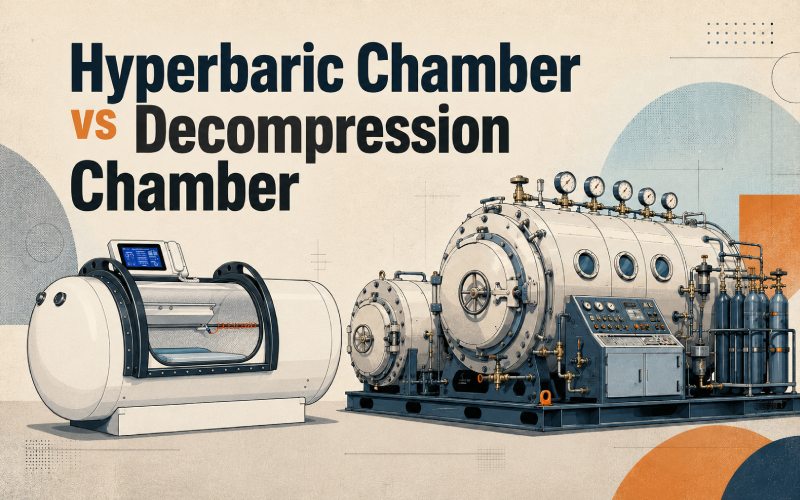
A decompression chamber is a type of hyperbaric chamber. A hyperbaric chamber is not automatically a decompression chamber.
That is the whole argument, really. The confusion starts when people use one term for the vessel and the other term for the job. In factory work, those are not the same thing.
Key Takeaways
- Hyperbaric chamber is the broad equipment category.
- Decompression chamber describes a chamber built for a specific pressure-duty role.
- Two chambers can look similar from the outside and still be specified very differently.
- Lock arrangement, gas routing, controls, and operating profile decide whether a chamber is truly suitable for decompression duty.
- For quoting, the duty statement matters more than the nickname.
Hyperbaric Chamber vs Decompression Chamber: The Engineering Difference
A hyperbaric chamber is any human-occupancy pressure vessel designed to operate above normal ambient pressure.
A decompression chamber is a chamber configured for controlled recompression and decompression duty, usually tied to diver support, surface operations, transfer logic, and outside operator control.
So the split is simple:
- Hyperbaric tells you the pressure condition.
- Decompression tells you the operational purpose.
This is why the two terms overlap, but do not fully replace each other.
A buyer can ask for a hyperbaric chamber and still leave half the job undefined.
A buyer asking for a decompression chamber is already closer to a real specification.
Design Differences in Hyperbaric vs Decompression Systems
The shell alone does not settle the question. Diameter and length do not settle it either. The difference shows up in the system build.
Table: Hyperbaric chamber vs decompression chamber design priorities
| Design point | Hyperbaric chamber | Decompression chamber |
| Core meaning | Broad pressure-vessel category | Chamber built for decompression duty |
| Naming basis | Pressure environment | Operational role |
| Lock arrangement | Can be simple or application-specific | Often requires main lock, entry lock, or service-lock logic |
| Gas system | Depends on project scope | Usually needs controlled gas routing for repeated decompression operations |
| Operator controls | May be basic | Usually requires full outside control and monitoring |
| Installation style | Fixed, skid, portable, or containerized | Commonly deck-mounted, skid-mounted, or integrated into dive-support systems |
| Quoting priority | Pressure capability first | Duty cycle, lock transfer, gas handling, control philosophy, and pressure schedule first |
That table is the practical answer. Not academic. Just practical.
5 Features That Separate a Decompression Chamber from a General Hyperbaric Chamber
1. Lock Layout
This is usually the first real separator.
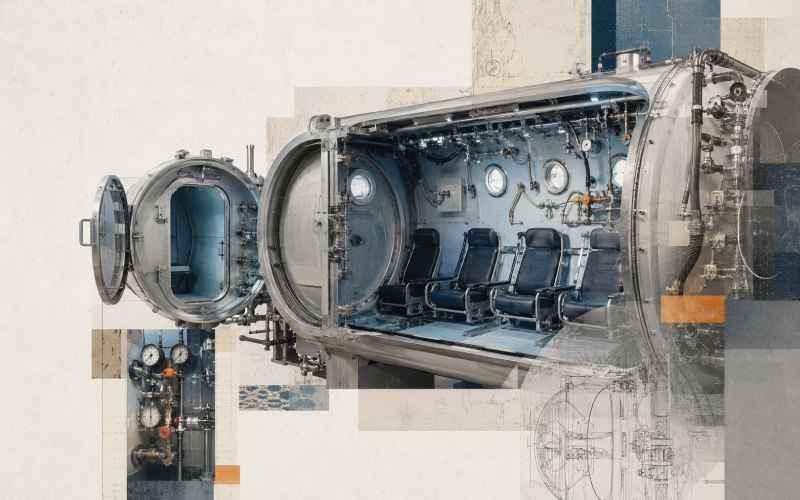
A general hyperbaric chamber may be a single-lock vessel with a very direct operating model. A decompression chamber often needs a different layout: main lock, entry lock, sometimes a medical lock or service lock depending on the project and transfer method.
Once lock-to-lock movement matters, the chamber stops being a simple pressure shell and starts behaving like a working system.
2. Gas Routing and Breathing Circuits
Not every pressurized vessel needs the same gas architecture.
A decompression chamber usually requires a more disciplined routing plan: supply manifolds, isolation logic, breathing gas distribution, dump control, reserve capacity, and cleaner operator-side switching. If that sounds like more pipework, it is. More penetrations too. More valves. More failure points to control.
A generic chamber can be simpler. A decompression unit usually should not be.
3. Pressure Rating vs Real Duty Cycle
A lot of buyers focus on maximum pressure. Fair. Still incomplete.
A chamber should be judged by how it is expected to run, not just by the highest number on the gauge. Repeated cycles, hold periods, occupancy duration, gas consumption, and recovery time all matter. A vessel rated for pressure is not automatically a good decompression platform.
This gets missed in early RFQs all the time.
4. Outside Operator Control
For decompression work, operator control is not a side item. It is part of the machine.
Panel logic, gauge readability, valve grouping, emergency vent access, communications, and reserve changeover should be designed around live operation from outside the vessel. A clean shell with a weak control station is still a weak system.
Looks fine in photos. Not fine in service.
5. Installation Environment
Where the chamber lives changes what the chamber needs.
A facility-installed chamber can be built around room access, fixed utilities, and easier service access. A deck decompression chamber has a different life. Motion. Salt. Space limits. Lifting points. Skid design. Pipe protection. Console placement. Shock and handling loads.
Same family of equipment. Different design pressure on the project team, too.

Can One Chamber Serve Both Roles?
Yes, sometimes.
A chamber can be both a hyperbaric chamber and a decompression chamber if the vessel design, lock arrangement, gas systems, controls, and operating basis support both roles.
But the overlap should be engineered, not assumed.
This is where many specifications go soft. Someone sees a pressurized human-occupancy vessel and assumes decompression capability comes with it. It does not. Not by default.
Why the Shell Shape Can Mislead Buyers
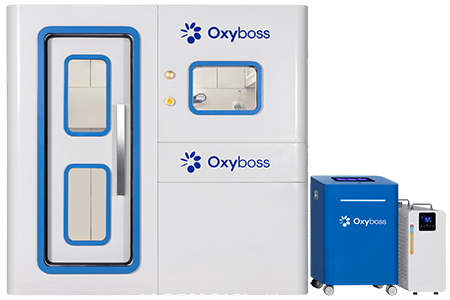
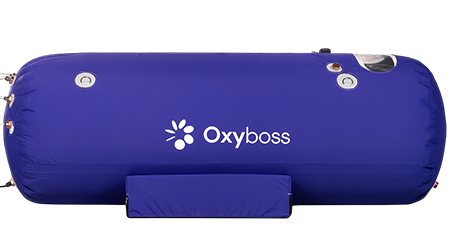
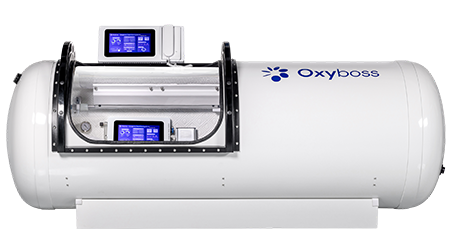
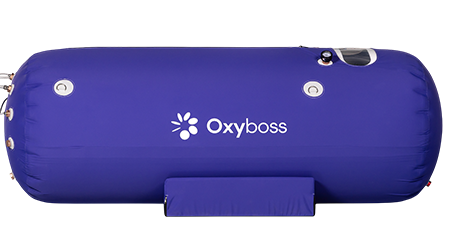
Most chambers in this category share familiar features: cylindrical body, doors, viewports, penetrations, piping, gauges. From a distance, they look close enough.
That visual similarity causes bad purchasing language.
“Looks like the same chamber.”
Usually not.
Two units with similar dimensions can have very different internals, very different operating logic, and very different quoting values once you factor in lock count, controls, gas reserves, electrical package, safety interlocks, and installation method.
The shell starts the conversation. It does not finish it.
FAQ
Is every decompression chamber a hyperbaric chamber?
Yes. A decompression chamber operates above ambient pressure, so it belongs to the hyperbaric chamber family.
Is every hyperbaric chamber a decompression chamber?
No. A hyperbaric chamber may be built for pressure exposure in a broad sense, while a decompression chamber is built around a narrower operational role with more specific system requirements.
Why do people use the terms as if they mean the same thing?
Because the equipment can look similar and the terms often get mixed in sales talk, procurement notes, and casual discussion. In engineering, the distinction comes back fast once lock layout, gas routing, and operating method are reviewed.
What is the main technical difference?
The main difference is not the shell. It is the duty-based system design around that shell: lock configuration, gas architecture, controls, and operating cycle.
Can a single-lock chamber be used for decompression duty?
Sometimes, depending on the application and operating basis. But many decompression projects require more than a basic single-lock arrangement. The duty should decide this, not habit.
What is the most common quoting mistake?
Requesting a “hyperbaric chamber” without defining pressure profile, occupancy, gas basis, lock count, or installation environment. That usually leads to a vague quotation and a slow project.
Which term should buyers use in an RFQ?
Use the term that reflects the actual job. If the chamber is intended for decompression duty, say so clearly. If the request is still broad, describe the duty in plain operating terms instead of relying on a product label.
Bottom Line
A decompression chamber is a hyperbaric chamber built for a more specific role.
A hyperbaric chamber is the larger category.
Same family. Not the same specification.